01 Read
What happened
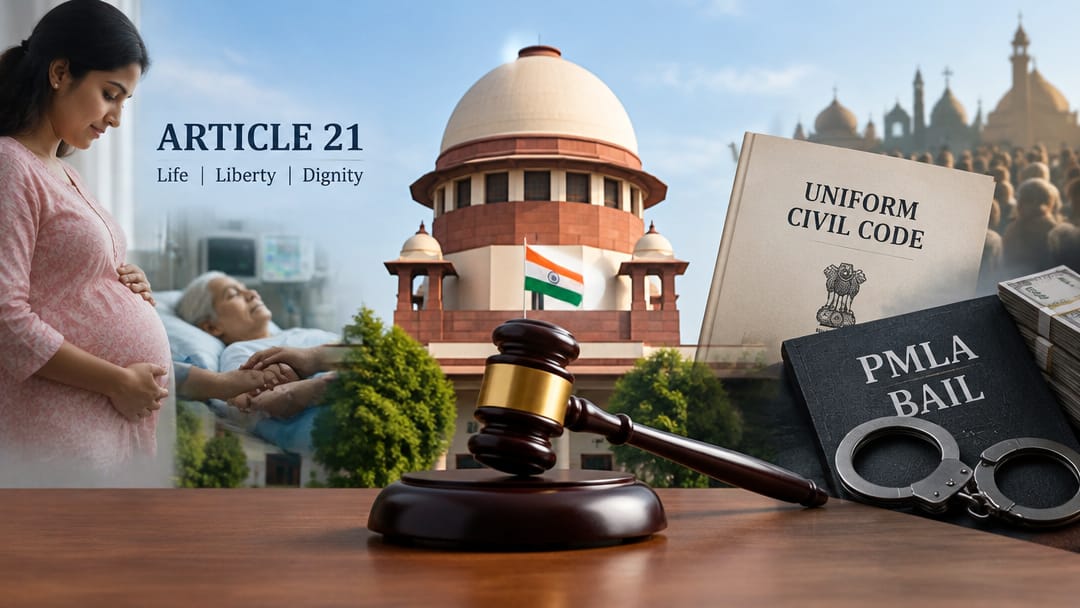
Between January and February 2026, Indian courts delivered rulings across several constitutional flashpoints. The Supreme Court clarified the scope of Article 21 in contexts ranging from maternity benefits to passive euthanasia guidelines, revisited bail conditions under the Prevention of Money Laundering Act, and engaged with questions around the Uniform Civil Code. These judgments collectively update the constitutional map on dignity, liberty, and equality rights tested heavily in CLAT PG.
02 Understand
Why it matters
The January–February 2026 cluster of Supreme Court rulings is best understood as a stress-test of Article 21's expanding perimeter. Since Maneka Gandhi v. Union of India (1978), Article 21 has grown from a bare guarantee against arbitrary deprivation of life and personal liberty into a substantive right encompassing dignity, livelihood, health, and a 'dignified death.' The passive euthanasia rulings of this period extend the Common Cause v. Union of India (2018) framework, which recognised the right to die with dignity and introduced Advance Medical Directives.
On maternity benefits, the Court reinforced the intersection of Article 21 and Article 42 (directive for maternity relief), holding that denial of benefits violates the right to live with dignity — a principle traceable to the Municipal Corporation of Delhi v. Female Workers (Muster Roll) (2000) line of cases.
The PMLA bail developments are constitutionally significant because Section 45 of the Prevention of Money Laundering Act imposes twin conditions for bail — the accused must satisfy the court that (a) there are reasonable grounds to believe they are not guilty, and (b) they will not commit any offence while on bail. Vijay Madanlal Choudhary v. Union of India (2022) upheld these twin conditions but left open nuanced applications, which 2026 rulings have refined.
The UCC discussion implicates Article 44 (Directive Principle) alongside Article 25 (religious freedom), and the Court's engagement tests whether a Directive Principle can override a fundamental right — a tension the examiner routinely exploits.
Remember + Why it matters
The key recall facts and exact examiner angle for CLAT PG are in the Crux app.
01
Key figure and date from this topic
02
Specific number or threshold to remember
03
Policy or regulatory implication
Read + Understand free forever · 30-day free trial