01 Read
What happened
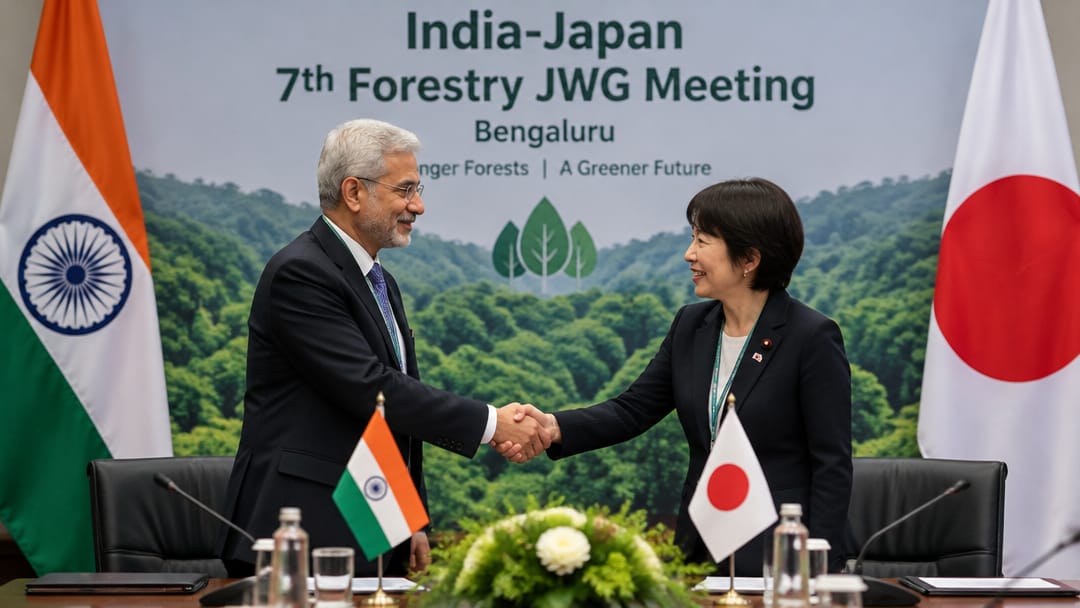
India and Japan held their 7th Joint Working Group meeting on forestry cooperation in Bengaluru, reviewing progress and strengthening collaboration in the sector. The meeting, convened under the bilateral forestry framework between the two countries, examined areas including forest management, afforestation, timber trade, and climate-linked forest conservation. This JWG mechanism forms part of India-Japan Special Strategic and Global Partnership, which covers environment and natural resource cooperation alongside defence, technology, and economic ties.
02 Understand
Why it matters
India and Japan established a bilateral forestry cooperation framework under their broader Special Strategic and Global Partnership, which was elevated to that status in 2014. The Joint Working Group on Forestry is the institutional mechanism through which both countries exchange technical expertise, share best practices in sustainable forest management, and coordinate on issues like agroforestry, bamboo, timber legality, and forest-based carbon sequestration.
Japan is a world leader in forest management — over 67% of its land is forested, and it has developed sophisticated community forestry and disaster-prevention forestry models. India, with roughly 24% of its geographical area under forest and tree cover (as per India State of Forest Report 2023), is actively pursuing forest restoration under its Nationally Determined Contributions (NDCs) which commit to creating an additional carbon sink of 2.5 to 3 billion tonnes of CO₂ equivalent through forest and tree cover by 2030.
The JWG mechanism allows India to draw on Japanese expertise in watershed forestry, urban greening, and climate-resilient plantations. For UPSC aspirants, the connection between bilateral forestry frameworks and India's international climate commitments is key. For NABARD aspirants, the agroforestry, bamboo economy, and forest-based livelihood dimensions are directly relevant to rural credit and green finance policy.
Remember + Why it matters
The key recall facts and exact examiner angle for NABARD Grade A are in the Crux app.
01
Key figure and date from this topic
02
Specific number or threshold to remember
03
Policy or regulatory implication
Read + Understand free forever · 30-day free trial