01 Read
What happened
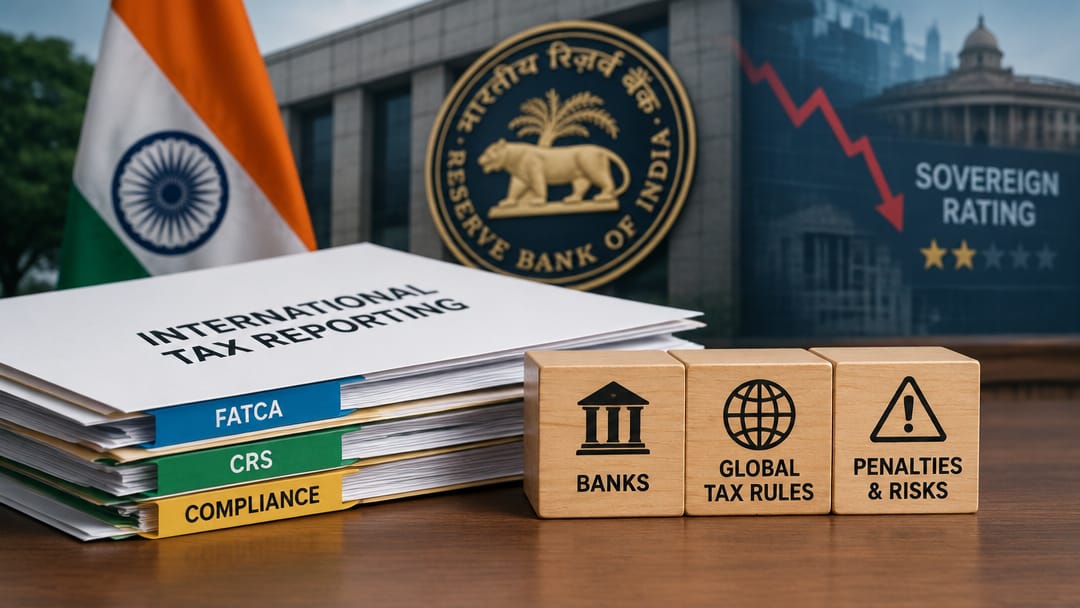
India's Principal Director General of Income Tax, Debjyoti Das, has warned that persistent lapses in international tax reporting by Indian financial institutions could jeopardise the country's sovereign credit rating and trigger withholding tax penalties under the FATCA and Common Reporting Standard frameworks. Non-compliant institutions risk being treated as recalcitrant by partner jurisdictions, inviting a 30% withholding tax on US-source payments and broader reputational damage to India's financial credibility internationally.
02 Understand
Why it matters
This warning sits at the intersection of international tax compliance, financial regulation, and sovereign creditworthiness — three themes the examiner tests separately but which this event connects.
The Foreign Account Tax Compliance Act (FATCA), enacted by the US in 2010, requires foreign financial institutions (FFIs) to report information on US account holders to the IRS. India signed an Intergovernmental Agreement (IGA) with the US in 2015, making compliance mandatory for Indian FFIs. Non-compliant FFIs face a 30% withholding tax on all US-sourced income — dividends, interest, and gross proceeds.
The Common Reporting Standard (CRS), developed by the OECD, is the multilateral equivalent: participating countries automatically exchange financial account information. India is a CRS-signatory. Persistent reporting failures signal to partner jurisdictions that India's institutions cannot be trusted to exchange tax information accurately — a reputational risk that credit rating agencies can factor into sovereign assessments.
The transmission mechanism matters for the exam: lapses → loss of 'compliant' status → withholding tax penalties on cross-border transactions → reduced foreign capital flows → pressure on current account and forex reserves → potential sovereign rating downgrade. This chain connects tax administration to macroeconomic stability, making it relevant to both UPSC macro questions and RBI/SEBI regulatory compliance questions.
The Income Tax Department's Principal DG flagging this publicly suggests enforcement is being stepped up, which is itself an exam-relevant administrative development.
The Foreign Account Tax Compliance Act (FATCA), enacted by the US in 2010, requires foreign financial institutions (FFIs) to report information on US account holders to the IRS. India signed an Intergovernmental Agreement (IGA) with the US in 2015, making compliance mandatory for Indian FFIs. Non-compliant FFIs face a 30% withholding tax on all US-sourced income — dividends, interest, and gross proceeds.
The Common Reporting Standard (CRS), developed by the OECD, is the multilateral equivalent: participating countries automatically exchange financial account information. India is a CRS-signatory. Persistent reporting failures signal to partner jurisdictions that India's institutions cannot be trusted to exchange tax information accurately — a reputational risk that credit rating agencies can factor into sovereign assessments.
The transmission mechanism matters for the exam: lapses → loss of 'compliant' status → withholding tax penalties on cross-border transactions → reduced foreign capital flows → pressure on current account and forex reserves → potential sovereign rating downgrade. This chain connects tax administration to macroeconomic stability, making it relevant to both UPSC macro questions and RBI/SEBI regulatory compliance questions.
The Income Tax Department's Principal DG flagging this publicly suggests enforcement is being stepped up, which is itself an exam-relevant administrative development.
Remember + Why it matters
The key recall facts and exact examiner angle for UPSC CSE are in the Crux app.
01
Key figure and date from this topic
02
Specific number or threshold to remember
03
Policy or regulatory implication
Read + Understand free forever · 30-day free trial