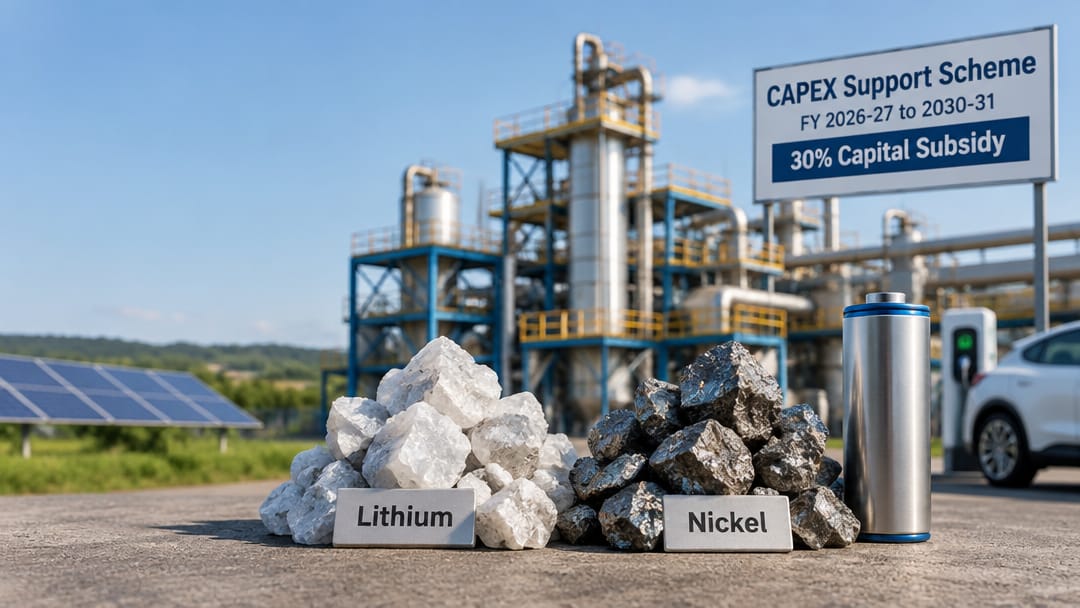
30% capital subsidy for lithium and nickel processing plants, FY2027–31
What happened
India's CAPEX Support Scheme, running from FY 2026-27 to FY 2030-31, offers a 30% capital subsidy to establish two lithium and two nickel processing plants domestically. The scheme targets critical mineral processing, addressing India's heavy import dependence on battery-grade lithium and nickel — both essential for electric vehicles and energy storage. By incentivising domestic refining capacity, the government aims to reduce vulnerability in the clean energy supply chain before the decade ends.
Why it matters
Critical minerals are raw materials essential for clean energy technologies, defence electronics, and advanced manufacturing — but whose supply chains are geographically concentrated. Lithium and nickel are the two most strategically sensitive: lithium is the core input for lithium-ion batteries used in EVs and grid storage, while nickel is critical for high-energy-density battery cathodes and stainless steel alloys.
India currently mines negligible lithium (a significant reserve was identified in Reasi, J&K in 2023, estimated at 5.9 million tonnes) but has virtually no domestic processing capacity. It similarly lacks nickel refining infrastructure. This means even if raw ore is extracted domestically, India would need to export it for processing — recreating import dependence at a different stage of the value chain.
The CAPEX Support Scheme breaks this by subsidising the capital cost of setting up processing plants — the most capital-intensive and technically complex step. A 30% subsidy substantially de-risks private investment in a sector where payback periods are long and technology acquisition is expensive.
The scheme fits within India's broader Critical Minerals Mission (launched 2023) and aligns with the Production Linked Incentive (PLI) logic — but differs by targeting upstream processing rather than finished goods. For UPSC and RBI/NABARD aspirants, the key static anchor is: which minerals are classified as 'critical,' where India's known reserves lie, and what the policy architecture for securing supply chains looks like.
🔒
Key figure and date from this topic
Specific number or threshold to remember
Policy or regulatory implication