2,576 of 4,144 government buildings solarised under PM Surya Ghar
What happened
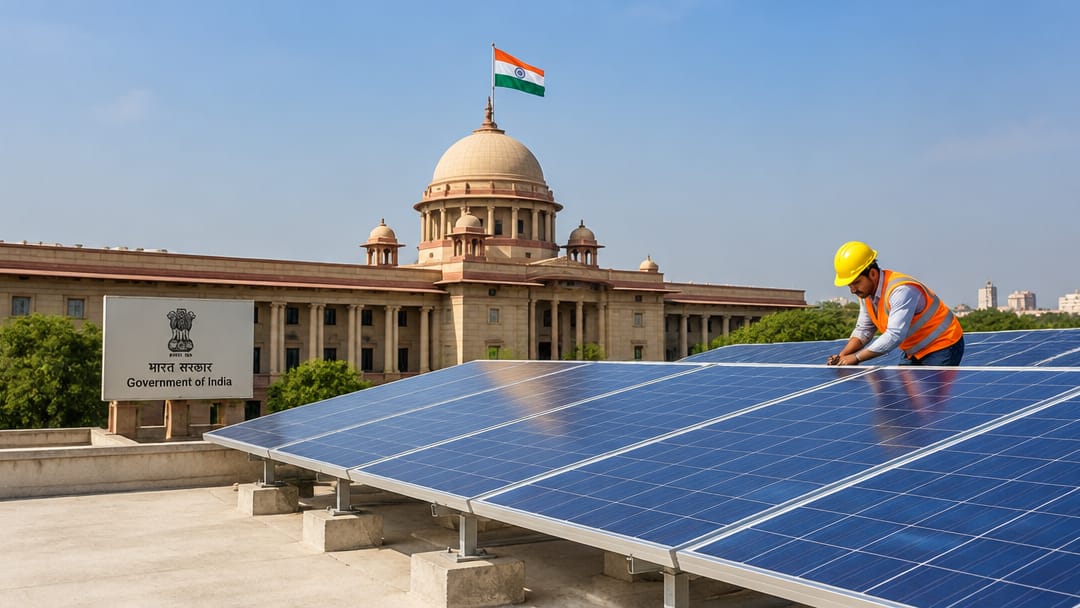
Under PM Surya Ghar Muft Bijli Yojana, 2,576 of the 4,144 identified government buildings have been equipped with rooftop solar panels, with an installed capacity of 61 MW. The scheme targets free electricity for households and solarisation of public infrastructure. This progress update reflects India's push to expand rooftop solar across government premises as part of its broader renewable energy and net-zero commitments.
Why it matters
PM Surya Ghar Muft Bijli Yojana was launched in February 2024 with an outlay of ₹75,021 crore. Its twin objectives are: (1) providing up to 300 units of free electricity per month to one crore households through rooftop solar, and (2) solarising government buildings to reduce the state's own electricity expenditure and demonstrate public-sector leadership in the energy transition.
The government-building component is significant from an exam perspective because it links to India's Nationally Determined Contribution (NDC) under the Paris Agreement — specifically the target of achieving 500 GW of non-fossil fuel electricity capacity by 2030 and meeting 50% of energy needs from renewables. Rooftop solar on public buildings is a measurable, verifiable contribution toward that goal.
The scheme is administered by the Ministry of New and Renewable Energy (MNRE). Implementation uses the National Portal for Rooftop Solar, which allows direct subsidy transfer to beneficiaries. The Central Financial Assistance (CFA) for residential installations ranges from ₹30,000 for a 1 kW system to ₹78,000 for systems of 3 kW and above.
For NABARD aspirants, the rural dimension matters: solarising gram panchayat buildings and rural government offices reduces diesel dependence, cuts operational costs, and feeds into the broader green credit and rural energy transition agenda that NABARD co-finances through its climate-linked lending windows.
30% capital subsidy for lithium and nickel processing plants, FY2027–31
What happened
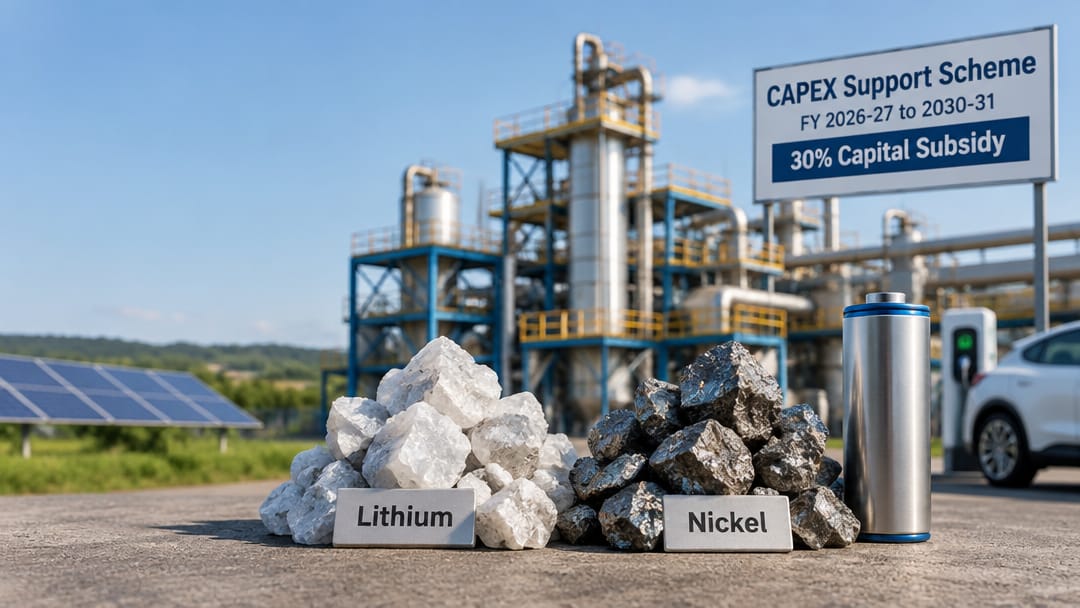
India's CAPEX Support Scheme, running from FY 2026-27 to FY 2030-31, offers a 30% capital subsidy to establish two lithium and two nickel processing plants domestically. The scheme targets critical mineral processing, addressing India's heavy import dependence on battery-grade lithium and nickel — both essential for electric vehicles and energy storage. By incentivising domestic refining capacity, the government aims to reduce vulnerability in the clean energy supply chain before the decade ends.
Why it matters
Critical minerals are raw materials essential for clean energy technologies, defence electronics, and advanced manufacturing — but whose supply chains are geographically concentrated. Lithium and nickel are the two most strategically sensitive: lithium is the core input for lithium-ion batteries used in EVs and grid storage, while nickel is critical for high-energy-density battery cathodes and stainless steel alloys.
India currently mines negligible lithium (a significant reserve was identified in Reasi, J&K in 2023, estimated at 5.9 million tonnes) but has virtually no domestic processing capacity. It similarly lacks nickel refining infrastructure. This means even if raw ore is extracted domestically, India would need to export it for processing — recreating import dependence at a different stage of the value chain.
The CAPEX Support Scheme breaks this by subsidising the capital cost of setting up processing plants — the most capital-intensive and technically complex step. A 30% subsidy substantially de-risks private investment in a sector where payback periods are long and technology acquisition is expensive.
The scheme fits within India's broader Critical Minerals Mission (launched 2023) and aligns with the Production Linked Incentive (PLI) logic — but differs by targeting upstream processing rather than finished goods. For UPSC and RBI/NABARD aspirants, the key static anchor is: which minerals are classified as 'critical,' where India's known reserves lie, and what the policy architecture for securing supply chains looks like.
India and Germany expand clean energy partnership to green hydrogen and supply chains
What happened
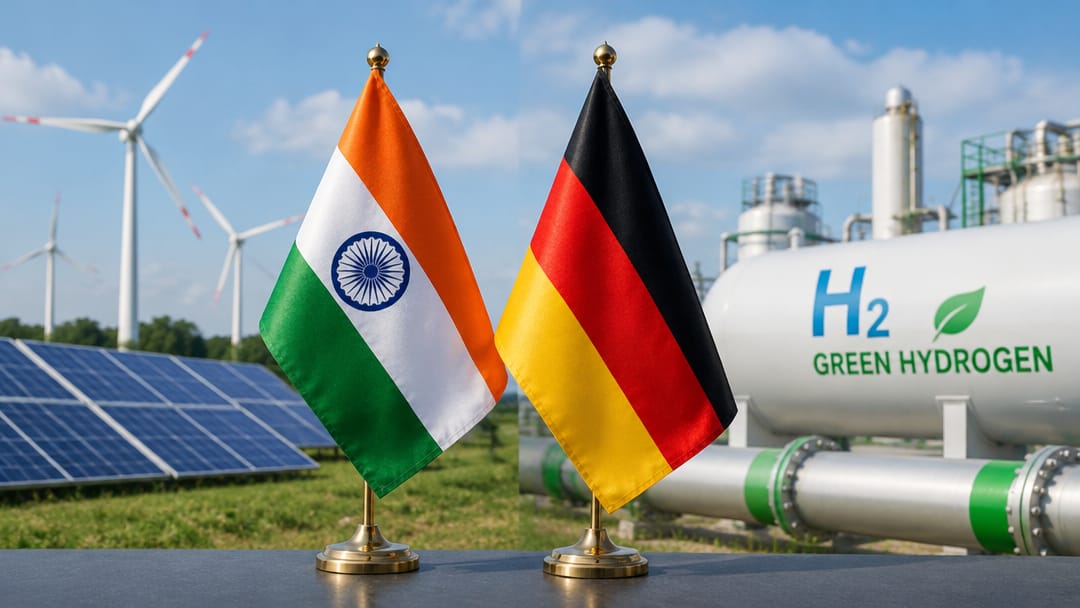
India and Germany have expanded their bilateral clean energy partnership to cover green hydrogen production, renewable energy supply chains, and technology exchange. The partnership builds on existing Indo-German cooperation frameworks and aligns with India's National Green Hydrogen Mission target of producing 5 million metric tonnes annually by 2030. Germany, transitioning away from Russian fossil fuels, sees India as a strategic supplier and technology co-developer in the global green energy transition.
Why it matters
The India-Germany clean energy partnership sits at the intersection of three major policy frameworks: India's National Green Hydrogen Mission (launched January 2023), the Indo-German Partnership for Green and Sustainable Development signed at the 6th Inter-Governmental Consultations (IGC) in 2022, and the broader UNFCCC-linked NDC commitments both countries have made.
Green hydrogen — produced by electrolyzing water using renewable electricity — is central to decarbonizing hard-to-abate sectors like steel, fertilizers, and heavy transport. India's mission targets 5 MMT annual production by 2030, aiming to make India a global export hub. Germany, which needs to replace Russian gas and meet its own 2045 carbon-neutrality target, is an ideal off-take partner.
For exam purposes, the key mechanisms here are: (1) bilateral technology transfer under the Indo-German Energy Forum (IGEF), which has operated since 2006; (2) green hydrogen's classification as a strategic commodity under India's energy security doctrine; and (3) supply chain resilience — ensuring critical minerals like platinum (used in electrolyzers) flow reliably.
NABARD's angle is agricultural: green hydrogen enables green ammonia, which could domestically source fertilizer production and reduce import dependence — directly relevant to rural input cost stability and food security.