01 Read
What happened
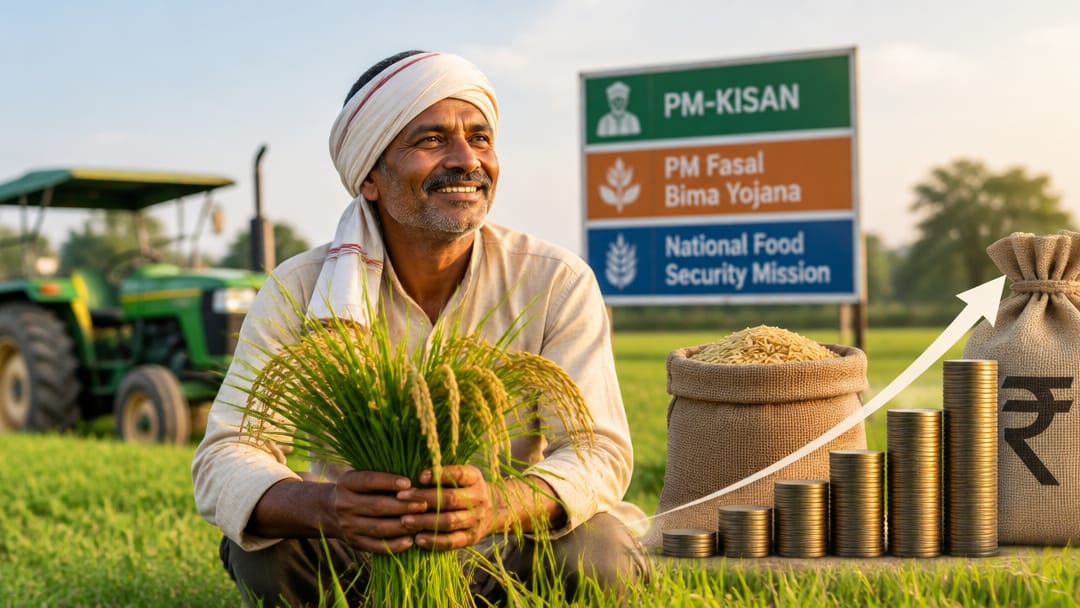
India's budget for the Department of Agriculture and Farmers Welfare has risen from ₹27,663 crore in 2013-14 to ₹1,40,528.78 crore in 2026-27, a five-fold increase over thirteen years. This growth reflects a sustained policy shift toward rural welfare, food security, and farm income support. Key schemes driving this expansion include PM-KISAN, PM Fasal Bima Yojana, and the National Food Security Mission, alongside structural reforms in credit delivery and allied sectors like fisheries and animal husbandry.
02 Understand
Why it matters
The five-fold rise in agriculture budget allocation is not merely a fiscal headline — it reflects a deliberate policy architecture designed to address India's agrarian distress through multiple instruments simultaneously.
At the core is income support: PM-KISAN provides ₹6,000 per year directly to landholding farmer families, operationalising Direct Benefit Transfer (DBT) at massive scale. This reduces leakage compared to earlier input subsidies and is a standard RBI-angle question on financial inclusion and DBT efficiency.
Risk coverage comes through PM Fasal Bima Yojana (PMFBY), which restructured the crop insurance framework by capping farmer premium contributions and shifting actuarial risk to the government — exam questions often test premium caps (2% for Kharif, 1.5% for Rabi, 5% for horticulture).
Credit delivery has been reformed via the Kisan Credit Card (KCC) scheme, expanded to animal husbandry and fisheries, with the short-term credit limit revised upward. NABARD's refinance role in rural credit is directly linked to this budget expansion.
For UPSC, the governance angle matters: the shift from subsidy-based to rights-based agriculture support, convergence of schemes, and PM-KISAN's role in doubling farmer income. For NABARD, priority sector lending targets, agricultural credit flow, and the RIDF (Rural Infrastructure Development Fund) corpus connect directly. For RBI, the DBT pipeline and Jan Dhan-Aadhaar-Mobile (JAM) trinity link agriculture welfare to financial inclusion architecture.
The allied sectors — fisheries under PM Matsya Sampada Yojana and animal husbandry under PM Rashtriya Pashudhan Vikas Yojana — are increasingly tested as separate scheme questions.
Remember + Why it matters
The key recall facts and exact examiner angle for UPSC CSE are in the Crux app.
01
Key figure and date from this topic
02
Specific number or threshold to remember
03
Policy or regulatory implication
Read + Understand free forever · 30-day free trial