01 Read
What happened
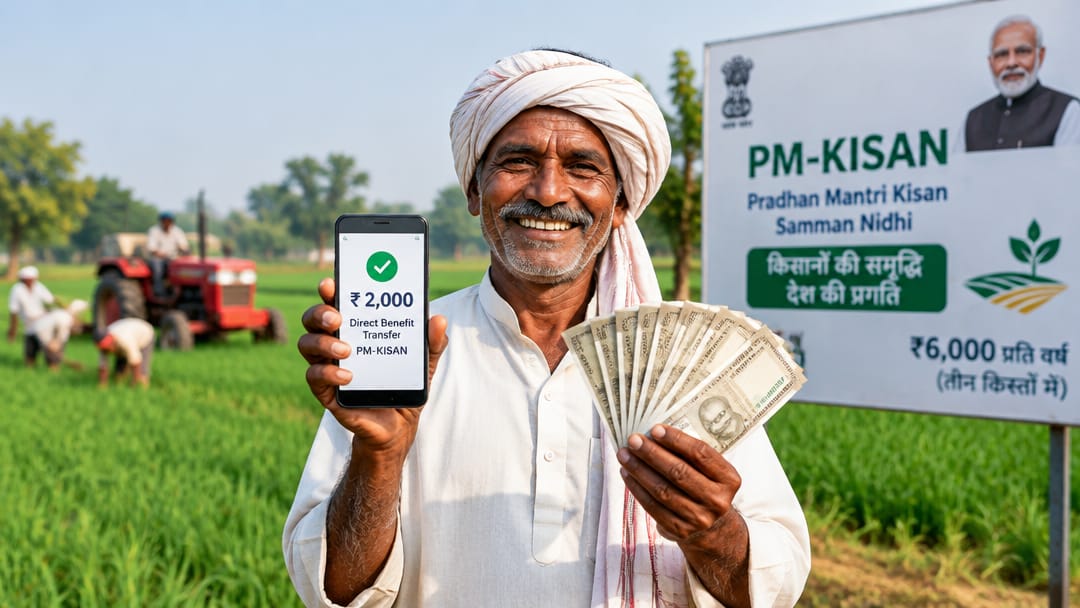
PM-KISAN, the Pradhan Mantri Kisan Samman Nidhi scheme, provides direct income support of ₹6,000 per year to eligible farmer families across India, disbursed in three equal instalments of ₹2,000 each. Currently benefiting over 9.34 crore farmers, it operates through Direct Benefit Transfer. ICAR-CIFRI observed PM-KISAN Utsav Diwas alongside Khet Jagrukta Diwas, highlighting the scheme's role in strengthening rural economies and promoting awareness among farming communities about government welfare outreach.
02 Understand
Why it matters
PM-KISAN (Pradhan Mantri Kisan Samman Nidhi) was launched in February 2019 under the Ministry of Agriculture and Farmers' Welfare. It is a Central Sector Scheme — meaning it is fully funded by the Government of India, unlike Centrally Sponsored Schemes where states share costs. This distinction is frequently tested.
The scheme provides ₹6,000 per year in three instalments of ₹2,000 each, credited directly to the bank accounts of eligible farmer families through the Direct Benefit Transfer (DBT) mechanism. This eliminates middlemen and reduces leakage, making it a model for last-mile financial delivery.
Eligibility covers all landholding farmer families with cultivable land, subject to exclusion criteria: income taxpayers, institutional landholders, constitutional post-holders, and serving/retired government employees above a threshold are excluded. The scheme uses the Aadhaar-seeded land records database for identification.
For NABARD aspirants, the scheme connects to rural credit: the cash transfer supplements farm income, reducing distress borrowing and improving loan repayment capacity. For UPSC aspirants, PM-KISAN exemplifies DBT-based welfare architecture under the JAM Trinity (Jan Dhan–Aadhaar–Mobile). The current beneficiary count of 9.34 crore is a precision figure the examiner will test. PM-KISAN Utsav Diwas is observed on February 24, marking the scheme's anniversary.
Remember + Why it matters
The key recall facts and exact examiner angle for UPSC CSE are in the Crux app.
01
Key figure and date from this topic
02
Specific number or threshold to remember
03
Policy or regulatory implication
Read + Understand free forever · 30-day free trial