01 Read
What happened
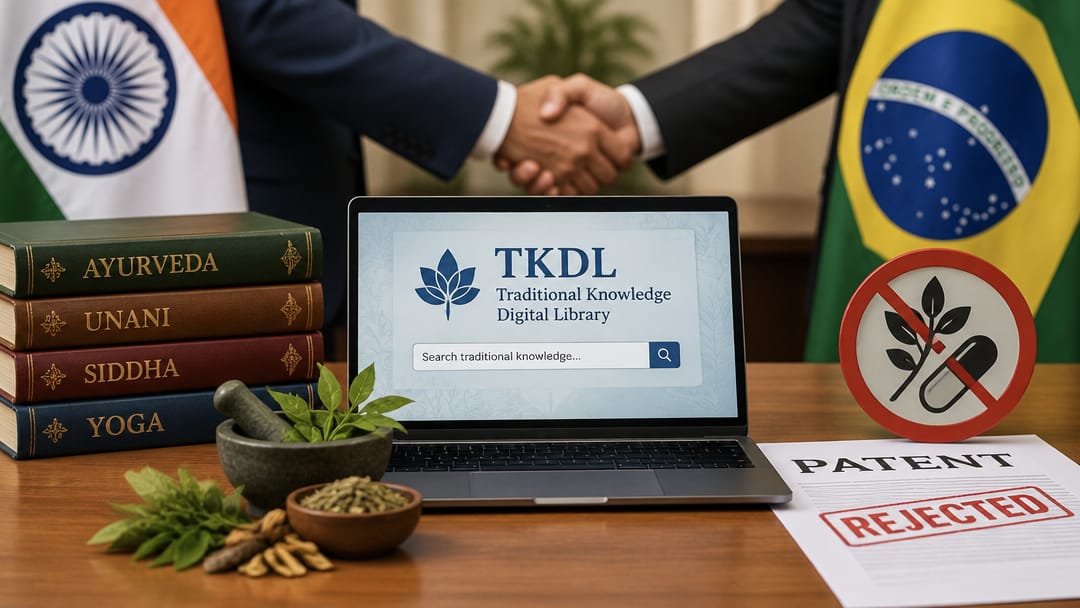
India's CSIR and Brazil's National Institute of Industrial Property (INPI) signed a TKDL Access Agreement, granting Brazil access to India's Traditional Knowledge Digital Library. The agreement, welcomed by leaders of both nations, allows Brazilian patent examiners to search TKDL's database of traditional medicinal knowledge before granting patents. This prevents biopiracy — the illegal patenting of India's documented Ayurvedic, Unani, Siddha, and Yoga practices by foreign entities claiming them as novel inventions.
02 Understand
Why it matters
The Traditional Knowledge Digital Library (TKDL) is a pioneering Indian database created in 2001 by CSIR and the Ministry of AYUSH. It documents over 0.29 million medicinal formulations drawn from classical Indian texts — Ayurveda, Unani, Siddha, and Yoga — in five international languages (English, French, German, Spanish, Japanese) and in formats compatible with international patent classification systems.
The core problem TKDL solves is biopiracy: foreign patent offices, unaware of prior art documented only in Sanskrit or Hindi classical texts, would grant patents on traditional remedies. Famous cases include the turmeric patent (granted by the US in 1995, revoked after CSIR challenged it) and the neem patent challenge before the European Patent Office.
TKDL Access Agreements are signed with patent offices of other countries, giving their examiners access to search this database during patent examination. Before this Brazil agreement, TKDL had signed agreements with the European Patent Office, the US Patent and Trademark Office, the UK Intellectual Property Office, Germany, Canada, Australia, Japan, and others.
The India-Brazil agreement is significant because Brazil is a megadiverse country with its own biodiversity concerns, and cooperation signals South-South solidarity on intellectual property and traditional knowledge protection. It also fits within the broader framework of the Convention on Biological Diversity (CBD) and the Nagoya Protocol on access and benefit-sharing, both of which India and Brazil have ratified. CSIR is the nodal agency managing TKDL on India's behalf.
Remember + Why it matters
The key recall facts and exact examiner angle for UPSC CSE are in the Crux app.
01
Key figure and date from this topic
02
Specific number or threshold to remember
03
Policy or regulatory implication
Read + Understand free forever · 30-day free trial