01 Read
What happened
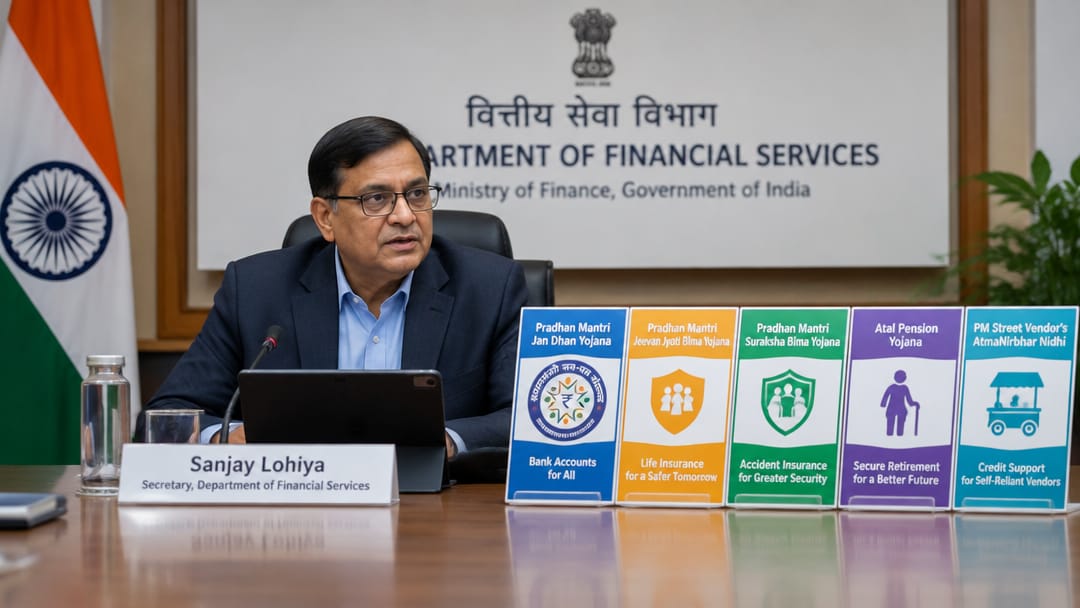
Department of Financial Services Secretary Sanjay Lohiya chaired a review meeting on Financial Inclusion schemes including Pradhan Mantri Jan Dhan Yojana, Pradhan Mantri Jeevan Jyoti Bima Yojana, Pradhan Mantri Suraksha Bima Yojana, Atal Pension Yojana, and PM Street Vendor's AtmaNirbhar Nidhi. The meeting assessed scheme-level progress and saturation targets. These five schemes collectively form India's core financial inclusion architecture, linking bank accounts, micro-insurance, pension, and credit access for underserved populations.
02 Understand
Why it matters
India's financial inclusion architecture rests on five interlocking schemes launched between 2014 and 2015 under the Jan Dhan–Aadhaar–Mobile (JAM) trinity framework. Each scheme targets a specific gap in the financial security chain.
PMJDY (2014) is the foundation: it provides zero-balance savings accounts with a RuPay debit card, a ₹10,000 overdraft facility, and ₹2 lakh accidental insurance. Over 53 crore accounts have been opened as of recent data, with more than 55% held by women.
PM Jeevan Jyoti Bima Yojana (PMJJBY) offers renewable life insurance of ₹2 lakh for a premium of ₹436 per year (revised), targeting working-age adults aged 18–50 with bank accounts.
PM Suraksha Bima Yojana (PMSBY) provides accidental death and disability cover of ₹2 lakh for just ₹20 per year (revised to ₹20 per annum), for ages 18–70.
Atal Pension Yojana (APY) addresses old-age income security for unorganised sector workers aged 18–40, with guaranteed monthly pensions of ₹1,000–₹5,000 depending on contribution and entry age. NPS Trust administers it; PFRDA regulates it.
PM SVANidhi provides collateral-free working capital loans of ₹10,000 (first tranche), ₹20,000, and ₹50,000 to street vendors, with an interest subsidy of 7%.
For RBI and NABARD aspirants, understanding how these schemes connect to priority sector lending, SLBC monitoring, and Jan Dhan accounts as conduits for Direct Benefit Transfers is critical. The DFS review signals active saturation monitoring — a recurring exam angle.
PMJDY (2014) is the foundation: it provides zero-balance savings accounts with a RuPay debit card, a ₹10,000 overdraft facility, and ₹2 lakh accidental insurance. Over 53 crore accounts have been opened as of recent data, with more than 55% held by women.
PM Jeevan Jyoti Bima Yojana (PMJJBY) offers renewable life insurance of ₹2 lakh for a premium of ₹436 per year (revised), targeting working-age adults aged 18–50 with bank accounts.
PM Suraksha Bima Yojana (PMSBY) provides accidental death and disability cover of ₹2 lakh for just ₹20 per year (revised to ₹20 per annum), for ages 18–70.
Atal Pension Yojana (APY) addresses old-age income security for unorganised sector workers aged 18–40, with guaranteed monthly pensions of ₹1,000–₹5,000 depending on contribution and entry age. NPS Trust administers it; PFRDA regulates it.
PM SVANidhi provides collateral-free working capital loans of ₹10,000 (first tranche), ₹20,000, and ₹50,000 to street vendors, with an interest subsidy of 7%.
For RBI and NABARD aspirants, understanding how these schemes connect to priority sector lending, SLBC monitoring, and Jan Dhan accounts as conduits for Direct Benefit Transfers is critical. The DFS review signals active saturation monitoring — a recurring exam angle.
Remember + Why it matters
The key recall facts and exact examiner angle for NABARD Grade A are in the Crux app.
01
Key figure and date from this topic
02
Specific number or threshold to remember
03
Policy or regulatory implication
Read + Understand free forever · 30-day free trial