01 Read
What happened
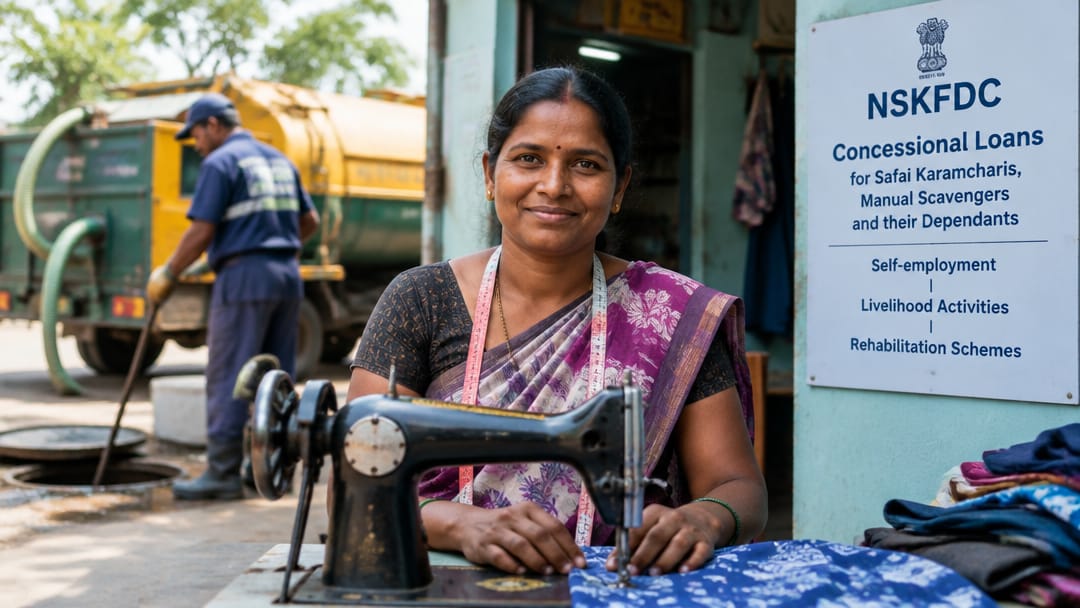
The National Safai Karamcharis Finance and Development Corporation (NSKFDC) provides concessional-rate loans to safai karamcharis, manual scavengers, and their dependants for self-employment and livelihood activities. Operating under the Ministry of Social Justice and Empowerment, it channels funds through State Channelising Agencies and scheduled commercial banks. The corporation also administers rehabilitation schemes for manual scavengers, aiming to transition them out of hazardous sanitation work into sustainable economic activities.
02 Understand
Why it matters
NSKFDC was established in 1997 as a not-for-profit company under Section 25 of the Companies Act, 1956 (now Section 8 under Companies Act 2013), with its registered office in New Delhi. It functions under the administrative control of the Ministry of Social Justice and Empowerment.
Its core mandate is threefold: (1) financial assistance through concessional loans for income-generating activities, (2) skill development training, and (3) implementation of rehabilitation programmes for manual scavengers under the Self Employment Scheme for Rehabilitation of Manual Scavengers (SRMS).
Under its loan schemes, NSKFDC provides term loans at interest rates as low as 5% per annum — significantly below commercial bank rates — channelled through State Channelising Agencies (SCAs) and Regional Rural Banks (RRBs). The eligible beneficiary pool includes safai karamcharis, manual scavengers, and their family dependants whose annual family income does not exceed a prescribed ceiling.
The SRMS scheme is particularly significant: it provides a one-time cash assistance of ₹40,000 and concessional loans up to ₹15 lakh for identified manual scavengers to pursue alternative livelihoods. This directly connects to India's legislative commitment under the Prohibition of Employment as Manual Scavengers and their Rehabilitation Act, 2013.
For RBI aspirants, NSKFDC's credit delivery through SCAs and RRBs is a priority-sector-adjacent mechanism. For NABARD aspirants, its rural credit channel and livelihood promotion are core. For UPSC aspirants, the scheme represents the welfare-to-rights continuum in social justice policy.
Remember + Why it matters
The key recall facts and exact examiner angle for RBI Grade B are in the Crux app.
01
Key figure and date from this topic
02
Specific number or threshold to remember
03
Policy or regulatory implication
Read + Understand free forever · 30-day free trial