01 Read
What happened
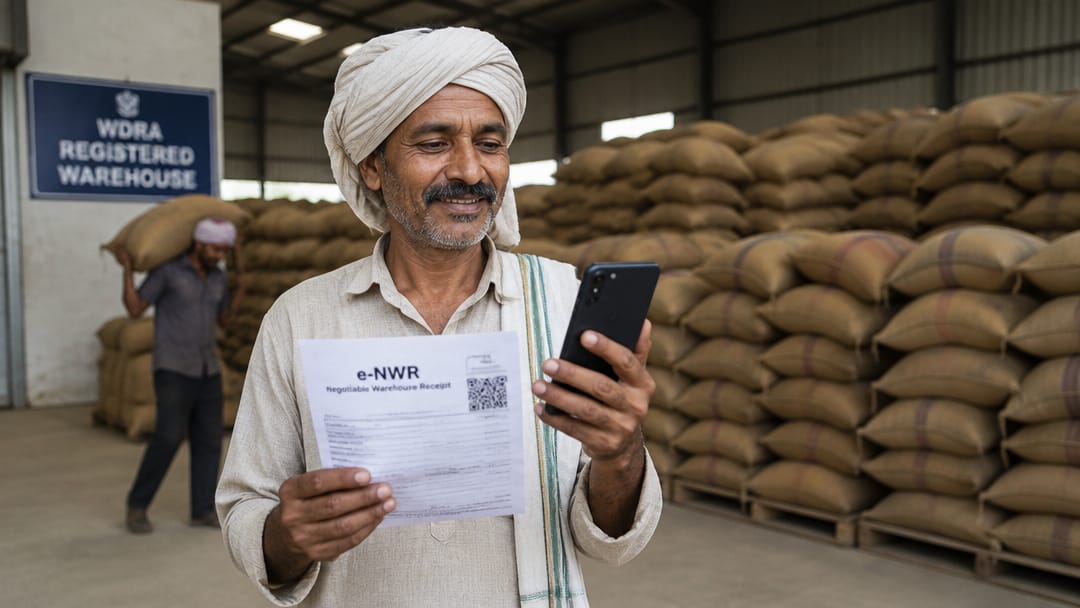
Farmers storing crops in WDRA-registered warehouses can obtain loans against electronic Negotiable Warehouse Receipts (e-NWRs). Under the Kisan Credit Card scheme, post-harvest loans up to ₹3 lakh attract a 7 per cent interest rate for the first six months, with a 3 per cent interest subvention from the government. The e-NWR, issued digitally on the NERL platform, serves as collateral, allowing farmers to avoid distress selling while waiting for better market prices.
02 Understand
Why it matters
The e-NWR (electronic Negotiable Warehouse Receipt) system is a post-harvest credit mechanism regulated by the Warehousing Development and Regulatory Authority (WDRA) under the Warehousing (Development and Regulation) Act, 2007. When a farmer deposits produce in a WDRA-accredited warehouse, the warehouse issues an e-NWR through the National Electronic Repository Limited (NERL) platform. This digital receipt is legally negotiable — it can be pledged with banks as collateral to obtain loans without physically moving the crop.
The policy problem it solves: Indian farmers have historically been forced into distress selling immediately after harvest when prices are lowest, because they need cash to repay loans and fund the next crop cycle. The e-NWR system decouples the need for cash from the need to sell, giving farmers the holding power to wait for better prices.
The credit delivery mechanism connects to two major schemes: (1) the Kisan Credit Card (KCC), under which post-harvest loans up to ₹3 lakh are classified as short-term agricultural credit and qualify for interest subvention — the government pays 2% subvention and an additional 3% prompt repayment incentive, bringing the effective rate to 4% for timely repayers; and (2) Priority Sector Lending (PSL) guidelines, under which e-NWR-backed loans count as agricultural credit. NABARD plays a key role in refinancing such credit through cooperative banks and RRBs. The system directly supports financial inclusion by extending formal credit to small and marginal farmers who may lack traditional collateral like land titles.
The policy problem it solves: Indian farmers have historically been forced into distress selling immediately after harvest when prices are lowest, because they need cash to repay loans and fund the next crop cycle. The e-NWR system decouples the need for cash from the need to sell, giving farmers the holding power to wait for better prices.
The credit delivery mechanism connects to two major schemes: (1) the Kisan Credit Card (KCC), under which post-harvest loans up to ₹3 lakh are classified as short-term agricultural credit and qualify for interest subvention — the government pays 2% subvention and an additional 3% prompt repayment incentive, bringing the effective rate to 4% for timely repayers; and (2) Priority Sector Lending (PSL) guidelines, under which e-NWR-backed loans count as agricultural credit. NABARD plays a key role in refinancing such credit through cooperative banks and RRBs. The system directly supports financial inclusion by extending formal credit to small and marginal farmers who may lack traditional collateral like land titles.
Remember + Why it matters
The key recall facts and exact examiner angle for NABARD Grade A are in the Crux app.
01
Key figure and date from this topic
02
Specific number or threshold to remember
03
Policy or regulatory implication
Read + Understand free forever · 30-day free trial