01 Read
What happened
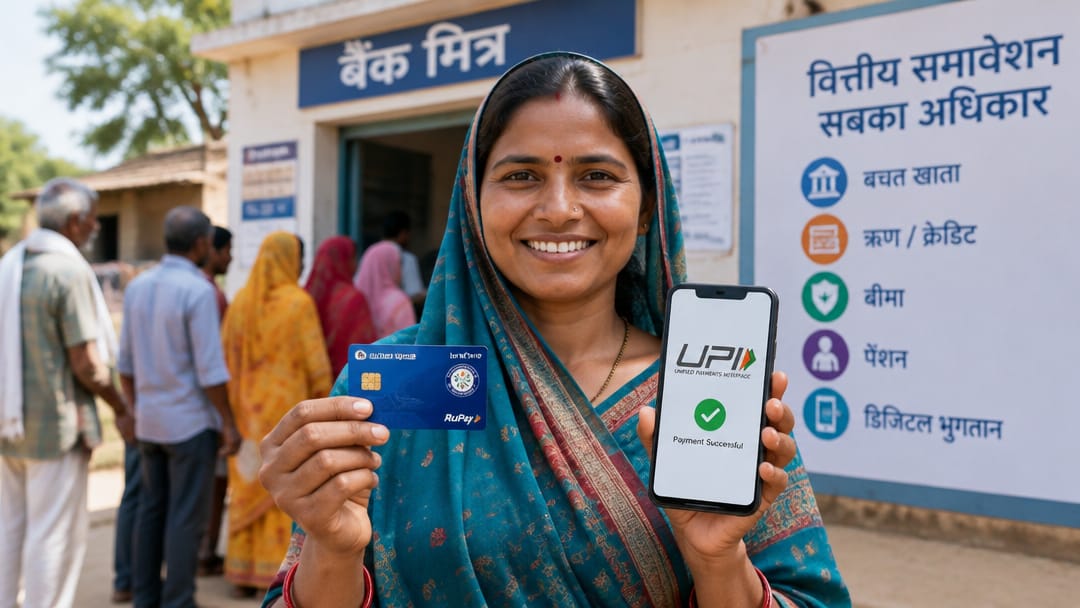
India's financial inclusion drive spans banking, credit, insurance, pensions, and digital payments. The Jan Dhan Yojana has opened over 53 crore accounts since 2014, linking beneficiaries to DBT transfers, RuPay cards, and micro-insurance. UPI now processes over 100 crore transactions daily. PM-JJBY, PM-SBY, and APY extend life, accident, and pension cover to low-income citizens. The push integrates BC networks, Aadhaar-linked KYC, and PMMY credit to close gaps in rural and semi-urban access.
02 Understand
Why it matters
Financial inclusion means ensuring every citizen can access affordable, formal financial services — savings, credit, insurance, remittances, and pensions — without discrimination based on income or geography. India's approach is built on five pillars: banking access (PMJDY), payment infrastructure (UPI, RuPay), credit (PMMY, KCC), social security (PM-JJBY, PM-SBY, APY), and investment access (small savings, mutual funds via AMFI's B30 cities push).
The policy problem being solved: before 2014, over 40% of Indian adults were unbanked. Cash-based welfare delivery suffered from leakages. The JAM Trinity — Jan Dhan accounts, Aadhaar biometric ID, and Mobile phones — created the infrastructure for direct benefit transfer (DBT), eliminating middlemen and reducing leakage.
For RBI, the examiner focuses on the regulatory mechanism: Business Correspondents (BCs) as last-mile agents, priority sector lending (PSL) targets requiring 40% of ANBC toward agriculture, MSMEs, and weaker sections, and the RBI's Financial Inclusion Index (FI-Index), which is published annually and captures inclusion across access, usage, and quality dimensions.
For NABARD, rural credit flow, Kisan Credit Cards (KCC), Self-Help Group–Bank Linkage Programme, and cooperative credit structure are the core angles.
For SEBI, the investor inclusion dimension — AMFI's B30 initiative, Investor Education and Protection Fund (IEPF), and mobile-first demat penetration — is the relevant angle.
For UPSC, the governance lens matters most: JAM Trinity as a welfare delivery reform, DBT impact on leakage reduction, and financial inclusion as a tool for poverty alleviation and gender empowerment (women account for 55%+ of PMJDY accounts).
Remember + Why it matters
The key recall facts and exact examiner angle for SEBI Grade A are in the Crux app.
01
Key figure and date from this topic
02
Specific number or threshold to remember
03
Policy or regulatory implication
Read + Understand free forever · 30-day free trial