01 Read
What happened
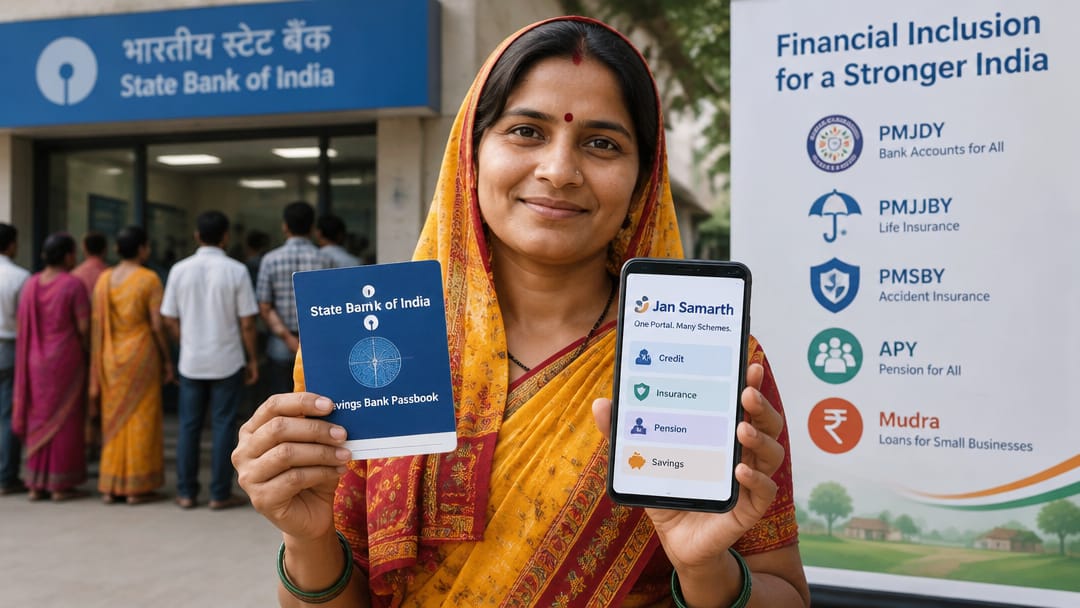
India's financial inclusion drive, anchored by Pradhan Mantri Jan Dhan Yojana (PMJDY), has opened over 53 crore bank accounts, with more than 55% held by women. The Jan Samarth portal unifies 13 credit-linked government schemes on a single digital platform. Together with PMJJBY, PMSBY, APY, and Mudra, these initiatives form a layered ecosystem covering savings, insurance, credit, and pensions for previously unbanked populations across rural and urban India.
02 Understand
Why it matters
Financial inclusion means ensuring every citizen has access to affordable formal financial services — savings, credit, insurance, and remittances — regardless of geography or income. India's approach is architected in layers.
The foundation is PMJDY (launched August 28, 2014), which mandates zero-balance accounts with a RuPay debit card, a ₹10,000 overdraft facility, and a ₹2 lakh accidental insurance cover. With 53+ crore accounts and deposits exceeding ₹2.3 lakh crore, it is the world's largest financial inclusion programme.
Above the savings layer sits an insurance layer: PMJJBY (life cover ₹2 lakh at ₹436/year) and PMSBY (accidental death/disability ₹2 lakh at ₹20/year). The pension layer is covered by Atal Pension Yojana (APY), targeting unorganised sector workers with guaranteed pensions of ₹1,000–₹5,000/month on retirement at 60.
The credit layer is served by Pradhan Mantri Mudra Yojana (PMMY), which lends to micro-enterprises under three sub-categories — Shishu (up to ₹50,000), Kishore (₹50,001–₹5 lakh), and Tarun (₹5–₹10 lakh) — without collateral. A fourth tier, Tarun Plus (up to ₹20 lakh), was added for graduates.
Jan Samarth is the digital convergence layer, a government portal that connects 13 credit-linked schemes — from education loans to Mudra — through a single application interface, eliminating the need for a borrower to visit multiple ministries or portals.
For RBI and NABARD exams, the critical angle is the role of Business Correspondents (BCs), Priority Sector Lending (PSL) targets, and how PMJDY accounts serve as conduits for Direct Benefit Transfers (DBT), reducing leakage in welfare delivery.
The foundation is PMJDY (launched August 28, 2014), which mandates zero-balance accounts with a RuPay debit card, a ₹10,000 overdraft facility, and a ₹2 lakh accidental insurance cover. With 53+ crore accounts and deposits exceeding ₹2.3 lakh crore, it is the world's largest financial inclusion programme.
Above the savings layer sits an insurance layer: PMJJBY (life cover ₹2 lakh at ₹436/year) and PMSBY (accidental death/disability ₹2 lakh at ₹20/year). The pension layer is covered by Atal Pension Yojana (APY), targeting unorganised sector workers with guaranteed pensions of ₹1,000–₹5,000/month on retirement at 60.
The credit layer is served by Pradhan Mantri Mudra Yojana (PMMY), which lends to micro-enterprises under three sub-categories — Shishu (up to ₹50,000), Kishore (₹50,001–₹5 lakh), and Tarun (₹5–₹10 lakh) — without collateral. A fourth tier, Tarun Plus (up to ₹20 lakh), was added for graduates.
Jan Samarth is the digital convergence layer, a government portal that connects 13 credit-linked schemes — from education loans to Mudra — through a single application interface, eliminating the need for a borrower to visit multiple ministries or portals.
For RBI and NABARD exams, the critical angle is the role of Business Correspondents (BCs), Priority Sector Lending (PSL) targets, and how PMJDY accounts serve as conduits for Direct Benefit Transfers (DBT), reducing leakage in welfare delivery.
Remember + Why it matters
The key recall facts and exact examiner angle for RBI Grade B are in the Crux app.
01
Key figure and date from this topic
02
Specific number or threshold to remember
03
Policy or regulatory implication
Read + Understand free forever · 30-day free trial