01 Read
What happened
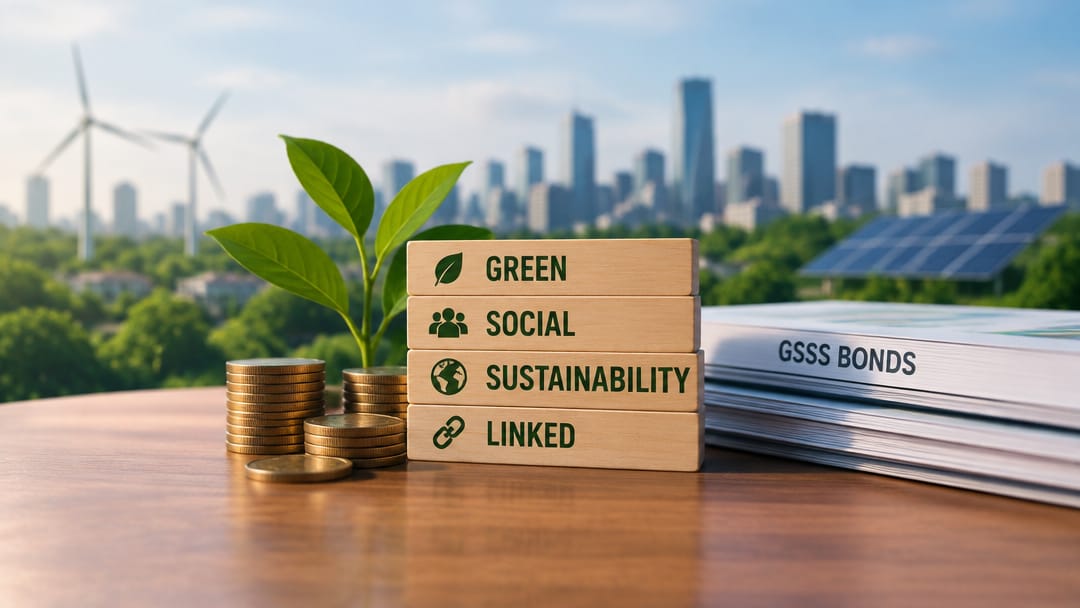
Environmental Finance's Sustainable Bonds Insight 2026 report maps global trends in green, social, sustainability, and sustainability-linked (GSSS) bonds. The free report uses infographics and data to track issuance patterns, sectoral shifts, and regulatory developments across the GSSS market. For Indian aspirants, it anchors concepts directly tested in exams: how labelled bonds are classified, who issues them, and how frameworks like SEBI's green bond guidelines and RBI's green finance circulars interact with international standards set by ICMA.
02 Understand
Why it matters
GSSS bonds are debt instruments whose proceeds or structural features are tied to environmental or social objectives. Each category has a distinct definition under the International Capital Market Association (ICMA) framework:
• Green bonds: proceeds exclusively for climate or environmental projects (renewable energy, clean transport, water management).
• Social bonds: proceeds for projects with positive social outcomes (affordable housing, healthcare, food security).
• Sustainability bonds: proceeds split between green and social projects.
• Sustainability-linked bonds (SLBs): structurally linked to the issuer's ESG performance targets (KPIs); proceeds are general-purpose but the coupon adjusts if targets are missed.
The critical distinction examiners exploit: green/social/sustainability bonds are use-of-proceeds instruments, while SLBs are KPI-linked instruments — a frequent statement-based trap.
In India, SEBI issued a framework for green bonds in 2023, aligning with ICMA principles and requiring listing on recognised exchanges. RBI has encouraged banks to issue green bonds and integrate climate risk into their supervisory frameworks. NABARD operates the National Adaptation Fund for Climate Change (NAFCC) and issues green bonds to fund rural climate-resilient infrastructure.
The global GSSS market has grown to exceed $5 trillion in cumulative issuance. Sovereign green bonds have become a key instrument — India issued its first Sovereign Green Bond in January 2023, raising ₹8,000 crore, with proceeds earmarked for the Green Finance Framework sectors.
For exam purposes: know the ICMA taxonomy, the difference between use-of-proceeds vs KPI-linked structures, India's sovereign green bond timeline, and SEBI/RBI roles.
Remember + Why it matters
The key recall facts and exact examiner angle for NABARD Grade A are in the Crux app.
01
Key figure and date from this topic
02
Specific number or threshold to remember
03
Policy or regulatory implication
Read + Understand free forever · 30-day free trial