01 Read
What happened
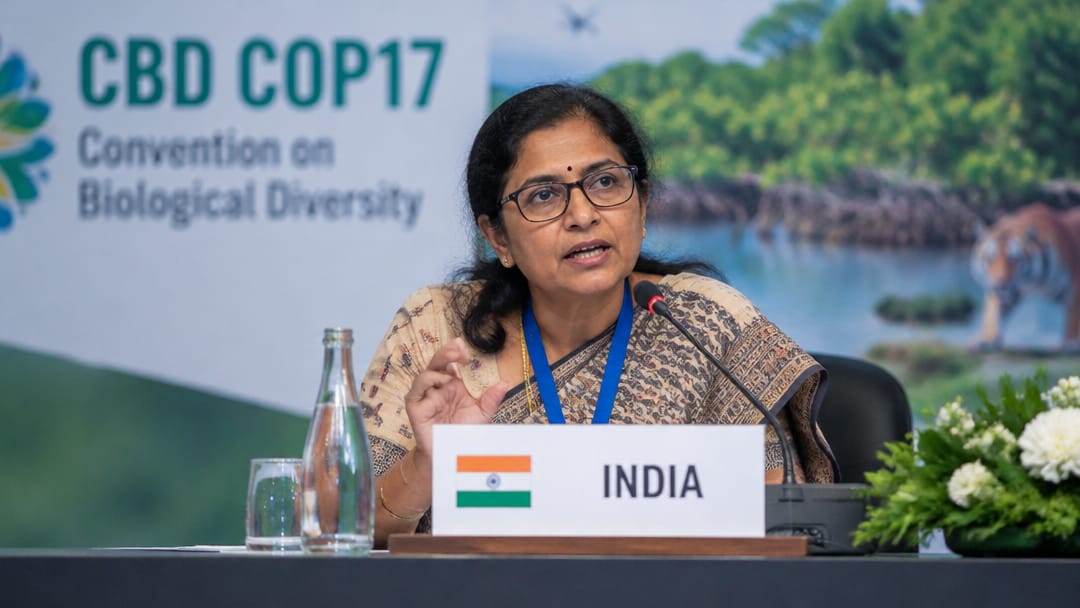
At the Convention on Biological Diversity's COP17, India urged that any use of synthetic biology in conservation must be governed by rigorous, science-based safeguards to prevent unintended ecological harm. India also highlighted its flagship programmes on big cats, mangroves, wetlands, and soil health, framing biodiversity protection as inseparable from ecosystem services. The position reflects India's broader stance: embrace biotechnological innovation cautiously, with precautionary principles anchoring any regulatory framework under the CBD.
02 Understand
Why it matters
Synthetic biology involves redesigning or engineering living organisms — sometimes creating entirely novel genetic sequences — for purposes ranging from medicine to conservation. At the CBD, its application in biodiversity contexts (e.g., gene drives to eliminate invasive species, engineered organisms to restore ecosystems) is deeply controversial. The core tension is between biotechnological potential and biosafety risk: a gene drive released into a wild population, for instance, cannot be recalled.
India's position at COP17 aligns with the CBD's precautionary approach enshrined in the Cartagena Protocol on Biosafety (2000), which governs the transboundary movement of living modified organisms. India is a party to both the CBD and the Cartagena Protocol, with the Ministry of Environment, Forest and Climate Change (MoEFCC) as the nodal ministry.
COP17 of the CBD is significant because it follows the landmark Kunming-Montreal Global Biodiversity Framework (GBF), adopted at COP15 in December 2022, which set 23 targets including the '30x30' goal — protecting 30% of land and oceans by 2030. Synthetic biology's role in meeting these targets remains unresolved.
For UPSC, the examiner will test: which convention governs synthetic biology in biodiversity contexts, what the Cartagena Protocol covers, India's nodal ministry, and how the GBF's targets interface with emerging biotechnologies. India's conservation showcases — Project Tiger, Mangrove Initiative for Shoreline Habitats and Tangible Incomes (MISHTI), and the National Wetland Conservation Programme — are all exam-relevant static facts linked to this news.
Remember + Why it matters
The key recall facts and exact examiner angle for NABARD Grade A are in the Crux app.
01
Key figure and date from this topic
02
Specific number or threshold to remember
03
Policy or regulatory implication
Read + Understand free forever · 30-day free trial