01 Read
What happened
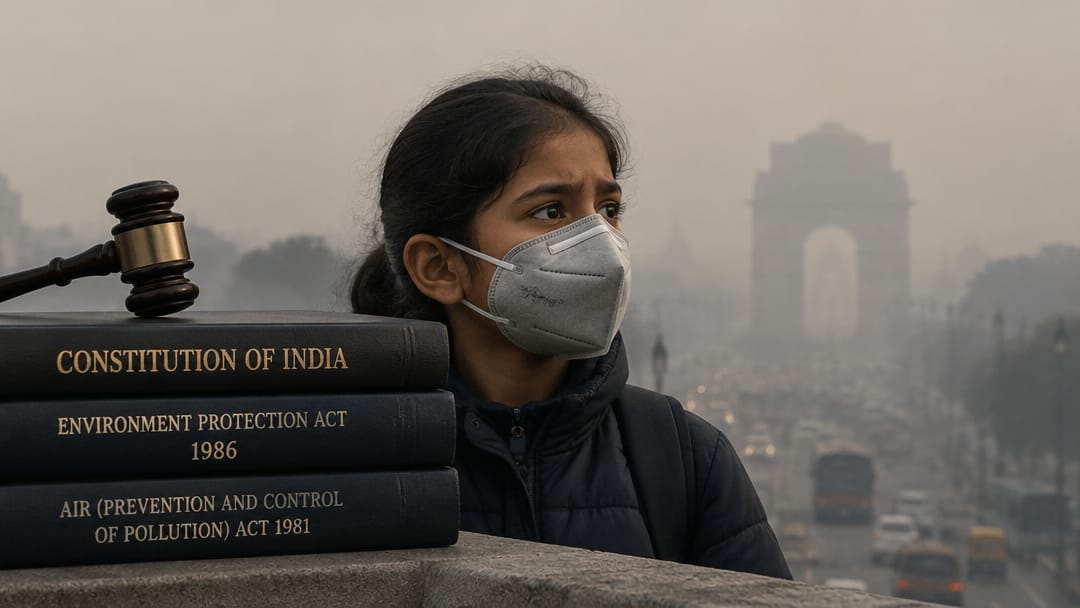
Despite constitutional protections under Article 21 and environmental statutes like the Air (Prevention and Control of Pollution) Act 1981, Delhi's air quality continues to deteriorate each winter. Courts have read the right to clean air into the right to life, but judicial pronouncements have not translated into sustained compliance. The gap between legal entitlement and lived reality raises a pointed question for constitutional law: when a fundamental right exists on paper but fails in practice, what remedies actually work?
02 Understand
Why it matters
The right to clean air in India is not explicitly written in the Constitution but has been judicially constructed through Article 21, which guarantees the right to life and personal liberty. The Supreme Court in Subhash Kumar v. State of Bihar (1991) first held that the right to life includes the right to enjoyment of pollution-free water and air. This was reinforced in M.C. Mehta v. Union of India, a series of landmark cases that made environmental enforcement through PIL a defining feature of Indian constitutional practice.
The doctrinal architecture rests on three pillars. First, Article 21 is the source right — any state action or omission that degrades air quality to life-threatening levels constitutes a violation. Second, Articles 48A (Directive Principle requiring the state to protect the environment) and 51A(g) (Fundamental Duty of citizens to protect the natural environment) provide interpretive support, though they are not independently enforceable. Third, the Air (Prevention and Control of Pollution) Act 1981 and the Environment (Protection) Act 1986 create statutory mechanisms, including the Central Pollution Control Board (CPCB) and State Pollution Control Boards.
The critical constitutional test the Court applies is whether state inaction is arbitrary under Article 14 or whether it directly imperils life under Article 21. The Court has in several M.C. Mehta cases issued continuing mandamus — a supervisory jurisdiction where it retains the case and monitors compliance — to bridge the enforcement gap. The GRAP (Graded Response Action Plan) system operative in Delhi is a direct product of Supreme Court directions, not parliamentary legislation, illustrating how judicial orders now function as quasi-regulatory instruments in the environmental space.
Remember + Why it matters
The key recall facts and exact examiner angle for UPSC CSE are in the Crux app.
01
Key figure and date from this topic
02
Specific number or threshold to remember
03
Policy or regulatory implication
Read + Understand free forever · 30-day free trial