01 Read
What happened
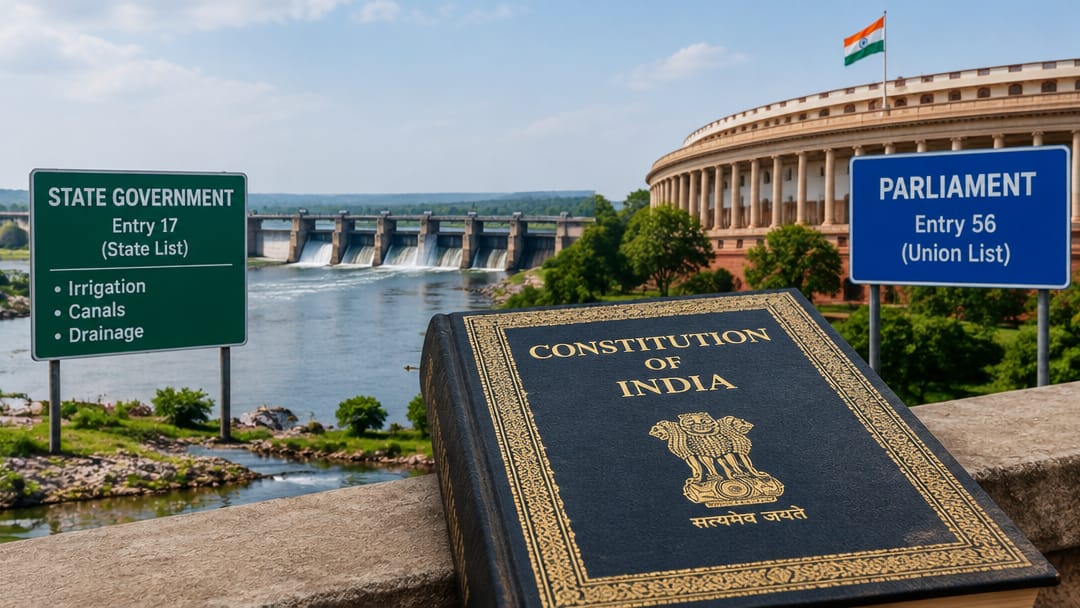
India's Constitution splits water governance between states and Parliament. Entry 17 of the State List gives states primary authority over water — including irrigation, canals, and drainage. But Entry 56 of the Union List empowers Parliament to regulate inter-state rivers and river valleys, overriding state authority where declared expedient in the public interest. This federal tension underpins major water disputes like the Cauvery and Krishna conflicts, making the constitutional allocation of water powers a recurring exam and litigation flashpoint.
02 Understand
Why it matters
Water in India is constitutionally allocated across two lists in the Seventh Schedule. Entry 17 of List II (State List) covers water supply, irrigation, canals, drainage, embankments, water storage, and hydroelectric power — placing these squarely under state legislative competence. This reflects the founding logic that water is a local resource best managed by states closest to it.
However, Entry 56 of List I (Union List) carves out a significant exception: Parliament may legislate on the regulation and development of inter-state rivers and river valleys to the extent declared by law to be expedient in the public interest. This is not automatic Union power — Parliament must affirmatively declare the expediency. When it does, Union law prevails over inconsistent state law under Article 254.
Article 262 adds a further constitutional layer: Parliament may by law provide for adjudication of disputes relating to waters of inter-state rivers, and may also bar the jurisdiction of the Supreme Court and other courts in such disputes. Exercising this, Parliament enacted the Inter-State River Water Disputes Act, 1956 (amended 2002), under which tribunals like the Cauvery Water Disputes Tribunal and Krishna Water Disputes Tribunal were constituted.
Groundwater is not explicitly mentioned in any List, creating a gap. Courts have treated it as falling under Entry 17 of the State List as a component of land and water resources within state territory.
The overall constitutional design is state-primary but Union-supervisory for rivers that cross state boundaries — a structure producing perennial inter-state litigation.
Remember + Why it matters
The key recall facts and exact examiner angle for UPSC CSE are in the Crux app.
01
Key figure and date from this topic
02
Specific number or threshold to remember
03
Policy or regulatory implication
Read + Understand free forever · 30-day free trial