01 Read
What happened
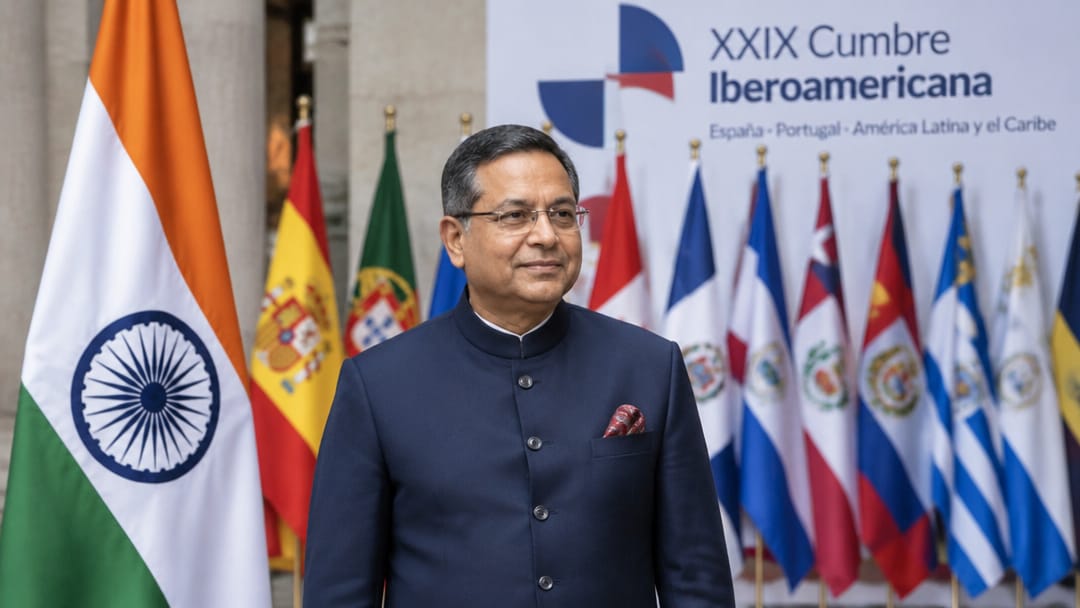
Minister of State for External Affairs Pabitra Margherita visited Spain from November 3 to 5 to attend the 30th Summit of the Ibero-American Conference, hosted in Spain. India is set to join the Conference as an observer state. The Ibero-American Conference brings together Spain, Portugal, and Latin American nations sharing Iberian heritage. India's observer status marks a formal entry into a bloc it had not previously been formally associated with.
02 Understand
Why it matters
The Ibero-American Conference (Conferencia Iberoamericana) is a multilateral forum comprising Spain, Portugal, Andorra, and 19 Latin American countries — all nations historically connected through Iberian (Spanish and Portuguese) colonial heritage. It was formally established in 1991 following the first Ibero-American Summit held in Guadalajara, Mexico. The Secretariat General (SEGIB) was created in 2003 to give the body a permanent institutional structure, headquartered in Madrid.
India gaining observer status is significant for several reasons. First, it expands India's diplomatic footprint into a bloc of 22 nations it was previously outside of. Second, Latin America is increasingly important for India's mineral security (lithium in Chile, Bolivia, Argentina — the 'Lithium Triangle'), agricultural trade, and pharmaceutical exports. Third, observer status in multilateral forums is a recurring UPSC theme — the examiner tests which country holds what status in which body, and when that status was acquired.
The Ibero-American Conference is distinct from the Iberian Peninsula (Spain + Portugal geographically) and from the broader Lusophone (Portuguese-speaking) Commonwealth of Nations (CPLP). UPSC frequently tests such distinctions. The conference operates on an annual summit cycle; the 30th Summit being hosted by Spain in 2024 marks a milestone year. India's participation under MoS (not the full External Affairs Minister) signals diplomatic engagement at a calibrated level — worth noting for statement-validity questions.
Remember + Why it matters
The key recall facts and exact examiner angle for UPSC CSE are in the Crux app.
01
Key figure and date from this topic
02
Specific number or threshold to remember
03
Policy or regulatory implication
Read + Understand free forever · 30-day free trial