01 Read
What happened
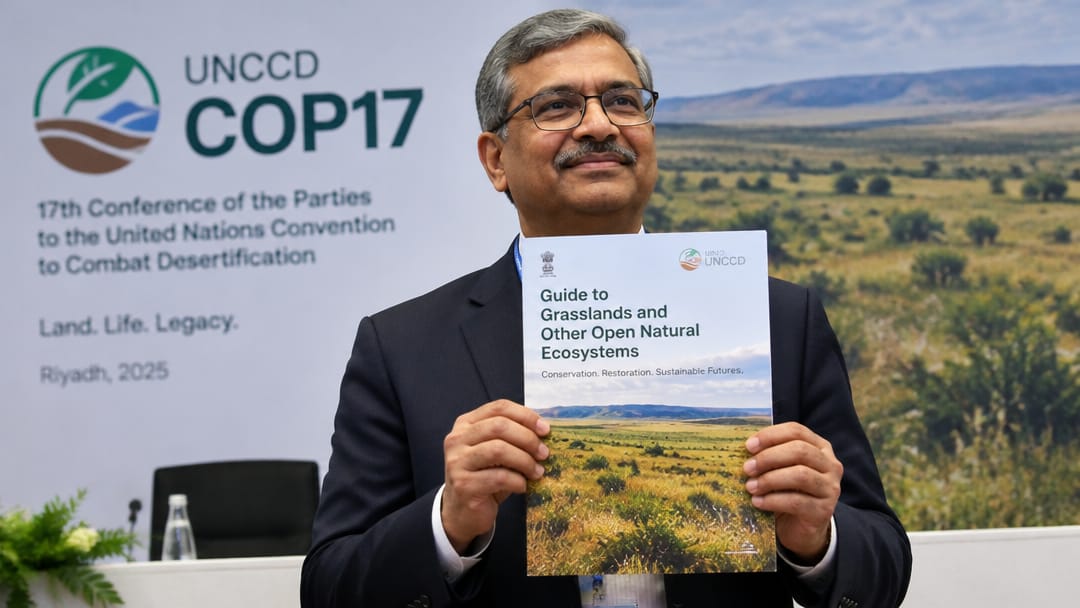
India released its first-ever Guide to Grasslands and Other Open Natural Ecosystems at the 17th Conference of Parties of the UN Convention to Combat Desertification, held in 2025. The guide formally recognises grasslands, savannas, scrublands, and other open natural ecosystems as distinct biomes requiring dedicated conservation — a significant policy shift from treating them as degraded forests or wasteland available for diversion.
02 Understand
Why it matters
India's grasslands and open natural ecosystems (ONEs) have historically suffered a classification problem: government land records labelled them 'wastelands' or 'degraded forests,' making them easy targets for diversion to solar parks, plantations, and infrastructure. This guide, launched at UNCCD COP17, is the first official national document to map, describe, and assert conservation value for these ecosystems.
The UNCCD (United Nations Convention to Combat Desertification) is the third Rio Convention alongside UNFCCC and CBD, adopted in 1994 and entered into force in 1996. India is a signatory. COP17 is a critical moment because the convention's 2022–2030 strategic framework explicitly targets Land Degradation Neutrality (LDN), and India has committed to restoring 26 million hectares of degraded land by 2030 under its NDC.
Grasslands cover roughly 12% of India's geographic area and support species like the Great Indian Bustard (Critically Endangered), Blackbuck, Chinkara, and Indian Wolf — all heavily dependent on open landscapes. Because grasslands store carbon in soil rather than biomass, they are systematically undercounted in carbon accounting, making them invisible in green-finance frameworks.
For NABARD aspirants: rural pastoral communities depend on these commons for livestock grazing. Their degradation directly affects rural livelihoods, making this relevant to NABARD's mandate on rural development and ecosystem services. The guide could unlock climate finance for grassland restoration projects under the Green Climate Fund and NABARD's own NCEF (National Clean Energy Fund) channels.
Remember + Why it matters
The key recall facts and exact examiner angle for UPSC CSE are in the Crux app.
01
Key figure and date from this topic
02
Specific number or threshold to remember
03
Policy or regulatory implication
Read + Understand free forever · 30-day free trial