01 Read
What happened
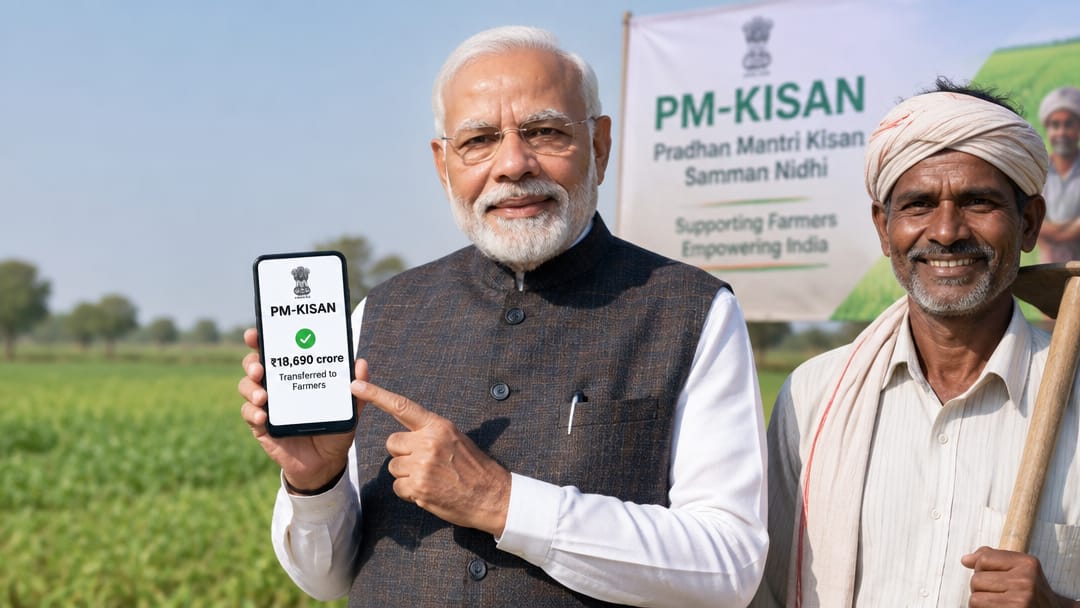
Prime Minister Narendra Modi released the 24th instalment of the PM-KISAN scheme, transferring over ₹18,690 crore directly to eligible farmer families via Direct Benefit Transfer. PM-KISAN provides ₹6,000 per year in three equal instalments of ₹2,000 each to small and marginal landholding farmer families. The scheme, launched in February 2019, is a central sector scheme funded entirely by the Government of India and administered by the Ministry of Agriculture and Farmers Welfare.
02 Understand
Why it matters
PM-KISAN (Pradhan Mantri Kisan Samman Nidhi) is a Central Sector Scheme — meaning it is 100% funded by the Union Government with no state share — that provides income support to farmer families holding cultivable land. The annual benefit of ₹6,000 is paid in three instalments of ₹2,000 each, credited directly to beneficiaries' Aadhaar-linked bank accounts through Direct Benefit Transfer (DBT), eliminating intermediaries and leakage.
The scheme was originally announced in the Interim Budget 2019 with effect from December 1, 2018, making all small and marginal farmers (up to 2 hectares) eligible. It was later expanded in June 2019 to cover all farmer families irrespective of landholding size, subject to exclusion criteria.
Key exclusions include institutional landholders, farmer families holding constitutional posts, serving or retired government employees, income tax payees, and professionals like doctors, engineers, and lawyers.
For competitive exams, three dimensions matter: (1) Financial inclusion — DBT through Jan Dhan-Aadhaar-Mobile (JAM) trinity is the delivery backbone; (2) Agricultural credit — NABARD's lens is whether income support reduces distress borrowing and strengthens rural credit repayment capacity; (3) Fiscal architecture — it is a Central Sector scheme, not Centrally Sponsored, a distinction examiners test frequently. The 24th instalment crossing ₹18,690 crore in a single transfer underscores the scheme's scale as one of the world's largest direct benefit transfer programmes.
Remember + Why it matters
The key recall facts and exact examiner angle for UPSC CSE are in the Crux app.
01
Key figure and date from this topic
02
Specific number or threshold to remember
03
Policy or regulatory implication
Read + Understand free forever · 30-day free trial