Art 21, euthanasia, UCC, and PMLA bail: SC rulings that define Jan–Feb 2026
What happened
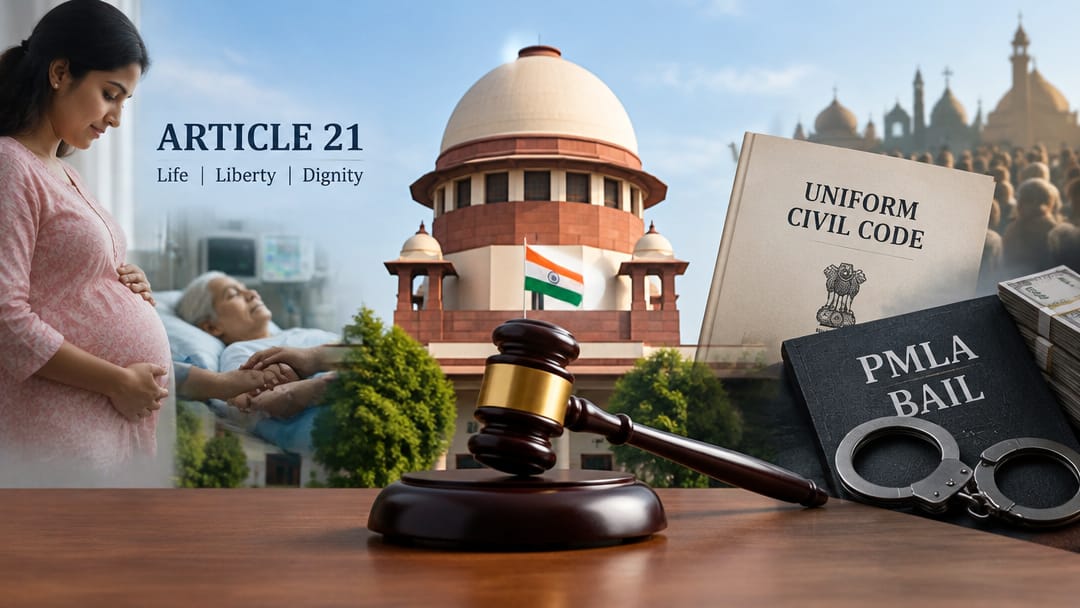
Between January and February 2026, Indian courts delivered rulings across several constitutional flashpoints. The Supreme Court clarified the scope of Article 21 in contexts ranging from maternity benefits to passive euthanasia guidelines, revisited bail conditions under the Prevention of Money Laundering Act, and engaged with questions around the Uniform Civil Code. These judgments collectively update the constitutional map on dignity, liberty, and equality rights tested heavily in CLAT PG.
Why it matters
The January–February 2026 cluster of Supreme Court rulings is best understood as a stress-test of Article 21's expanding perimeter. Since Maneka Gandhi v. Union of India (1978), Article 21 has grown from a bare guarantee against arbitrary deprivation of life and personal liberty into a substantive right encompassing dignity, livelihood, health, and a 'dignified death.' The passive euthanasia rulings of this period extend the Common Cause v. Union of India (2018) framework, which recognised the right to die with dignity and introduced Advance Medical Directives.
On maternity benefits, the Court reinforced the intersection of Article 21 and Article 42 (directive for maternity relief), holding that denial of benefits violates the right to live with dignity — a principle traceable to the Municipal Corporation of Delhi v. Female Workers (Muster Roll) (2000) line of cases.
The PMLA bail developments are constitutionally significant because Section 45 of the Prevention of Money Laundering Act imposes twin conditions for bail — the accused must satisfy the court that (a) there are reasonable grounds to believe they are not guilty, and (b) they will not commit any offence while on bail. Vijay Madanlal Choudhary v. Union of India (2022) upheld these twin conditions but left open nuanced applications, which 2026 rulings have refined.
The UCC discussion implicates Article 44 (Directive Principle) alongside Article 25 (religious freedom), and the Court's engagement tests whether a Directive Principle can override a fundamental right — a tension the examiner routinely exploits.
Court rules advocates' seating is a professional right, not a privilege
What happened
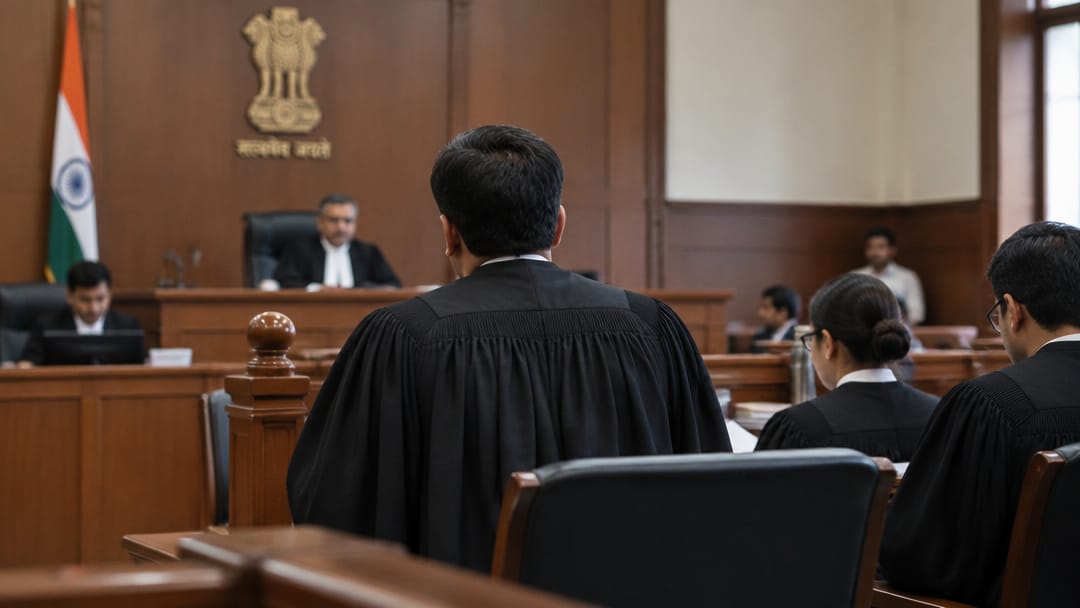
A recent judgment addressed whether advocates appearing in court have a right to seating as part of their professional dignity, weighing it against the constitutional guarantee of equality for all persons before a public court. The court held that seating arrangements for advocates reflect their role as officers of the court, not mere preference. The ruling distinguishes between advocates' functional position in judicial proceedings and the general right of any citizen to access courts.
Why it matters
This judgment engages two overlapping constitutional and professional-law principles. First, Article 14 guarantees equality before law to every person appearing before a court — litigants in person, accused, and advocates alike share the same public forum. Second, the Advocates Act, 1961 and Bar Council rules recognise advocates as officers of the court with specific functional duties: they assist the court, manage pleadings, and bear professional obligations that ordinary litigants do not. The court used this distinction — functional role versus mere presence — to hold that seating for advocates is not a privilege accorded by courtesy but a professional right flowing from their status as officers of the court.
The deeper principle the examiner will probe is whether rights flowing from professional status can coexist with, and even override in limited contexts, the general equality norm. The court's reasoning mirrors the logic seen in contempt jurisdiction and in-court conduct rules: advocates are subject to higher obligations precisely because they occupy a special position. This creates a hierarchy of courtroom entitlements without violating equality — a nuanced point that CLAT PG examiners love to test through passage-based questions requiring the aspirant to identify which statement correctly captures the court's reasoning rather than a popular but imprecise paraphrase.
Delhi HC: earning or married relatives not barred from accident compensation
What happened
The Delhi High Court has ruled that a married daughter, son, spouse, or sibling who earns independently cannot be automatically disqualified from receiving compensation under the Motor Vehicles Act following a fatal accident. The court held that dependency is not determined solely by marital status or income. Each claimant's actual financial and emotional dependence on the deceased must be assessed individually, rejecting a blanket exclusion rule that lower tribunals had applied to earning family members.
Why it matters
This ruling engages a recurring tension in motor accident compensation law: who qualifies as a 'dependent' under the Motor Vehicles Act, 1988? The Act and the structured compensation framework under Sections 163A and 166 do not define dependency exhaustively. Courts have historically imported the concept from fatal accident jurisprudence, where dependency traditionally meant financial reliance on the deceased's income.
The Delhi HC's ruling pushes back against a reductive interpretation that equates earning capacity or marital status with independence from the deceased. The court affirmed that dependency is a composite question — it encompasses not just financial support but also the reasonable expectation of future support, emotional dependency, and the nature of the family relationship.
Constitutionally, this intersects with Article 21 (right to life and livelihood) and Article 14 (equal treatment — no arbitrary class-based exclusion of claimants). The court's reasoning prevents tribunals from applying a shorthand rule that penalises claimants for being economically productive.
For CLAT PG, this judgment matters because it exemplifies how courts interpret 'just compensation' under the MV Act — a subject the examiner has repeatedly tested through passage-based questions requiring applicants to identify what criterion a court used, whether a proposition correctly states the holding, or which category of claimant is covered. The underlying principle — that statutory rights cannot be curtailed by judicially-created categorical exclusions without legislative backing — connects directly to the Article 14 and Article 21 doctrine the exam tests through landmark precedents.
AP tells HC that DGP guidelines ban parading accused; PIL closed
What happened
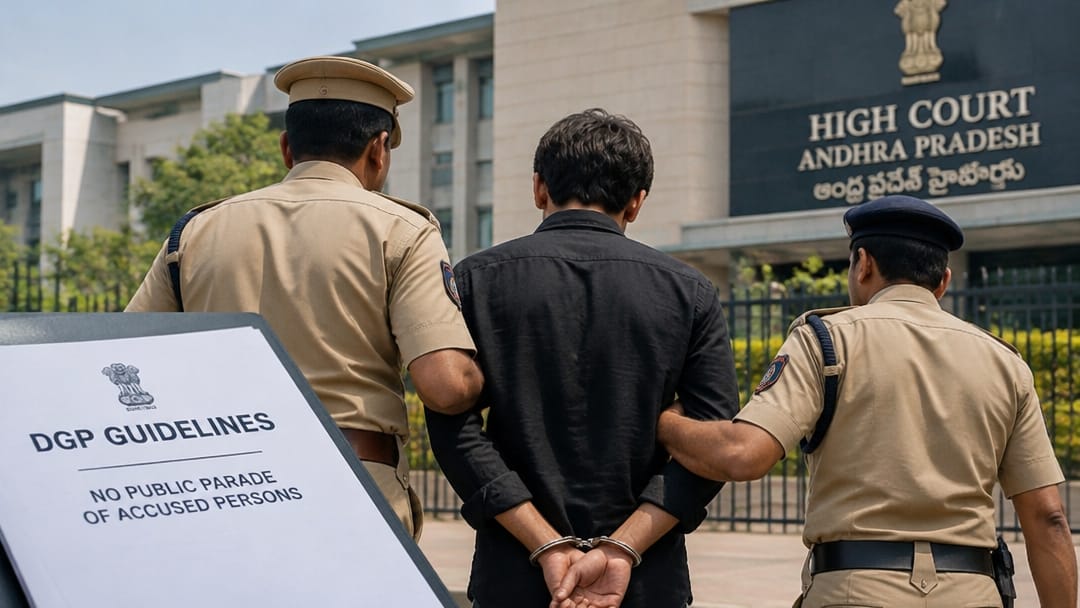
The Andhra Pradesh government informed the High Court that strict DGP-level guidelines already prohibit police from publicly parading accused persons, and that disciplinary action has been taken against violators. Satisfied with the state's submission, the High Court closed the PIL challenging the practice. The case revives attention to the constitutional and custodial rights of accused persons — a core area tested in CLAT PG through landmark Supreme Court precedents on police accountability.
Why it matters
Public parading of accused persons — where police display handcuffed or restrained suspects before media or crowds before conviction — violates multiple constitutional and statutory protections. The Supreme Court has consistently treated this as a breach of Article 21 (right to life and personal dignity), Article 20(3) (protection against self-incrimination), and the presumption of innocence.
The landmark case directly on point is Joginder Kumar v. State of UP (1994), where the Supreme Court laid down strict guidelines on arrest and custody, holding that arrest must not be used as a tool of harassment. The Court emphasised that the power of arrest must be exercised with restraint and that the dignity of the accused cannot be violated during investigation.
D.K. Basu v. State of West Bengal (1997) extended this framework comprehensively, issuing binding guidelines on custodial conduct — including that the accused must not be subjected to degrading treatment. These guidelines were subsequently codified: Section 41B of the CrPC (now mirrored in the BNSS) requires that the arrested person not be subjected to unnecessary restraint or public display.
International law adds another layer: Article 10 of the ICCPR (to which India is a party) mandates humane treatment of detainees. India has signed but not ratified the UN Convention Against Torture (CAT, 1984), a fact specifically tested in CLAT PG 2021.
The AP High Court closing the PIL on the strength of executive guidelines — rather than issuing fresh judicial directions — signals that institutional compliance, when demonstrated, can satisfy constitutional courts. However, the underlying rights remain enforceable independently under Article 32 or Article 226.
Delhi HC raises accident compensation to ₹4.26 cr for victim in coma since 2022
What happened
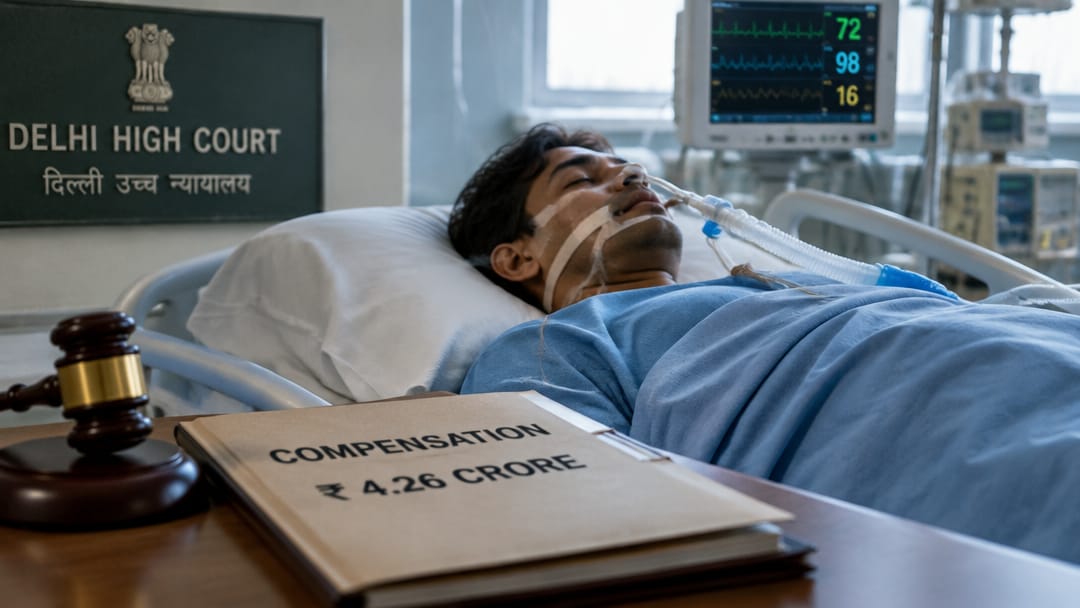
The Delhi High Court enhanced compensation to ₹4.26 crore for a road accident victim who has remained in a vegetative coma since 2022. Relying on the Supreme Court's ruling in Rashmirekha Tripathy v. Sriram General Insurance Co. Ltd., the Court held that average income figures reflected in that judgment must guide compensation calculations. The ruling reinforces how courts assess future earnings, medical expenses, and attendant care costs for victims with permanent, catastrophic injuries under the Motor Vehicles Act.
Why it matters
This case sits at the intersection of Article 21 (right to life and dignity), the Motor Vehicles Act 1988, and the Supreme Court's evolving methodology for computing just compensation in accident claims.
The legal principle the Delhi HC applied flows from Rashmirekha Tripathy v. Sriram General Insurance Co. Ltd. (SC), where the Court held that when a victim's actual income cannot be reliably established, courts must use a notional income benchmark — effectively the average income recognised by the Supreme Court for that category of victim. This prevents tribunals from under-compensating victims merely because documentary proof of earnings is unavailable or contested.
For a victim in a persistent vegetative state, 'just compensation' under Section 168 of the MV Act must account for: (1) loss of future earning capacity (using multiplier method), (2) cost of future medical and attendant care (since the victim needs round-the-clock nursing), (3) pain and suffering, and (4) loss of amenities of life. The catastrophic nature of the injury — coma since 2022 — means the multiplier period is long and attendant care costs are substantial, explaining why the award reached ₹4.26 crore.
Constitutionally, the Supreme Court has repeatedly held (Sarla Verma v. DTC, National Insurance Co. v. Pranay Sethi) that compensation must be 'just' and not 'niggardly,' anchoring the right to fair compensation in Article 21's guarantee of dignified life. CLAT PG examiners test whether aspirants can identify the correct precedent chain, the components of compensation, and how notional income is applied.
Karnataka HC upholds SFIO complaint against Razorpay founders under Section 212
What happened
The Karnataka High Court dismissed a petition by Razorpay co-founders Harshil Mathur and Shashank Kumar seeking to quash an SFIO complaint filed against them. The case is linked to alleged corporate fraud investigated by the Serious Fraud Investigation Office under Section 212 of the Companies Act, 2013. The HC refused to interfere with the SFIO proceedings, affirming the agency's statutory authority to investigate and file complaints against company directors and officers.
Why it matters
This case spotlights the Serious Fraud Investigation Office (SFIO) — a multi-disciplinary body under the Ministry of Corporate Affairs established under Section 211 of the Companies Act, 2013. Its investigative powers are governed by Section 212, which authorises the Central Government to order an SFIO investigation when fraud is suspected in a company's affairs.
Key features of Section 212 that CLAT PG tests:
1. TRIGGER: The Central Government may order SFIO investigation on receipt of a report from the Registrar or inspector, or on intimation from any court, or in public interest.
2. EXCLUSIVITY: Once SFIO takes up investigation, no other agency (police, ROC) can investigate the same matter without SFIO's prior permission.
3. DIRECTOR LIABILITY: Section 212(6) creates a presumption of guilt — if an officer or director is arrested by SFIO, bail is granted only if the court is satisfied that the accused is not guilty and will not commit any offence while on bail (conditions mirroring PMLA).
4. COGNIZABLE AND NON-BAILABLE: Offences investigated by SFIO under Section 212(6) are cognizable and non-bailable.
5. SFIO report as complaint: Under Section 212(14), the SFIO investigation report filed with the court is deemed to be a police report under Section 173 CrPC (now BNSS).
The Razorpay case affirms that High Courts will not ordinarily interfere with SFIO proceedings at the complaint stage, reinforcing SFIO's autonomous investigative authority.