RBI issues fresh money market circulars, updating LAF and liquidity norms
What happened
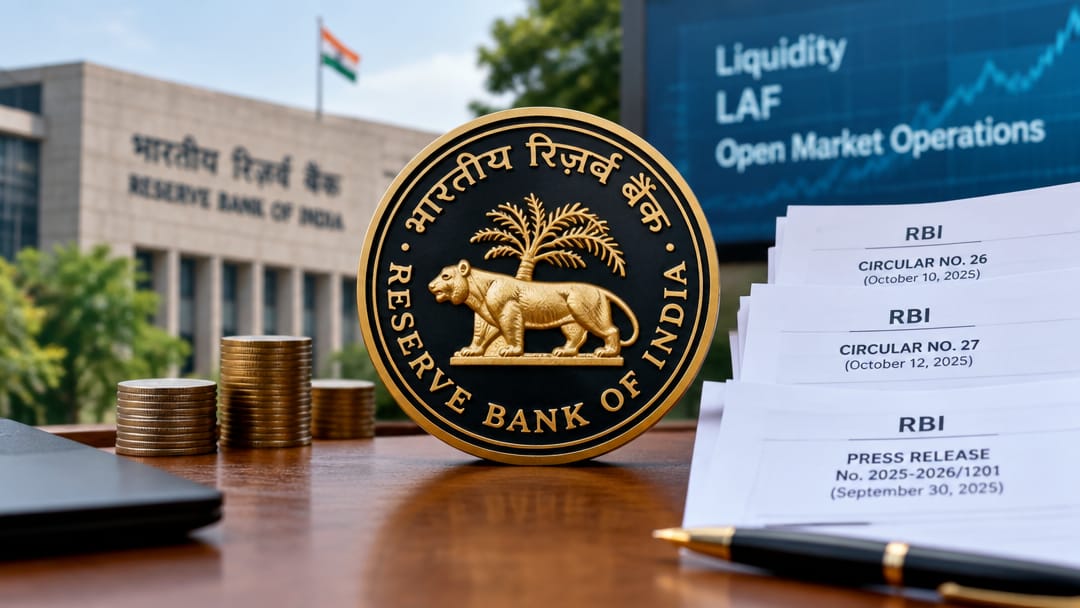
The Reserve Bank of India issued Press Release No. 2025-2026/1201 on September 30, 2025, followed by Circular No. 26 and Circular No. 27 on October 10 and October 12, 2025 respectively, updating money market operations. These circulars govern the Liquidity Adjustment Facility corridor, open market operations, and related instruments through which RBI manages short-term liquidity and transmits monetary policy signals to the broader financial system.
Why it matters
Money market operations are the primary channel through which the RBI's Monetary Policy Committee decisions reach the real economy. The LAF corridor — bounded by the Standing Deposit Facility rate at the floor and the Marginal Standing Facility rate at the ceiling — keeps the weighted average call money rate anchored near the repo rate, which is the policy rate.
When RBI conducts Variable Rate Repo (VRR) auctions, it injects liquidity; Variable Rate Reverse Repo (VRRR) absorbs it. The width of the corridor signals how tightly the RBI wishes to control overnight rates. A narrower corridor (symmetric ±25 bps) indicates precision inflation targeting; a wider corridor gives banks more flexibility but weakens transmission.
Circulars such as these update operational details — eligible collateral, auction timings, cut-off yields, and participation norms — that determine how effectively rate changes pass through to bank lending rates and, ultimately, to credit growth and inflation. For aspirants, the key linkage is: MPC sets repo rate → LAF corridor operationalises it → call money rates align → MCLR adjusts → loan rates change → investment and consumption respond → output and inflation adjust. Every circular that modifies these mechanics is an exam-relevant data point because RBI Grade B questions routinely blank out exact rates, dates, and circular numbers.
e-NWR loans: farmers can borrow at 7% against stored crops using KCC
What happened
Farmers storing crops in WDRA-registered warehouses can obtain loans against electronic Negotiable Warehouse Receipts (e-NWRs). Under the Kisan Credit Card scheme, post-harvest loans up to ₹3 lakh attract a 7 per cent interest rate for the first six months, with a 3 per cent interest subvention from the government. The e-NWR, issued digitally on the NERL platform, serves as collateral, allowing farmers to avoid distress selling while waiting for better market prices.
Why it matters
The e-NWR (electronic Negotiable Warehouse Receipt) system is a post-harvest credit mechanism regulated by the Warehousing Development and Regulatory Authority (WDRA) under the Warehousing (Development and Regulation) Act, 2007. When a farmer deposits produce in a WDRA-accredited warehouse, the warehouse issues an e-NWR through the National Electronic Repository Limited (NERL) platform. This digital receipt is legally negotiable — it can be pledged with banks as collateral to obtain loans without physically moving the crop.
The policy problem it solves: Indian farmers have historically been forced into distress selling immediately after harvest when prices are lowest, because they need cash to repay loans and fund the next crop cycle. The e-NWR system decouples the need for cash from the need to sell, giving farmers the holding power to wait for better prices.
The credit delivery mechanism connects to two major schemes: (1) the Kisan Credit Card (KCC), under which post-harvest loans up to ₹3 lakh are classified as short-term agricultural credit and qualify for interest subvention — the government pays 2% subvention and an additional 3% prompt repayment incentive, bringing the effective rate to 4% for timely repayers; and (2) Priority Sector Lending (PSL) guidelines, under which e-NWR-backed loans count as agricultural credit. NABARD plays a key role in refinancing such credit through cooperative banks and RRBs. The system directly supports financial inclusion by extending formal credit to small and marginal farmers who may lack traditional collateral like land titles.
Green finance in India: how capital flows are being redirected toward climate goals
What happened
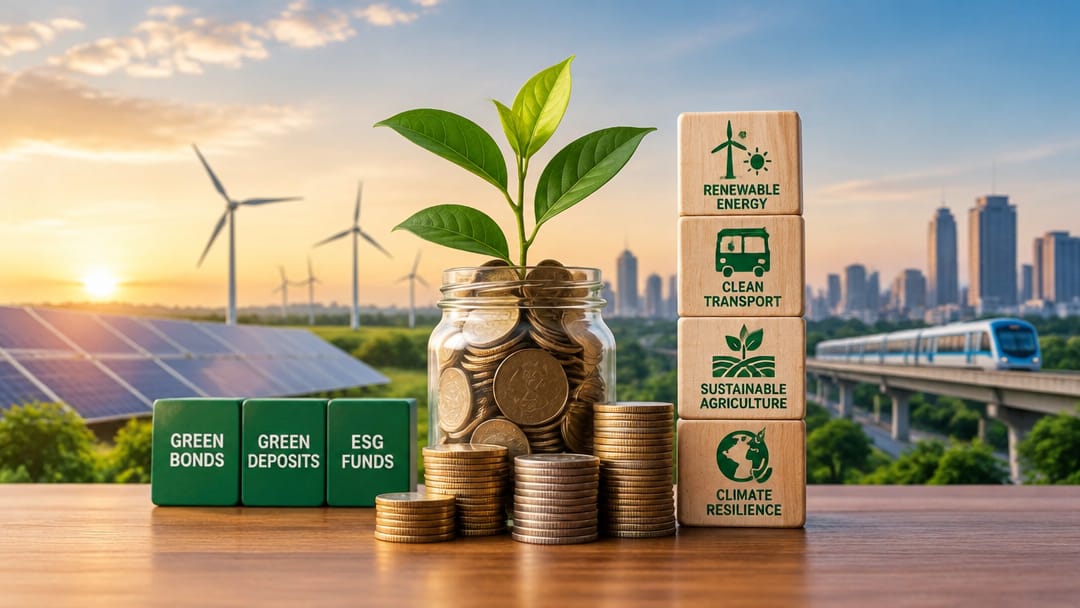
Green finance channels capital into projects that deliver environmental benefits — renewable energy, clean transport, sustainable agriculture, and climate resilience. In India, instruments such as green bonds, green deposits, and ESG funds are growing, supported by SEBI's green bond framework and RBI's sustainable finance guidelines. India's NDC targets and its net-zero commitment by 2070 require an estimated $2.5 trillion in climate investment by 2030, making private green finance indispensable alongside public spending.
Why it matters
Green finance is not a single instrument but an ecosystem of mechanisms that price environmental risk into capital allocation decisions. It operates across three layers.
First, instruments: Green bonds raise debt for specific environmental projects, with proceeds ring-fenced and independently verified. Sustainability-linked bonds tie borrowing costs to ESG targets. Green deposits allow banks to lend retail savings to green projects. India's sovereign green bond programme, launched in 2022-23, raised ₹16,000 crore in its first tranche.
Second, regulators: SEBI mandates Business Responsibility and Sustainability Reporting (BRSR) for the top 1,000 listed companies and has issued a framework for green debt securities. RBI issued its Sustainable Finance Framework for its own balance sheet and has been integrating climate risk into banking supervision through its Discussion Paper on Climate Risk (2023). NABARD operates the National Adaptation Fund for Climate Change (NAFCC) and channels green credit to rural and agricultural sectors.
Third, the global architecture: Green finance is anchored in the Paris Agreement's Article 2.1(c), which calls for making finance flows consistent with low-carbon, climate-resilient development. The Green Climate Fund (GCF) and Global Environment Facility (GEF) are multilateral instruments that co-finance India's climate projects. India's NDC, updated in 2022, targets 50% cumulative electric power from non-fossil sources by 2030 — a commitment that makes green finance a policy imperative, not just a market preference.
Fuel prices and macro conditions shape the energy mix — and banking risk
What happened
A research study finds that fuel prices and macroeconomic variables such as GDP growth and inflation jointly influence electricity demand, the share of renewables versus fossil fuels in the generation mix, and corporate financial risk in the energy sector. As economies transition away from fossil fuels, these linkages create transmission channels through which energy-sector volatility can affect bank balance sheets, green finance flows, and sovereign climate commitments including India's NDC targets.
Why it matters
This study sits at the intersection of energy economics and financial stability — a nexus that is increasingly central to exam syllabi for RBI Grade B and UPSC CSE.
**The core mechanism:** Fuel price shocks (oil, coal, gas) alter the relative cost of thermal versus renewable electricity generation. When fossil fuel prices spike, renewables become comparatively cheaper, accelerating the transition. When macro conditions deteriorate (recession, high inflation), electricity demand falls and investment in new capacity — especially capital-intensive solar and wind — contracts. This creates a feedback loop where macroeconomic instability delays decarbonisation.
**Why this matters for banking:** Energy companies carry stranded-asset risk (fossil-fuel plants that become uneconomical before their useful life ends) and transition risk (regulatory changes repricing carbon-intensive assets). These risks migrate onto bank balance sheets through loans and bonds. The RBI's 2023 Report on Currency and Finance flagged climate-related financial risk as a systemic concern, and its discussion paper on climate risk disclosure (2024) asked banks to begin scenario analysis.
**India-specific linkage:** India's NDC commits to 500 GW of non-fossil electricity capacity by 2030 and net-zero by 2070. NABARD's Climate Change Fund and the RBI's priority-sector lending guidelines for renewable energy are the institutional channels through which this transition is financed. Fuel-price volatility — especially coal price swings — directly affects the viability of this transition financing.
**Green finance instruments:** Green bonds, sustainability-linked loans, and the RBI's green deposit framework (2023) are designed to channel capital toward the energy transition while managing the macro-financial risks the study identifies.
DFS reviews PMJDY and allied financial inclusion schemes' progress
What happened
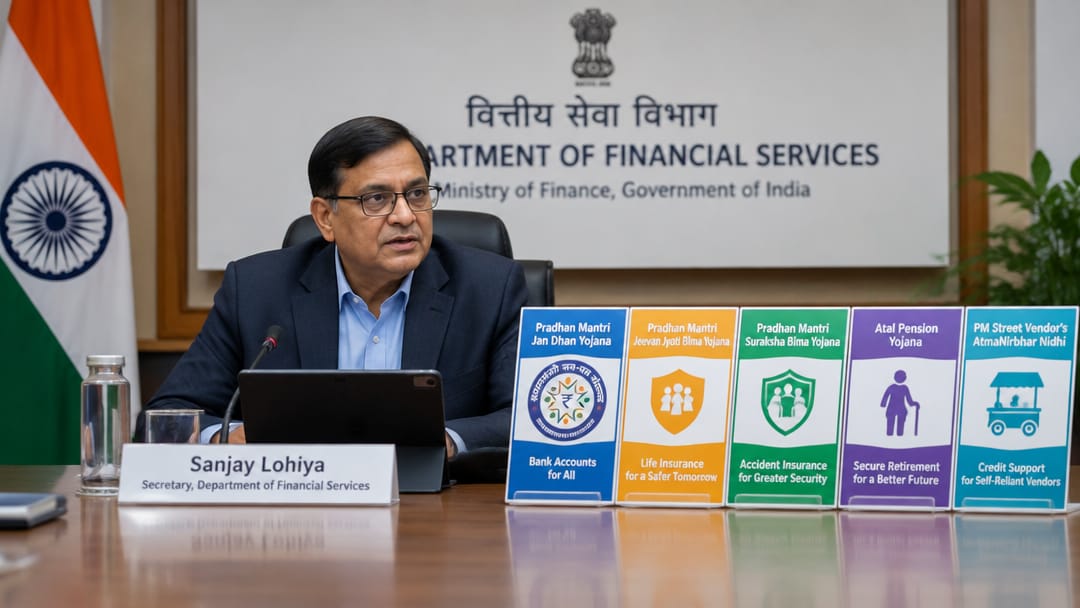
Department of Financial Services Secretary Sanjay Lohiya chaired a review meeting on Financial Inclusion schemes including Pradhan Mantri Jan Dhan Yojana, Pradhan Mantri Jeevan Jyoti Bima Yojana, Pradhan Mantri Suraksha Bima Yojana, Atal Pension Yojana, and PM Street Vendor's AtmaNirbhar Nidhi. The meeting assessed scheme-level progress and saturation targets. These five schemes collectively form India's core financial inclusion architecture, linking bank accounts, micro-insurance, pension, and credit access for underserved populations.
Why it matters
India's financial inclusion architecture rests on five interlocking schemes launched between 2014 and 2015 under the Jan Dhan–Aadhaar–Mobile (JAM) trinity framework. Each scheme targets a specific gap in the financial security chain.
PMJDY (2014) is the foundation: it provides zero-balance savings accounts with a RuPay debit card, a ₹10,000 overdraft facility, and ₹2 lakh accidental insurance. Over 53 crore accounts have been opened as of recent data, with more than 55% held by women.
PM Jeevan Jyoti Bima Yojana (PMJJBY) offers renewable life insurance of ₹2 lakh for a premium of ₹436 per year (revised), targeting working-age adults aged 18–50 with bank accounts.
PM Suraksha Bima Yojana (PMSBY) provides accidental death and disability cover of ₹2 lakh for just ₹20 per year (revised to ₹20 per annum), for ages 18–70.
Atal Pension Yojana (APY) addresses old-age income security for unorganised sector workers aged 18–40, with guaranteed monthly pensions of ₹1,000–₹5,000 depending on contribution and entry age. NPS Trust administers it; PFRDA regulates it.
PM SVANidhi provides collateral-free working capital loans of ₹10,000 (first tranche), ₹20,000, and ₹50,000 to street vendors, with an interest subsidy of 7%.
For RBI and NABARD aspirants, understanding how these schemes connect to priority sector lending, SLBC monitoring, and Jan Dhan accounts as conduits for Direct Benefit Transfers is critical. The DFS review signals active saturation monitoring — a recurring exam angle.
NSKFDC: concessional loans for manual scavengers and safai karamcharis
What happened
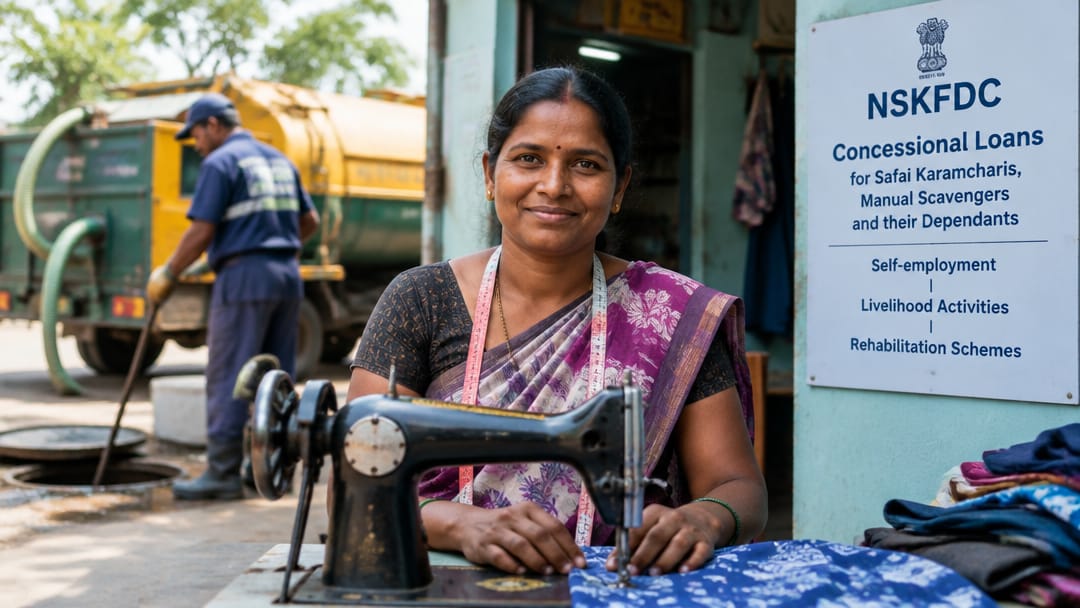
The National Safai Karamcharis Finance and Development Corporation (NSKFDC) provides concessional-rate loans to safai karamcharis, manual scavengers, and their dependants for self-employment and livelihood activities. Operating under the Ministry of Social Justice and Empowerment, it channels funds through State Channelising Agencies and scheduled commercial banks. The corporation also administers rehabilitation schemes for manual scavengers, aiming to transition them out of hazardous sanitation work into sustainable economic activities.
Why it matters
NSKFDC was established in 1997 as a not-for-profit company under Section 25 of the Companies Act, 1956 (now Section 8 under Companies Act 2013), with its registered office in New Delhi. It functions under the administrative control of the Ministry of Social Justice and Empowerment.
Its core mandate is threefold: (1) financial assistance through concessional loans for income-generating activities, (2) skill development training, and (3) implementation of rehabilitation programmes for manual scavengers under the Self Employment Scheme for Rehabilitation of Manual Scavengers (SRMS).
Under its loan schemes, NSKFDC provides term loans at interest rates as low as 5% per annum — significantly below commercial bank rates — channelled through State Channelising Agencies (SCAs) and Regional Rural Banks (RRBs). The eligible beneficiary pool includes safai karamcharis, manual scavengers, and their family dependants whose annual family income does not exceed a prescribed ceiling.
The SRMS scheme is particularly significant: it provides a one-time cash assistance of ₹40,000 and concessional loans up to ₹15 lakh for identified manual scavengers to pursue alternative livelihoods. This directly connects to India's legislative commitment under the Prohibition of Employment as Manual Scavengers and their Rehabilitation Act, 2013.
For RBI aspirants, NSKFDC's credit delivery through SCAs and RRBs is a priority-sector-adjacent mechanism. For NABARD aspirants, its rural credit channel and livelihood promotion are core. For UPSC aspirants, the scheme represents the welfare-to-rights continuum in social justice policy.
Green Skills Passport: skilling youth for sustainability jobs
What happened
The Green Skills Passport is an EY-led initiative designed to equip youth and underserved communities with sustainability awareness and entrepreneurial competencies needed to access green jobs. It bridges the gap between conventional vocational training and the emerging green economy by offering structured learning pathways. The programme targets populations often excluded from formal skill ecosystems, aiming to make sustainability-linked livelihoods accessible. It aligns with global efforts to build a just transition workforce as economies shift toward low-carbon development models.
Why it matters
The Green Skills Passport sits at the intersection of skilling policy, green economy transition, and social inclusion — three themes that Indian competitive exams increasingly test together.
A 'green job' is defined by the International Labour Organization (ILO) as decent work that contributes to preserving or restoring the environment. India's push toward net-zero by 2070 and its National Green Hydrogen Mission, PM Surya Ghar, and Panchamrit commitments create structural demand for a workforce skilled in renewable energy, sustainable agriculture, waste management, eco-tourism, and climate-resilient infrastructure.
The Green Skills Passport model addresses a known market failure: green sectors are growing, but the labour supply lacks matching credentials. By targeting youth and underserved communities — groups that face barriers to formal education — it also serves a financial inclusion and social equity function relevant to NABARD and RBI syllabi.
For NABARD aspirants, the rural angle is critical: green agriculture, agroforestry, and climate-smart farming are green job categories where rural skilling programmes intersect with priority sector lending and livelihood finance. For RBI aspirants, green finance — green bonds, climate risk in bank lending, ESG disclosures — is the adjacent testable concept. For UPSC aspirants, this connects to India's Nationally Determined Contributions (NDCs), just transition policy, and schemes like PMKVY 4.0, which introduced a green skills component in its latest iteration.