SC: transfer under Indo-UK prisoner treaty does not bar remission rights in India
What happened
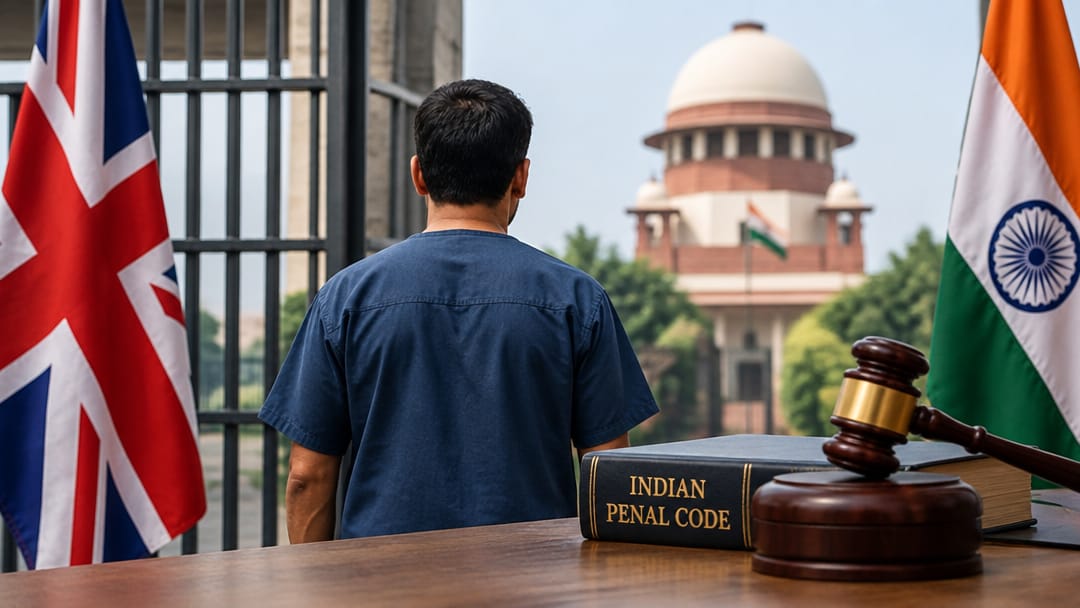
The Supreme Court has ruled that a prisoner transferred from the United Kingdom to India under the Indo-UK prisoner transfer agreement retains the right to seek remission of sentence under Indian law. The court held that transfer under a bilateral treaty does not extinguish the prisoner's entitlement to apply for remission as available to any other prisoner serving sentence in India, affirming that Indian penal provisions apply after transfer.
Why it matters
This ruling sits at the intersection of two important legal regimes: bilateral prisoner transfer agreements and domestic sentencing law.
India has entered into prisoner transfer agreements with several countries, including the UK. These agreements allow a convicted person to serve their sentence in their home country. The legal question the Supreme Court addressed is: once a prisoner is transferred under such a treaty, does the receiving state's full domestic legal framework — including remission — apply?
The Court answered yes. Remission is the reduction of a sentence by the competent authority (typically the State Government under Section 432 of the CrPC / Section 473 of the BNSS). It is a statutory right available to all prisoners serving sentences in India. The SC held that a transferred prisoner cannot be treated as a separate class who is denied this right merely because their original conviction arose abroad.
This matters for extradition law because it clarifies that extradition/transfer does not create a 'lesser prisoner' category. The treaty governs the transfer; Indian law governs the execution of the sentence thereafter.
For CLAT PG, the examiner tests the distinction between extradition (surrender for trial) and prisoner transfer (transfer to serve sentence already imposed), and which domestic rights survive or are extinguished upon transfer — this ruling answers the latter definitively.
P&H HC upholds MACT award for advocate's family, treating bar experience as income proof
What happened
The Punjab and Haryana High Court upheld a Motor Accident Claims Tribunal award to the family of a deceased advocate, holding that experience at the bar is a legitimate basis for estimating income even without documentary proof. The court relied on the Supreme Court's July 1, 2026 ruling in Rashmirekha Tripathy, which distinguishes self-employed professionals from salaried persons, allowing courts to reasonably estimate earnings based on professional standing and years of practice.
Why it matters
This ruling sits at the intersection of tort law compensation and constitutional property rights under Article 21 (right to life, which includes livelihood) and Article 300A (right to property). The core legal principle is that just compensation in motor accident claims cannot be denied merely because a self-employed professional lacks salary slips or income-tax returns. Courts must apply a 'reasonable estimate' standard for professionals like advocates, doctors, or architects whose income is inherently variable and often undocumented.
The Rashmirekha Tripathy precedent (SC, July 1, 2026) creates a formal doctrinal distinction between two classes: salaried employees (whose income is verifiable through payslips and Form 16) and self-employed professionals (whose income must be inferred from circumstantial evidence — years of practice, reputation, type of clientele, court appearances). For the second class, experience at the bar becomes evidence of earning capacity.
For CLAT PG purposes, this engages the 'fair hearing and reasoned determination' principle under natural justice — a tribunal cannot arbitrarily discount income without applying a rational methodology. It also engages the principle that deprivation of compensation for loss of life and livelihood must meet the proportionality standard embedded in Articles 21 and 300A. The examiner can use this passage to test whether a student can identify which class of claimant gets which evidentiary standard, and whether denial of compensation without reasoned methodology violates any fundamental right.
SC upholds Vedanta's right to enforce foreign arbitral awards, rebukes Centre's resistance
What happened
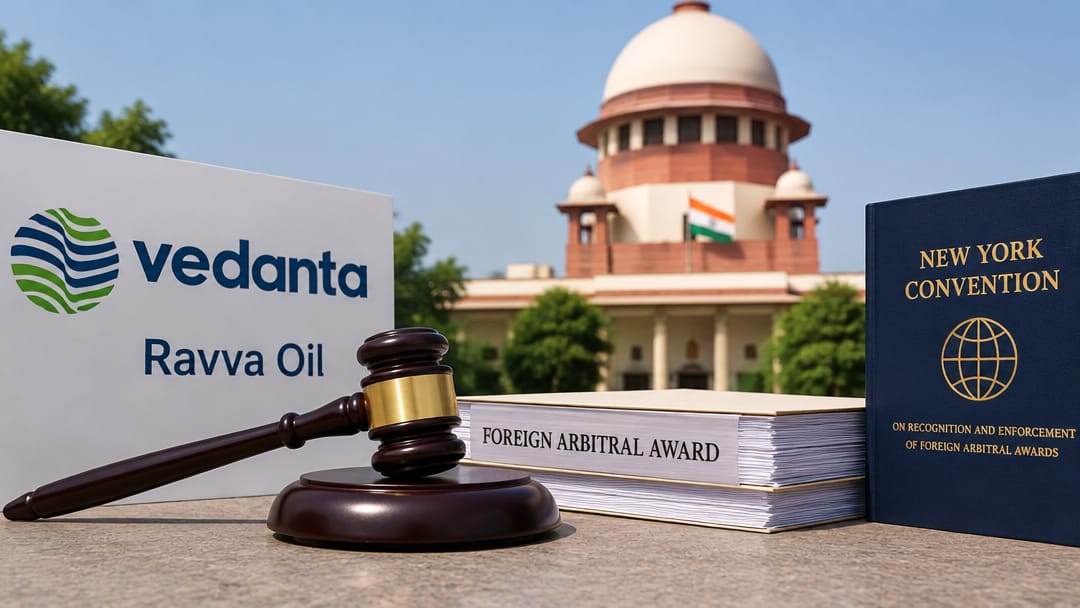
The Supreme Court dismissed the Centre's appeal against a Delhi High Court order allowing Vedanta and Ravva Oil to enforce foreign arbitral awards against India. The Court criticised the government for resisting enforcement of awards that India is bound to honour under international treaty obligations. The ruling reinforces that Indian courts must enforce foreign arbitral awards under the New York Convention unless narrow statutory exceptions under the Arbitration and Conciliation Act apply.
Why it matters
This ruling sits at the intersection of international commercial arbitration and India's treaty obligations. Foreign arbitral awards are enforceable in India under Part II of the Arbitration and Conciliation Act, 1996, which implements the New York Convention on the Recognition and Enforcement of Foreign Arbitral Awards (1958). India acceded to the Convention with two reservations: reciprocity (only Convention-country awards) and commerciality (only commercial disputes).
Enforcement can be refused only on narrow grounds listed in Section 48 of the Act — such as incapacity, lack of proper notice, award beyond scope, or violation of public policy. Indian courts have progressively narrowed the 'public policy' ground, most notably after the 2015 amendment which reversed the expansive Saw Pipes standard.
What makes this ruling significant is the Supreme Court's explicit rebuke of the government's posture. When the sovereign itself resists enforcement, it signals bad faith to foreign investors and contradicts India's stated goal of becoming an arbitration-friendly jurisdiction. The Court's language — that India is 'bound to honour' these awards — affirms the limited supervisory role of domestic courts in international arbitration and forecloses re-litigation of merits under the guise of enforcement objections. For CLAT PG, the key doctrinal points are: grounds for refusing enforcement under Section 48, the public policy standard post-2015, and the New York Convention's role.
SC censures IPS officer for illegal detention, then expunges HC's adverse remarks
What happened
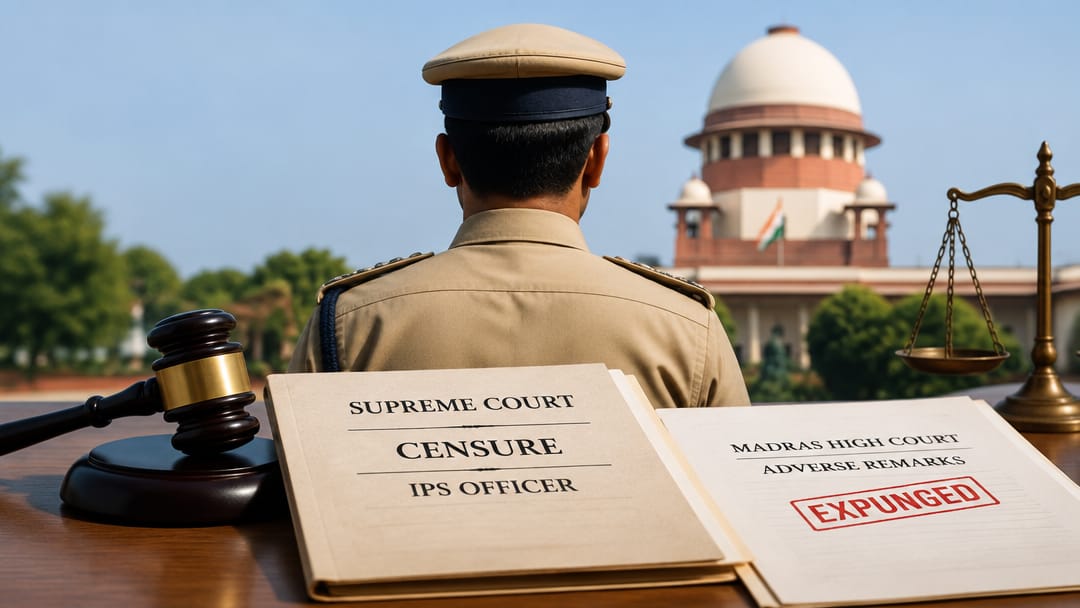
The Supreme Court on November 2 accepted the unconditional apology of Tamil Nadu IPS officer A. Arun, who had passed an erroneous preventive detention order, and issued a formal censure against him. Simultaneously, the Court expunged adverse remarks recorded against the officer by the Madras High Court. The ruling balances accountability for illegal detention under personal liberty guarantees with judicial mercy where genuine remorse is shown, making it a significant Article 21 precedent.
Why it matters
This ruling sits at the intersection of Article 21 (right to personal liberty), preventive detention law, and the supervisory power of constitutional courts over executive officers.
Preventive detention is a constitutionally recognized exception to personal liberty under Articles 22(3)–22(7). It allows the State to detain a person without trial, but this power is hedged with strict safeguards: the detaining authority must be the correct authority, the grounds must be communicated within five days (extendable to ten), and the detention must be reviewed by an Advisory Board within seven weeks. A senior IPS officer is a 'detaining authority' in many State detention statutes (e.g., the Tamil Nadu Prevention of Dangerous Activities Act). When such an officer passes a detention order that is legally unsustainable — whether for want of jurisdiction, non-application of mind, or procedural error — the High Court and Supreme Court can not only quash the order but also record adverse remarks against the officer.
The Supreme Court's decision to censure but simultaneously expunge the High Court's adverse remarks reflects a two-part constitutional principle: (1) accountability — a public official who curtails personal liberty without lawful authority cannot escape judicial notice; (2) proportionality — once genuine remorse and an unconditional apology are tendered, the court exercises mercy to ensure the punishment is not disproportionate to the wrong. This proportionality review itself echoes the 'just, fair, and reasonable' standard the Court applies under Article 21. The ruling also illustrates the Supreme Court's corrective jurisdiction under Article 136 to modify High Court observations that may be excessive.