01 Read
What happened
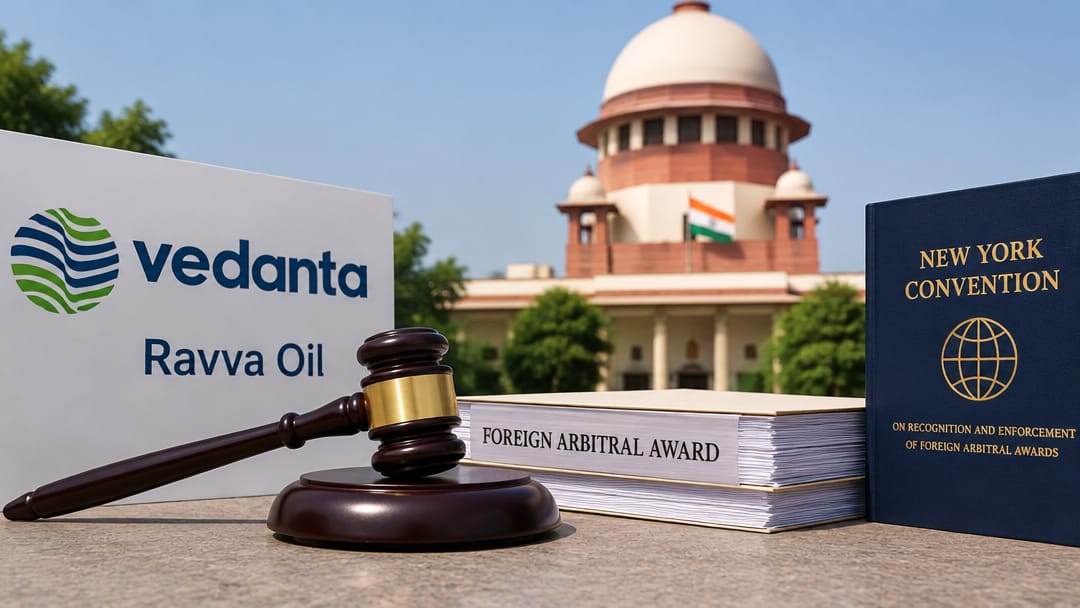
The Supreme Court dismissed the Centre's appeal against a Delhi High Court order allowing Vedanta and Ravva Oil to enforce foreign arbitral awards against India. The Court criticised the government for resisting enforcement of awards that India is bound to honour under international treaty obligations. The ruling reinforces that Indian courts must enforce foreign arbitral awards under the New York Convention unless narrow statutory exceptions under the Arbitration and Conciliation Act apply.
02 Understand
Why it matters
This ruling sits at the intersection of international commercial arbitration and India's treaty obligations. Foreign arbitral awards are enforceable in India under Part II of the Arbitration and Conciliation Act, 1996, which implements the New York Convention on the Recognition and Enforcement of Foreign Arbitral Awards (1958). India acceded to the Convention with two reservations: reciprocity (only Convention-country awards) and commerciality (only commercial disputes).
Enforcement can be refused only on narrow grounds listed in Section 48 of the Act — such as incapacity, lack of proper notice, award beyond scope, or violation of public policy. Indian courts have progressively narrowed the 'public policy' ground, most notably after the 2015 amendment which reversed the expansive Saw Pipes standard.
What makes this ruling significant is the Supreme Court's explicit rebuke of the government's posture. When the sovereign itself resists enforcement, it signals bad faith to foreign investors and contradicts India's stated goal of becoming an arbitration-friendly jurisdiction. The Court's language — that India is 'bound to honour' these awards — affirms the limited supervisory role of domestic courts in international arbitration and forecloses re-litigation of merits under the guise of enforcement objections. For CLAT PG, the key doctrinal points are: grounds for refusing enforcement under Section 48, the public policy standard post-2015, and the New York Convention's role.
Remember + Why it matters
The key recall facts and exact examiner angle for CLAT PG are in the Crux app.
01
Key figure and date from this topic
02
Specific number or threshold to remember
03
Policy or regulatory implication
Read + Understand free forever · 30-day free trial