SEBI urges government to scrap LTCG tax on foreign investors ahead of Union Budget
What happened
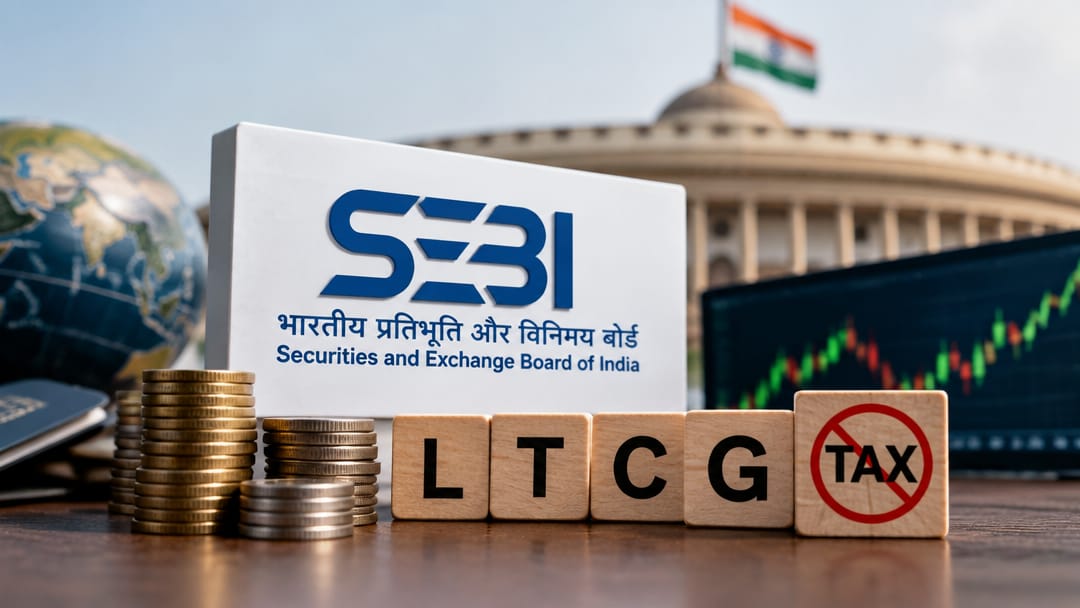
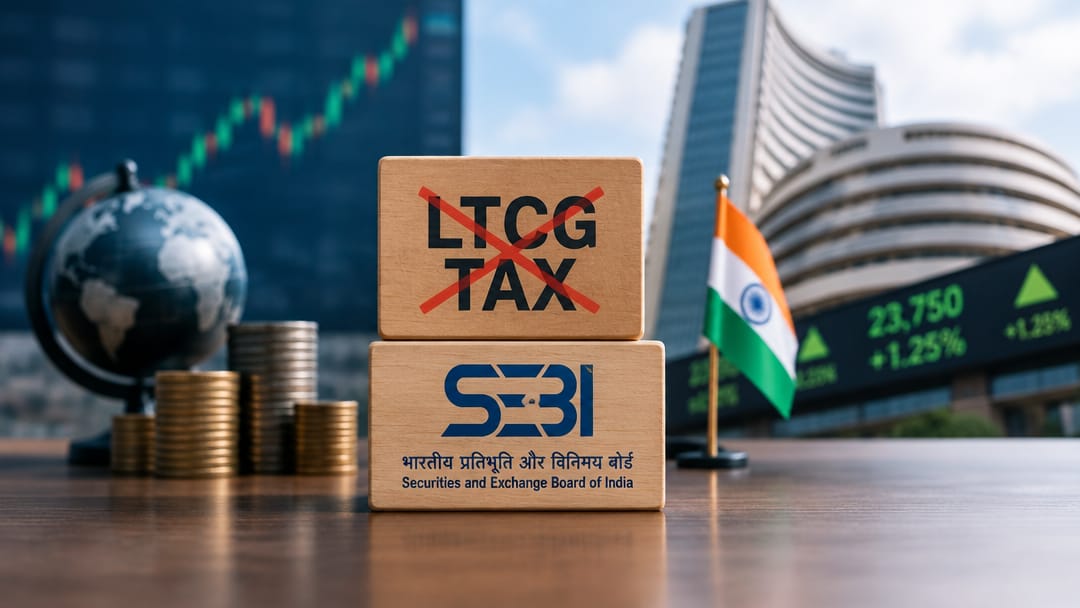
SEBI has recommended that the government remove the 12.5% long-term capital gains tax levied on foreign investors in Indian equities, according to two sources. The regulator also proposed that domestic mutual fund investors switching between schemes after holding units for over a year should not face a taxable event. The pre-budget recommendations are non-binding. Foreign investors have sold a record $31 billion in Indian stocks this year as the Nifty 50 has underperformed emerging market peers.
Why it matters
Long-term capital gains (LTCG) tax is levied on profits from selling assets held beyond a specified period. In India, securities held for more than one year attract LTCG tax at 12.5%, while short-term capital gains (STCG) on securities held under a year are taxed at 20%. Foreign Portfolio Investors (FPIs) also pay Securities Transaction Tax (STT) and withholding taxes on dividends, making India's transaction cost structure among the highest globally.
SEBI's recommendation is significant because it exposes a structural tension: the regulator's mandate is market development, but tax policy rests entirely with the Finance Ministry. SEBI's pre-budget representations are advisory and non-binding — the government retains final authority.
The proposal for mutual fund switchers addresses a behavioural barrier: investors who want to rebalance portfolios are currently taxed on notional gains when switching schemes, discouraging active portfolio management. Exempting switches (after one-year holding) from LTCG would treat intra-mutual-fund movement as a continuation of investment rather than a disposal.
The backdrop matters: the Nifty 50 has fallen 4.8% over two years while the MSCI Emerging Market index rose 40%. FPI outflows of $31 billion are a record. India's mutual fund AUM stands at ₹82.6 trillion, with ₹30 billion flowing in monthly via SIPs. SEBI's move is part of a broader effort to reduce the cost of capital for equity markets and retain foreign capital.
SEBI creates depositary receipt route for foreign investors to access REITs and InvITs
What happened
SEBI issued a depositary receipts framework on November 2, 2026, allowing foreign investors to purchase units of Real Estate Investment Trusts and Infrastructure Investment Trusts through depositary receipts listed abroad. The move extends the existing depositary receipt mechanism — previously available for equity shares — to REIT and InvIT units, broadening the investor base for these instruments and deepening India's capital markets by channelling foreign capital into real estate and infrastructure sectors.
Why it matters
Depositary receipts (DRs) are negotiable financial instruments issued by a foreign depositary bank representing ownership of a specified number of underlying securities held in the home country. Indian companies have long used American Depositary Receipts (ADRs) and Global Depositary Receipts (GDRs) to raise foreign capital. SEBI's new framework now extends this mechanism to REITs and InvITs.
REITs pool capital to own income-generating real estate (offices, malls, warehouses) and distribute at least 90% of net distributable cash flows to unit-holders. InvITs do the same for infrastructure assets — roads, power lines, pipelines. Both trade on Indian stock exchanges and are regulated by SEBI.
The DR route matters because many foreign institutional investors face regulatory or mandate-based restrictions on directly investing in Indian markets. By buying DRs on a foreign exchange, they gain economic exposure to REIT/InvIT units without navigating direct FPI registration. For India, this widens the capital pool available to fund real estate and infrastructure projects — both priority sectors — without repatriating equity control.
For exam purposes, the key distinction is that DRs are not the underlying instrument; they are certificates representing the underlying units held by a custodian in India. The DR holder's rights (dividends, distributions) flow through the depositary arrangement. SEBI is the primary regulator for both the underlying REITs/InvITs and the DR framework in India.
SEBI recommends scrapping LTCG tax on foreign investors to stem outflows
What happened
SEBI has recommended that the government eliminate the long-term capital gains tax levied on foreign institutional investors, according to a Reuters report. The proposal aims to make Indian equity markets more attractive to overseas capital. However, market experts caution that tax relief alone is insufficient to reverse sustained FII outflows, pointing to broader structural factors including global risk appetite, dollar strength, and concerns about India's earnings growth trajectory as equally decisive determinants.
Why it matters
Long-term capital gains (LTCG) tax on equities was reintroduced in India through the Union Budget 2018, imposing a 10% tax on gains exceeding ₹1 lakh from listed equity shares held for more than one year. Prior to 2018, such gains were fully exempt. The Finance Act 2024 revised the LTCG rate upward to 12.5%, removing the earlier indexation benefit for certain asset classes.
Foreign Institutional Investors (FIIs) and Foreign Portfolio Investors (FPIs) are particularly sensitive to tax treatment because they compare after-tax returns across competing emerging markets. When India raised or maintained LTCG, it reduced India's relative attractiveness compared to jurisdictions with no such levy.
SEBI's role here is notable: as the capital markets regulator, SEBI does not set tax policy — that is the Finance Ministry's domain — but it can make formal recommendations to the government, particularly when tax structures affect market depth and liquidity. This is an example of SEBI exercising its advisory function rather than its regulatory or enforcement function.
Experts who disagree with the sufficiency of tax cuts point to non-tax drivers of FII behaviour: US Federal Reserve rate expectations, the strength of the US dollar, relative valuations, and India-specific earnings disappointments. This debate — structural vs. tax-driven outflows — is a classic exam theme connecting capital market regulation to macroeconomic policy.
Green finance alone cannot close the SDG funding gap without technology
What happened
Researchers argue that closing the global sustainable-development financing gap requires green finance and technological innovation to operate as complementary pillars, not independent streams. Green bonds, climate funds, and ESG-linked lending must be paired with clean-tech deployment to deliver measurable emissions reductions. The study highlights that without technological absorptive capacity, financial flows fail to translate into real-economy decarbonisation outcomes, making the finance-technology nexus central to meeting Paris Agreement and SDG targets.
Why it matters
Green finance refers to financial instruments and frameworks specifically designed to fund environmentally sustainable projects — including green bonds, sustainability-linked loans, climate investment funds, and central bank green asset-purchase programmes. India's ecosystem includes the RBI's green deposit framework, SEBI's green bond disclosure norms, and NABARD's climate-linked refinancing for agriculture.
The core argument of the research is that capital alone is insufficient. Technological innovation — clean energy, precision agriculture, carbon capture, climate-resilient infrastructure — is what converts financial flows into actual emissions reductions. Without absorptive technological capacity, money pools in low-risk, low-impact projects (so-called 'greenwashing').
For India, this nexus matters across three levels. At the sovereign level, India's NDC targets (45% emissions intensity reduction by 2030, 500 GW non-fossil capacity) require simultaneous scaling of green capital and clean technology. At the institutional level, RBI's climate risk framework and SEBI's BRSR (Business Responsibility and Sustainability Reporting) push banks and listed companies to disclose how finance is linked to real-economy decarbonisation. At the development-finance level, NABARD's climate bonds and watershed programmes must demonstrate technology-linked outcomes, not just disbursement figures.
The SDG financing gap is estimated at roughly $4 trillion annually globally. Bridging it requires mobilising private capital through blended finance structures where public green finance de-risks private clean-technology investment — a mechanism the G20 Sustainable Finance Working Group has formally endorsed.