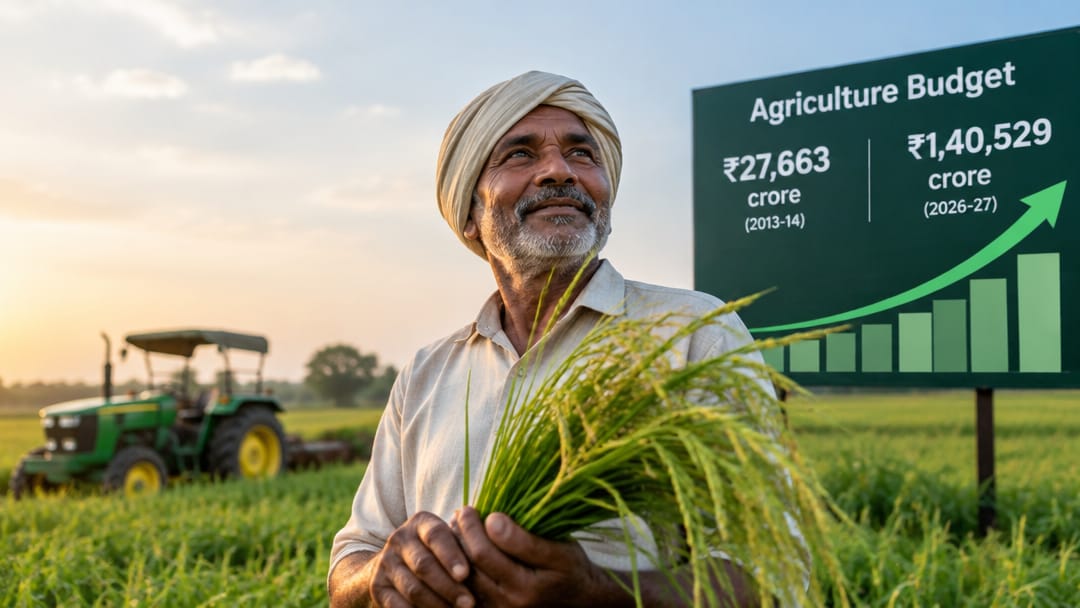
Agriculture budget up 5x in 13 years: from ₹27,663 crore to ₹1,40,529 crore
What happened
India's Department of Agriculture and Farmers Welfare budget grew from ₹27,663 crore in 2013-14 to ₹1,40,528.78 crore in 2026-27, a five-fold increase over thirteen years. This PIB factsheet highlights expanded public investment across crop insurance, MSP procurement, digital agriculture, natural farming, and allied sectors like fisheries and animal husbandry, reflecting a structural shift in how the government funds agricultural development and farmer income support.
Why it matters
The five-fold budget expansion signals more than fiscal generosity — it represents a layered policy architecture built over successive Union Budgets. Understanding this requires mapping the schemes that consume this outlay.
The largest allocations flow through PM-KISAN (income support of ₹6,000/year to eligible farmers), Pradhan Mantri Fasal Bima Yojana (PMFBY, crop insurance), PM Krishi Sinchayee Yojana (irrigation), and the Agriculture Infrastructure Fund (AIF). The MSP (Minimum Support Price) mechanism, while not a direct budget line, triggers procurement spending through FCI and state agencies funded partly by this department.
Allied sectors — fisheries (PM Matsya Sampada Yojana), animal husbandry (National Livestock Mission), and horticulture (Mission for Integrated Development of Horticulture, MIDH) — now draw dedicated sub-budget lines, reflecting that 'agriculture' policy has broadened beyond crop production.
For NABARD aspirants, this matters because NABARD's own refinance operations, rural infrastructure development fund (RIDF), and credit guarantee mechanisms are downstream of these policy commitments. When the agriculture budget rises, NABARD's target credit flow, priority sector benchmarks, and institutional credit deployment all shift.
For UPSC, the testable angle is the policy rationale: does higher budget spending translate to farmer income doubling (the 2022 target that was not formally declared achieved), and what structural reforms — land records, e-NAM, FPO promotion — accompanied the fiscal expansion?
The examiner will blank out either the base year figure, the current year figure, or the multiplier — all three must be memorised exactly.
The largest allocations flow through PM-KISAN (income support of ₹6,000/year to eligible farmers), Pradhan Mantri Fasal Bima Yojana (PMFBY, crop insurance), PM Krishi Sinchayee Yojana (irrigation), and the Agriculture Infrastructure Fund (AIF). The MSP (Minimum Support Price) mechanism, while not a direct budget line, triggers procurement spending through FCI and state agencies funded partly by this department.
Allied sectors — fisheries (PM Matsya Sampada Yojana), animal husbandry (National Livestock Mission), and horticulture (Mission for Integrated Development of Horticulture, MIDH) — now draw dedicated sub-budget lines, reflecting that 'agriculture' policy has broadened beyond crop production.
For NABARD aspirants, this matters because NABARD's own refinance operations, rural infrastructure development fund (RIDF), and credit guarantee mechanisms are downstream of these policy commitments. When the agriculture budget rises, NABARD's target credit flow, priority sector benchmarks, and institutional credit deployment all shift.
For UPSC, the testable angle is the policy rationale: does higher budget spending translate to farmer income doubling (the 2022 target that was not formally declared achieved), and what structural reforms — land records, e-NAM, FPO promotion — accompanied the fiscal expansion?
The examiner will blank out either the base year figure, the current year figure, or the multiplier — all three must be memorised exactly.
🔒
Key figure and date from this topic
Specific number or threshold to remember
Policy or regulatory implication