Agriculture budget up 5x in 13 years: from ₹27,663 crore to ₹1,40,529 crore
What happened
India's Department of Agriculture and Farmers Welfare budget grew from ₹27,663 crore in 2013-14 to ₹1,40,528.78 crore in 2026-27, a five-fold increase over thirteen years. This PIB factsheet highlights expanded public investment across crop insurance, MSP procurement, digital agriculture, natural farming, and allied sectors like fisheries and animal husbandry, reflecting a structural shift in how the government funds agricultural development and farmer income support.
Why it matters
The five-fold budget expansion signals more than fiscal generosity — it represents a layered policy architecture built over successive Union Budgets. Understanding this requires mapping the schemes that consume this outlay.
The largest allocations flow through PM-KISAN (income support of ₹6,000/year to eligible farmers), Pradhan Mantri Fasal Bima Yojana (PMFBY, crop insurance), PM Krishi Sinchayee Yojana (irrigation), and the Agriculture Infrastructure Fund (AIF). The MSP (Minimum Support Price) mechanism, while not a direct budget line, triggers procurement spending through FCI and state agencies funded partly by this department.
Allied sectors — fisheries (PM Matsya Sampada Yojana), animal husbandry (National Livestock Mission), and horticulture (Mission for Integrated Development of Horticulture, MIDH) — now draw dedicated sub-budget lines, reflecting that 'agriculture' policy has broadened beyond crop production.
For NABARD aspirants, this matters because NABARD's own refinance operations, rural infrastructure development fund (RIDF), and credit guarantee mechanisms are downstream of these policy commitments. When the agriculture budget rises, NABARD's target credit flow, priority sector benchmarks, and institutional credit deployment all shift.
For UPSC, the testable angle is the policy rationale: does higher budget spending translate to farmer income doubling (the 2022 target that was not formally declared achieved), and what structural reforms — land records, e-NAM, FPO promotion — accompanied the fiscal expansion?
The examiner will blank out either the base year figure, the current year figure, or the multiplier — all three must be memorised exactly.
Women hold just 8.1% of SC working strength despite rising to three judges
What happened
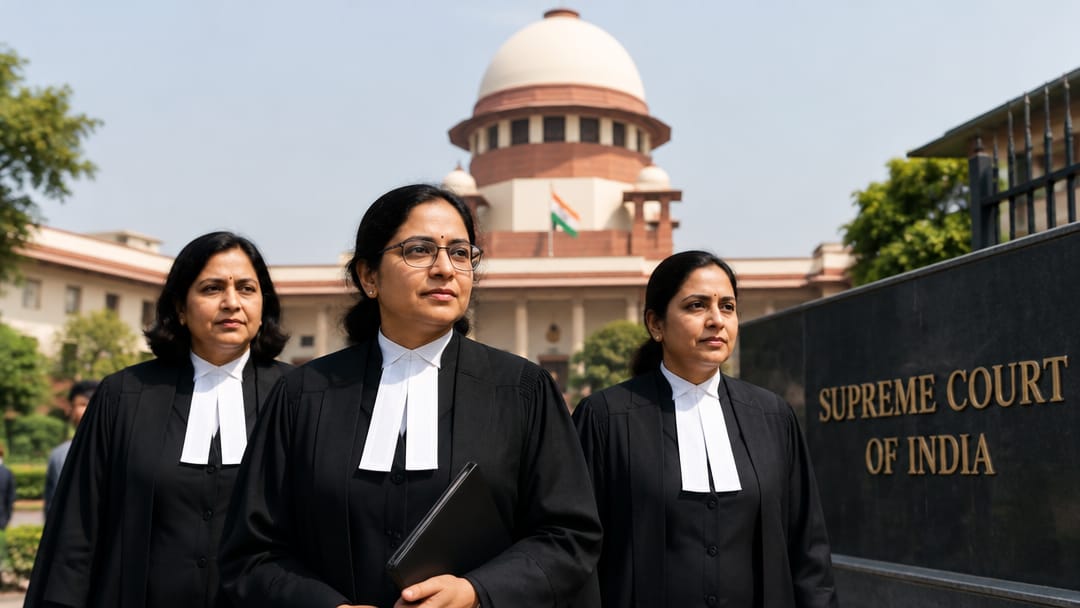
The Supreme Court now has three women judges, up from two, yet women constitute only 8.1 percent of its working strength. Critics argue the Collegium system, which self-selects judges from among senior advocates and sitting judges, structurally disadvantages women by relying on informal networks dominated by men. No woman has ever served as Chief Justice of India, and representation at High Court level remains similarly low, raising questions about whether judicial self-appointment reproduces existing gender hierarchies.
Why it matters
The Collegium system governs judicial appointments to the Supreme Court and High Courts through a body of the five senior-most Supreme Court judges, led by the Chief Justice. It emerged from the Three Judges Cases — S.P. Gupta (1981), Supreme Court Advocates-on-Record Association (1993), and the Presidential Reference (1998) — which progressively shifted appointment power from the executive to the judiciary in the name of judicial independence.
The system has no statutory basis; it operates through constitutional convention and Supreme Court interpretation of Articles 124 and 217. Crucially, it has no mandatory diversity criteria, no transparent shortlisting process, and no obligation to consider gender representation.
This matters for CLAT PG because the examiner tests understanding of how structural design — not just explicit discrimination — can produce gender-unequal outcomes, linking directly to indirect discrimination doctrine and the reasonable accommodation principle. The 8.1 percent figure is not merely a statistic; it is evidence that an institution can formally prohibit discrimination while its selection architecture systematically filters out women.
For UPSC, the static angle is the constitutional framework: Articles 124 and 217 govern Supreme Court and High Court appointments respectively; the Three Judges Cases are the precedent backbone; and the NJAC judgment (2015) is the most recent constitutional moment where the Supreme Court struck down Parliament's attempt to replace the Collegium. The tension between judicial independence and democratic accountability — including gender diversity — is the live policy debate the examiner anchors questions to.
States own water, but Parliament controls inter-state rivers
What happened
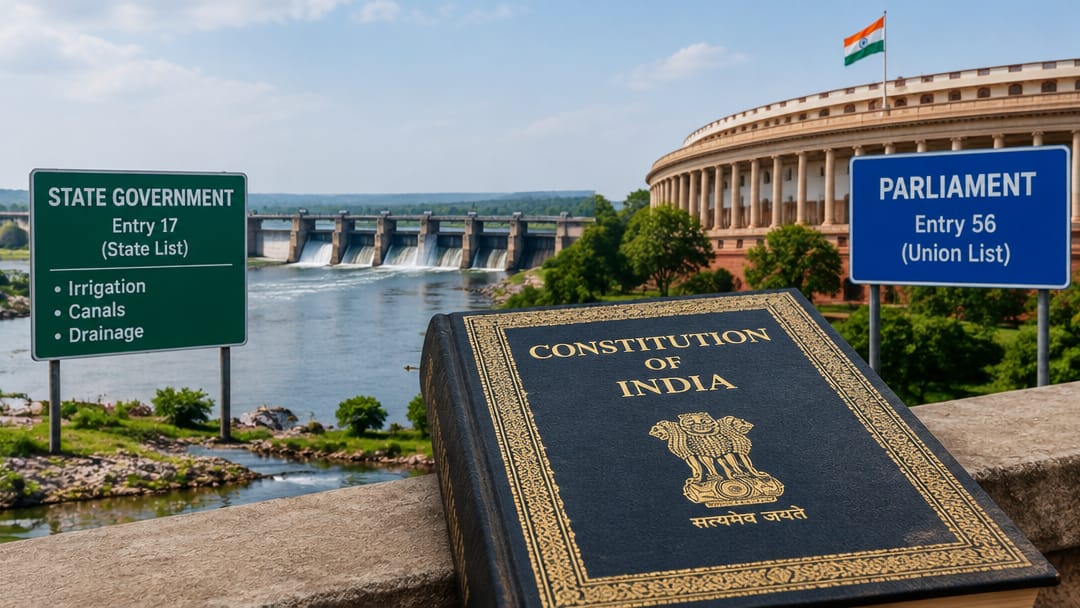
India's Constitution splits water governance between states and Parliament. Entry 17 of the State List gives states primary authority over water — including irrigation, canals, and drainage. But Entry 56 of the Union List empowers Parliament to regulate inter-state rivers and river valleys, overriding state authority where declared expedient in the public interest. This federal tension underpins major water disputes like the Cauvery and Krishna conflicts, making the constitutional allocation of water powers a recurring exam and litigation flashpoint.
Why it matters
Water in India is constitutionally allocated across two lists in the Seventh Schedule. Entry 17 of List II (State List) covers water supply, irrigation, canals, drainage, embankments, water storage, and hydroelectric power — placing these squarely under state legislative competence. This reflects the founding logic that water is a local resource best managed by states closest to it.
However, Entry 56 of List I (Union List) carves out a significant exception: Parliament may legislate on the regulation and development of inter-state rivers and river valleys to the extent declared by law to be expedient in the public interest. This is not automatic Union power — Parliament must affirmatively declare the expediency. When it does, Union law prevails over inconsistent state law under Article 254.
Article 262 adds a further constitutional layer: Parliament may by law provide for adjudication of disputes relating to waters of inter-state rivers, and may also bar the jurisdiction of the Supreme Court and other courts in such disputes. Exercising this, Parliament enacted the Inter-State River Water Disputes Act, 1956 (amended 2002), under which tribunals like the Cauvery Water Disputes Tribunal and Krishna Water Disputes Tribunal were constituted.
Groundwater is not explicitly mentioned in any List, creating a gap. Courts have treated it as falling under Entry 17 of the State List as a component of land and water resources within state territory.
The overall constitutional design is state-primary but Union-supervisory for rivers that cross state boundaries — a structure producing perennial inter-state litigation.
KCC crop loans reach 4% via three stacked subsidies — here's the arithmetic
What happened
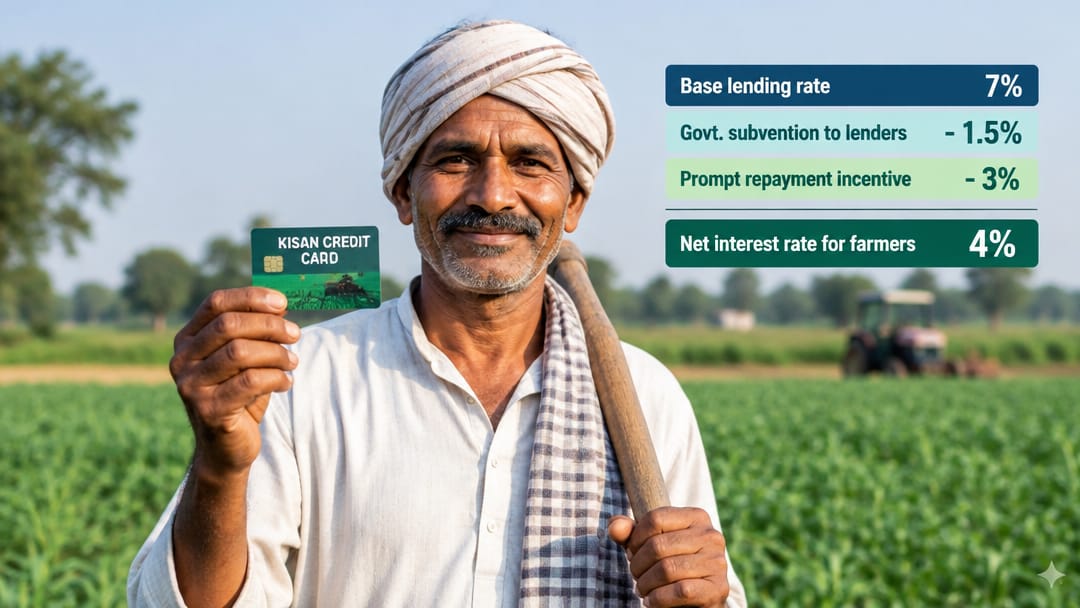
Under the Modified Interest Subvention Scheme, farmers borrowing short-term crop loans through Kisan Credit Cards pay a net interest rate of 4%. The base lending rate is 7%, reduced to 5.5% by a 1.5% government subvention to lenders. Prompt repayers receive an additional 3% incentive, bringing the effective rate to 4%. The scheme covers loans up to ₹3 lakh for crop cultivation, post-harvest, and allied activities, implemented through NABARD and scheduled commercial banks.
Why it matters
The Modified Interest Subvention Scheme (MISS) is India's primary mechanism to deliver affordable short-term agricultural credit — a core priority-sector lending instrument. It operates through a two-layer subsidy architecture built on top of the Kisan Credit Card (KCC) infrastructure.
Layer 1 — Lender-side subvention: The government compensates banks 1.5% on crop loans up to ₹3 lakh, so banks can lend at 7% gross but effectively receive 8.5%, making it commercially viable to price loans at 7% for farmers.
Layer 2 — Borrower-side prompt repayment incentive (PRI): Farmers who repay on time receive a 3% interest rebate, reducing their effective cost from 7% to 4%. This design nudges credit discipline — irregular repayers pay 7%, not 4%.
The scheme is routed through NABARD for cooperative banks and RRBs, and directly through the Ministry of Finance for scheduled commercial banks. This dual-channel delivery makes it simultaneously a NABARD refinance issue, an RBI priority-sector compliance matter, and a Union Budget fiscal outlay item.
For UPSC, the governance angle is the welfare delivery mechanism and rural credit outreach. For RBI, the KCC integration, priority-sector lending norms, and bank compliance matter. For NABARD, the refinance channel and cooperative bank participation are central. The ₹3 lakh ceiling, the 7% base rate, the 1.5% subvention, and the 3% PRI are the four numbers every examiner tests.
India has laws guaranteeing clean air, but enforcement remains the gap
What happened
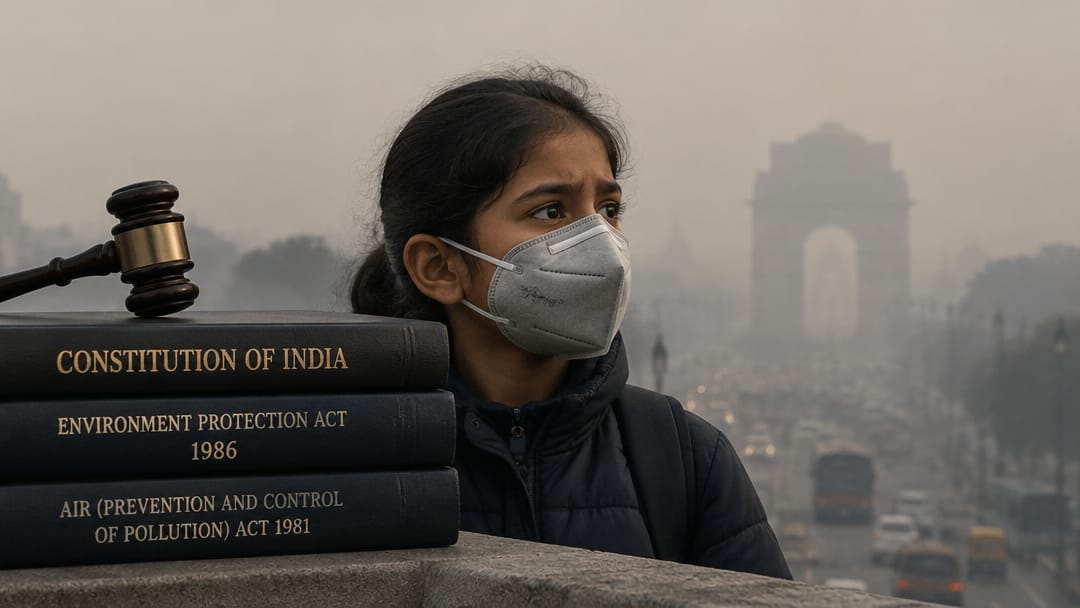
Despite constitutional protections under Article 21 and environmental statutes like the Air (Prevention and Control of Pollution) Act 1981, Delhi's air quality continues to deteriorate each winter. Courts have read the right to clean air into the right to life, but judicial pronouncements have not translated into sustained compliance. The gap between legal entitlement and lived reality raises a pointed question for constitutional law: when a fundamental right exists on paper but fails in practice, what remedies actually work?
Why it matters
The right to clean air in India is not explicitly written in the Constitution but has been judicially constructed through Article 21, which guarantees the right to life and personal liberty. The Supreme Court in Subhash Kumar v. State of Bihar (1991) first held that the right to life includes the right to enjoyment of pollution-free water and air. This was reinforced in M.C. Mehta v. Union of India, a series of landmark cases that made environmental enforcement through PIL a defining feature of Indian constitutional practice.
The doctrinal architecture rests on three pillars. First, Article 21 is the source right — any state action or omission that degrades air quality to life-threatening levels constitutes a violation. Second, Articles 48A (Directive Principle requiring the state to protect the environment) and 51A(g) (Fundamental Duty of citizens to protect the natural environment) provide interpretive support, though they are not independently enforceable. Third, the Air (Prevention and Control of Pollution) Act 1981 and the Environment (Protection) Act 1986 create statutory mechanisms, including the Central Pollution Control Board (CPCB) and State Pollution Control Boards.
The critical constitutional test the Court applies is whether state inaction is arbitrary under Article 14 or whether it directly imperils life under Article 21. The Court has in several M.C. Mehta cases issued continuing mandamus — a supervisory jurisdiction where it retains the case and monitors compliance — to bridge the enforcement gap. The GRAP (Graded Response Action Plan) system operative in Delhi is a direct product of Supreme Court directions, not parliamentary legislation, illustrating how judicial orders now function as quasi-regulatory instruments in the environmental space.
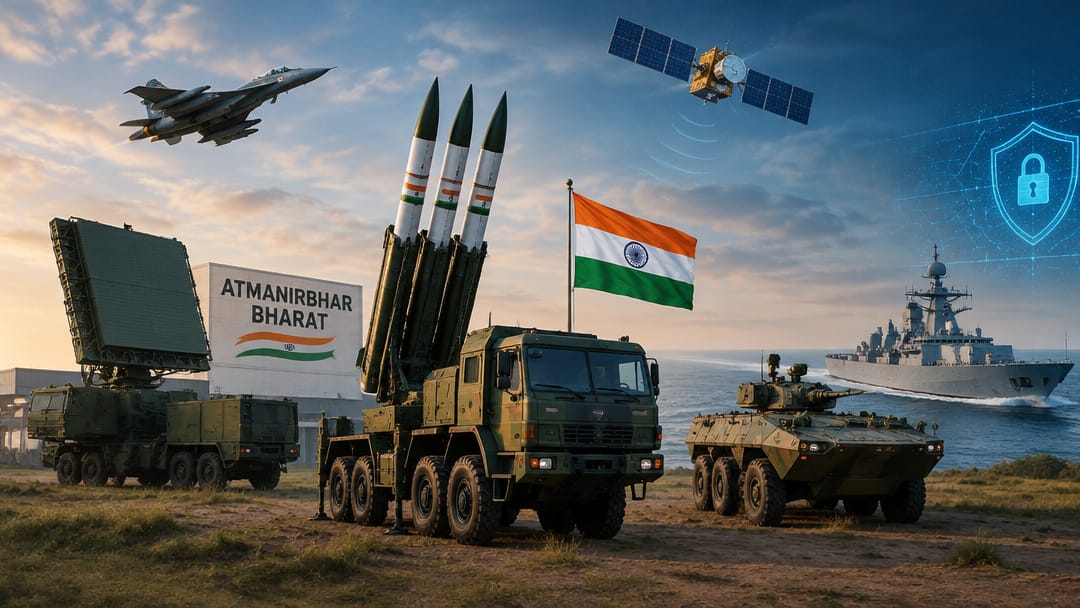
India's indigenous defence push spans missiles, radars, and electronic warfare
What happened
India has developed significant indigenous capabilities across missiles, artillery, ammunition, radars, electronic warfare systems, naval platforms, and armoured vehicles, marking a shift from import dependence to self-reliance in multi-domain warfare. DRDO, ISRO, and Defence PSUs drive this effort under the Atmanirbhar Bharat framework. The push covers land, sea, air, space, and cyber domains simultaneously, reflecting a doctrine that modern conflicts are won by integrating capabilities across all these domains rather than through single-domain superiority.
Why it matters
Multi-domain warfare (MDW) is a military doctrine holding that victory requires the simultaneous, coordinated use of capabilities across land, sea, air, space, cyber, and electromagnetic spectrum domains. Unlike older joint-operations thinking — which coordinated distinct service arms — MDW seeks true integration so that action in one domain creates exploitable advantages in others.
India's drive toward MDW capability is institutionally anchored in several reforms: the creation of the Chief of Defence Staff (CDS) post in January 2020 and the Department of Military Affairs (DMA); the ongoing theatre-command restructuring; and the iDEX (Innovations for Defence Excellence) scheme that funds startups developing dual-use technologies.
On the hardware side, key programmes include the BrahMos supersonic cruise missile (India-Russia JV), the Akash surface-to-air missile system, the LCA Tejas fighter, the INS Vikrant aircraft carrier (India's first indigenously built carrier, commissioned August 2022), the Arjun MBT, and the DRDO-developed ASAT capability demonstrated in Mission Shakti (March 2019).
Electronic warfare and cyber are the newer frontiers. India's Defence Cyber Agency and Defence Space Agency, both established in 2019, formalize non-kinetic domains. The examiner often tests the institutional architecture — which agency controls which domain — and landmark dates like Mission Shakti or INS Vikrant's commissioning.