India's GDP grows 6.4% in FY2024-25, services lead but manufacturing slows
What happened
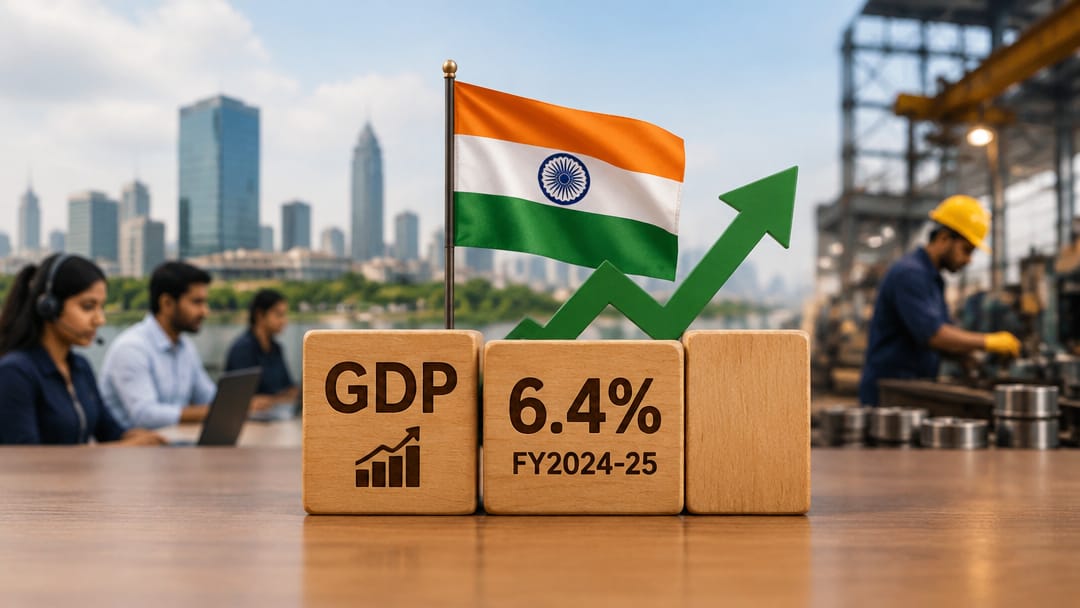
India's GDP grew 6.4% in FY2024-25, down from 8.2% in FY2023-24, according to the First Advance Estimate released by the National Statistical Office. Gross Value Added grew 6.4% at basic prices. Private final consumption expenditure rose strongly, while government capital expenditure remained a key driver. Services sector led growth; manufacturing moderated. India retained its position as the world's fastest-growing major economy, outpacing China's estimated 4.6% growth for the same period.
Why it matters
GDP measures the total monetary value of all final goods and services produced within a country in a given period. India uses two approaches: the expenditure method (C + I + G + NX) and the production/GVA method. GVA at basic prices plus net taxes on products equals GDP at market prices — a distinction examiners frequently test.
The First Advance Estimate (FAE), released by the National Statistical Office (NSO) in January, uses benchmark-indicator method with available data and is revised later into Second Advance, First Revised, and Final estimates. This sequencing itself is a testable fact.
The deceleration from 8.2% (FY24) to 6.4% (FY25) reflects several forces: global demand softness, moderation in manufacturing output, and base effects from an exceptionally strong prior year. However, private consumption remaining robust signals household balance sheet strength.
For NABARD aspirants: agricultural GVA growth directly links to rural credit demand and NABARD's refinancing volumes. When agri-GVA rises, Kisan Credit Card offtake and cooperative credit demand typically follow — the examiner often connects macro data to sectoral credit outcomes.
For RBI aspirants: the GDP-inflation tradeoff underpins MPC decisions. Lower-than-potential growth alongside moderating inflation creates space for rate cuts — the transmission mechanism from GDP data to monetary policy stance is a recurring exam concept.
India outpacing China in growth rate has become a standard distractor question — examiners test whether aspirants know the precise figures, not just the ranking.
The First Advance Estimate (FAE), released by the National Statistical Office (NSO) in January, uses benchmark-indicator method with available data and is revised later into Second Advance, First Revised, and Final estimates. This sequencing itself is a testable fact.
The deceleration from 8.2% (FY24) to 6.4% (FY25) reflects several forces: global demand softness, moderation in manufacturing output, and base effects from an exceptionally strong prior year. However, private consumption remaining robust signals household balance sheet strength.
For NABARD aspirants: agricultural GVA growth directly links to rural credit demand and NABARD's refinancing volumes. When agri-GVA rises, Kisan Credit Card offtake and cooperative credit demand typically follow — the examiner often connects macro data to sectoral credit outcomes.
For RBI aspirants: the GDP-inflation tradeoff underpins MPC decisions. Lower-than-potential growth alongside moderating inflation creates space for rate cuts — the transmission mechanism from GDP data to monetary policy stance is a recurring exam concept.
India outpacing China in growth rate has become a standard distractor question — examiners test whether aspirants know the precise figures, not just the ranking.
🔒
Key figure and date from this topic
Specific number or threshold to remember
Policy or regulatory implication