Pre-Trial Detention Cannot Become Punishment: Supreme Court [Read Order]
What happened
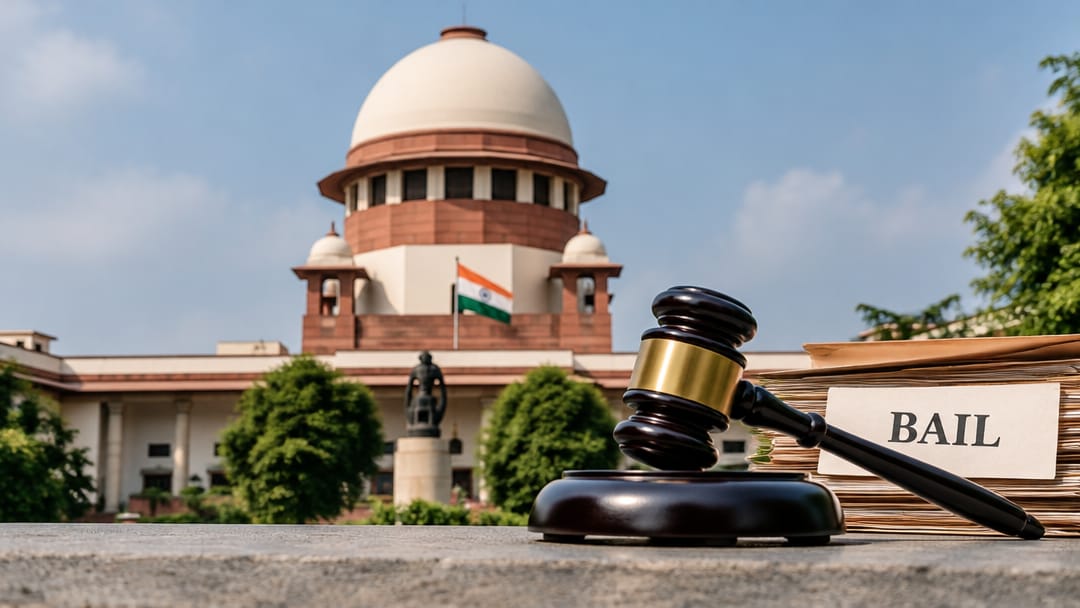
The Supreme Court granted bail to Mahesh Chandra Joshi and Mukesh Pathak, accused in an alleged ₹979.45 crore fraud in Jal Jeevan Mission tenders. The Court held that prolonged pre-trial detention effectively punishes an accused before conviction, violating the presumption of innocence. Reiterating that bail is the rule and jail the exception, the Court emphasised that continued custody without trial completion cannot be used as a substitute for sentencing.
Why it matters
This ruling reinforces one of the most tested principles in CLAT PG criminal procedure: the constitutional and statutory framework governing bail is premised on the presumption of innocence under Article 21. Pre-trial detention is a preventive measure, not a punitive one. When detention becomes indefinitely prolonged due to trial delays, it transforms into de facto punishment — which is constitutionally impermissible.
The Court's reasoning draws on the settled position from cases like Sanjay Chandra v. CBI (2012) and Satender Kumar Antil v. CBI (2022), where the Supreme Court held that economic offences, though serious, do not automatically justify denial of bail. Gravity of the offence is a relevant factor but not the sole determinant.
Under Section 437 and Section 439 of the CrPC (now Sections 480 and 483 of BNSS 2023), courts must weigh the triple test: flight risk, likelihood of tampering with evidence, and repeat offence risk. Conditions imposed must have a direct nexus to these objectives — not be punitive in nature.
The examiner frequently tests whether aspirants understand the distinction between bail conditions that serve legitimate custodial purposes versus those that are irrelevant or oppressive. An irrelevant condition — like demanding a surety from another state — can itself violate Article 21 by making bail practically illusory. This judgment is a textbook illustration of the principle that the bail system must serve liberty, not undermine it.
Kaziranga's buffer zone: SC's minimum becomes Assam's maximum
What happened
Assam notified a buffer zone for Kaziranga National Park far smaller than what wildlife law requires, treating the Supreme Court's interim minimum as a permanent ceiling. The article argues this inverts the logic of buffer zones under the Wildlife Protection Act, where judicial floors are meant to trigger state action, not replace it. The gap between the court-ordered minimum and a scientifically adequate buffer raises questions about whether PIL compliance can substitute for genuine conservation governance.
Why it matters
Buffer zones around protected areas are mandated under Section 18A of the Wildlife Protection Act, 1972 (inserted by the 2006 amendment), requiring states to notify an 'eco-sensitive' or buffer area around national parks and sanctuaries. The purpose is to create a transition zone that absorbs human-wildlife conflict pressure before it reaches the core protected area.
The legal controversy here turns on a well-known phenomenon in PIL enforcement: when a court sets a minimum threshold to prevent a worse outcome — say, compelling a state to notify at least some buffer — the state treats that floor as satisfying its full obligation. This is sometimes called 'compliance capture,' where the letter of a court order displaces the spirit of the underlying statute.
For CLAT PG, the key principle is the distinction between judicial interim relief and statutory compliance. An SC direction to notify a minimum area does not discharge the state's independent obligation under Section 18A to notify a scientifically determined buffer. The court's floor is a remedial device, not a legislative exemption.
For UPSC CSE, the static layer involves understanding what buffer zones are, how they differ from core zones and eco-sensitive zones under the Environment Protection Act, the role of the National Board for Wildlife, and Kaziranga's status as a UNESCO World Heritage Site and tiger reserve. Kaziranga is also notable for its one-horned rhinoceros population and its location across Assam's Golaghat, Nagaon, Karbi Anglong, and Biswanath districts.
Kerala HC expunges adverse remarks against a junior advocate under Article 227
What happened
The Kerala High Court expunged adverse remarks recorded by a trial court against a young advocate, holding that judges must guide junior lawyers professionally rather than castigate them on record. The court stressed that the Bar's duty includes mentoring newcomers and that adverse judicial remarks, if unwarranted, can irreparably harm a young lawyer's career and reputation. The ruling reaffirms that expunging remarks is a supervisory remedy available when lower courts exceed proper judicial conduct.
Why it matters
When a court records adverse remarks against a lawyer in its order or judgment, those remarks become part of the permanent judicial record and can damage the advocate's professional standing. The power to expunge such remarks lies with the High Court in its supervisory jurisdiction under Article 227 of the Constitution, which gives it superintendence over all subordinate courts and tribunals within its territory.
The Kerala High Court's intervention here rests on a well-established principle: judicial criticism of counsel must be proportionate, warranted, and aimed at correcting conduct — not at punishing or embarrassing an advocate. When a trial court records remarks that are excessive, unsubstantiated, or targeted at a junior lawyer who was still learning professional norms, the High Court can exercise its supervisory power to expunge those remarks and restore the record.
For CLAT PG, this ruling intersects two tested areas: (1) the scope of Article 227 supervisory jurisdiction and the distinction between Article 226 (writ jurisdiction) and Article 227 (superintendence), and (2) the professional duties of advocates under the Advocates Act 1961 and Bar Council of India Rules. Courts have consistently held that the Bar and the Bench share a mutual obligation — the Bench to correct proportionately, the Bar to maintain decorum. Adverse remarks that exceed this standard are liable to be struck from the record.
Postal receipt alone cannot prove court summons was served, rules J&K High Court
What happened
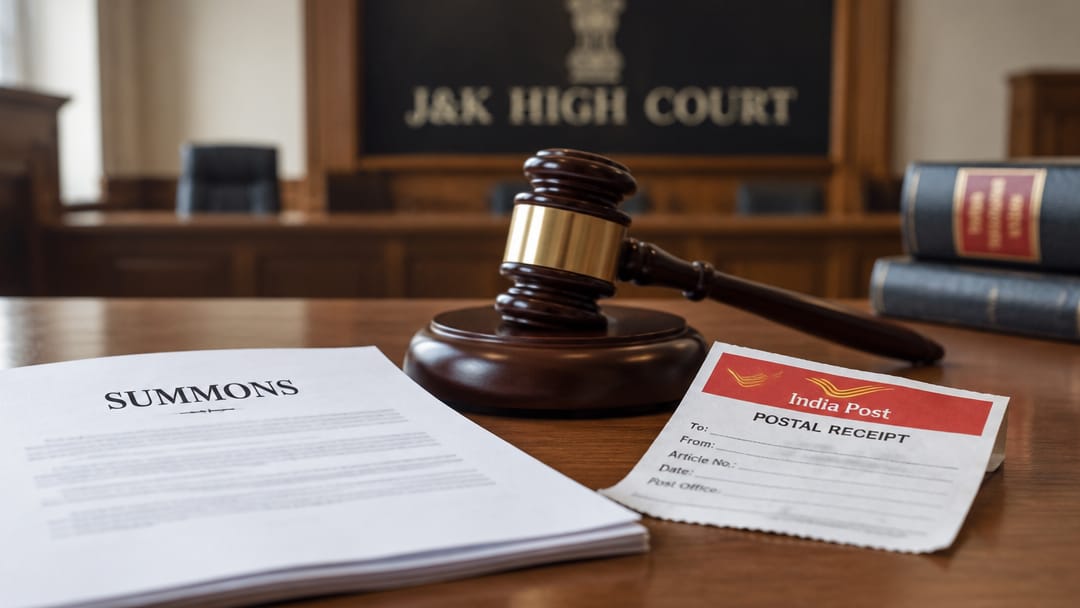
The Jammu & Kashmir High Court set aside a lower court order that had rejected the government's plea to reopen an ex parte decree. The court held that a mere postal receipt is insufficient proof of service of summons — actual delivery must be established. Because the government had not been properly served, proceeding ex parte and passing the decree was a procedural error. The court directed the trial court to allow the government to contest the matter afresh.
Why it matters
This ruling turns on a fundamental question in civil procedure: what constitutes valid service of summons? Under Order V of the Code of Civil Procedure, 1908, service of summons must be duly effected upon the defendant before a court can proceed. When a defendant fails to appear, a court may pass an ex parte decree under Order IX Rule 6 CPC. However, that power is conditional on proper prior service. A postal receipt only shows that a letter was dispatched — it does not confirm that the addressee actually received it. The distinction between dispatch and delivery is legally critical. For service by post to be legally complete, the letter must be shown to have been delivered, typically through an acknowledgement of receipt (postal AD card or process server's endorsement). The court applied the principle that an ex parte decree obtained without proper service is void or voidable, and the aggrieved party may seek to set it aside under Order IX Rule 13 CPC, which allows a defendant to apply to set aside an ex parte decree by showing either that summons were not duly served or that they were prevented by sufficient cause from appearing. This ruling is significant because government departments are frequent defendants in civil suits, and proof of service is often contested. The J&K High Court drew a clear line: process cannot substitute substance in procedural compliance.
Delhi HC upholds peace bond notice against student protest leader, dismisses petition
What happened
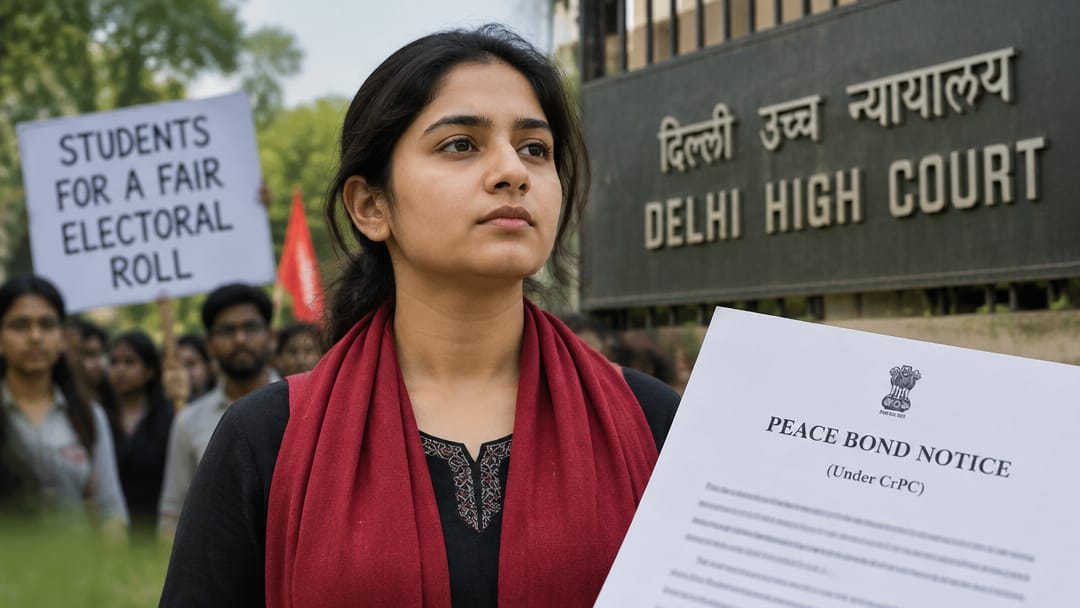
The Delhi High Court dismissed a petition challenging a peace bond notice issued to Neha Bora, a student leader associated with the All India Students Association. The notice arose amid protests over electoral roll revisions. The court found the notice legally valid, rejecting arguments that it violated free speech or assembly rights. The ruling is significant because it tests the boundary between preventive state action under CrPC peace bond provisions and constitutionally protected protest activity by civil society actors.
Why it matters
A peace bond notice — issued under Sections 107–110 of the Code of Criminal Procedure (now mirrored in the Bharatiya Nagarik Suraksha Sanhita, 2023) — is a preventive, not punitive, mechanism. A magistrate can direct a person to execute a bond with sureties if there is reasonable apprehension that their conduct may disturb public peace. The person need not have committed any offence; the standard is anticipatory.
The constitutional tension here is acute. Article 19(1)(a) guarantees free speech and Article 19(1)(b) guarantees peaceful assembly, but Article 19(2) and 19(3) permit reasonable restrictions in the interest of public order. The state often uses peace bond powers against political protesters, student leaders, and activists — which courts have sometimes found to be a chilling effect on legitimate dissent.
The Delhi HC's ruling upholding the notice signals that the court found the magistrate's apprehension of breach of peace to be legally sufficient — even where the petitioner argued the notice was retaliatory and politically motivated.
For CLAT PG, the key doctrinal question is: what distinguishes a valid preventive notice from an abuse of preventive power? Courts have held that the apprehension must be real, not imaginary, and the restriction must be proportionate. The PIL maintainability angle is also relevant — whether a third party could challenge such a notice on public interest grounds.
Tata Chemicals contests Kenya High Court's jurisdiction over its Magadi subsidiary
What happened
Tata Chemicals has challenged the jurisdiction of the Kenya High Court to adjudicate a dispute involving its subsidiary, Tata Chemicals Magadi Limited (TCML), which operates soda ash mining at Lake Magadi in Kenya. The company disclosed it is examining the court's order and will determine legal and other measures to address the matter. The dispute centres on TCML's operations, and Tata Chemicals argues the Kenyan court lacks authority to hear the case under applicable legal frameworks.
Why it matters
This dispute turns on a foundational principle of private international law: jurisdiction. When a multinational corporation operates through a foreign subsidiary, the question of which court can adjudicate disputes involving that entity depends on factors including where the company is incorporated, where the contract was performed, where the cause of action arose, and what dispute resolution clause governs the relationship.
Tata Chemicals Magadi Limited is incorporated and operates in Kenya, making the jurisdictional challenge notable — Tata Chemicals (the Indian parent) appears to be arguing that either an arbitration clause, a different forum selection agreement, or principles of corporate separateness mean the Kenyan High Court cannot exercise jurisdiction.
For CLAT PG, this event connects to two static concepts: (1) the doctrine of forum selection and how courts in cross-border disputes determine their own competence (kompetenz-kompetenz), and (2) the distinction between a parent company and its foreign subsidiary for purposes of jurisdiction and liability — a principle tested in corporate law questions. The examiner frequently tests whether aspirants understand that incorporation in a jurisdiction generally does confer that country's courts with jurisdiction, making Tata Chemicals' challenge legally interesting and potentially dependent on a contractual arbitration clause ousting court jurisdiction.