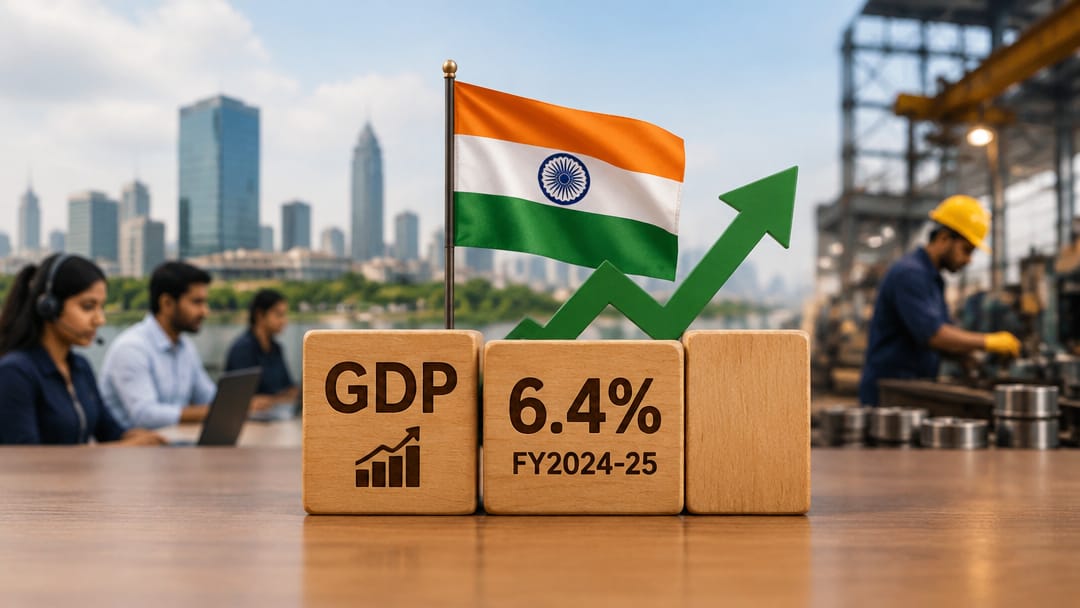
India's GDP grows 6.4% in FY2024-25, services lead but manufacturing slows
What happened
India's GDP grew 6.4% in FY2024-25, down from 8.2% in FY2023-24, according to the First Advance Estimate released by the National Statistical Office. Gross Value Added grew 6.4% at basic prices. Private final consumption expenditure rose strongly, while government capital expenditure remained a key driver. Services sector led growth; manufacturing moderated. India retained its position as the world's fastest-growing major economy, outpacing China's estimated 4.6% growth for the same period.
Why it matters
GDP measures the total monetary value of all final goods and services produced within a country in a given period. India uses two approaches: the expenditure method (C + I + G + NX) and the production/GVA method. GVA at basic prices plus net taxes on products equals GDP at market prices — a distinction examiners frequently test.
The First Advance Estimate (FAE), released by the National Statistical Office (NSO) in January, uses benchmark-indicator method with available data and is revised later into Second Advance, First Revised, and Final estimates. This sequencing itself is a testable fact.
The deceleration from 8.2% (FY24) to 6.4% (FY25) reflects several forces: global demand softness, moderation in manufacturing output, and base effects from an exceptionally strong prior year. However, private consumption remaining robust signals household balance sheet strength.
For NABARD aspirants: agricultural GVA growth directly links to rural credit demand and NABARD's refinancing volumes. When agri-GVA rises, Kisan Credit Card offtake and cooperative credit demand typically follow — the examiner often connects macro data to sectoral credit outcomes.
For RBI aspirants: the GDP-inflation tradeoff underpins MPC decisions. Lower-than-potential growth alongside moderating inflation creates space for rate cuts — the transmission mechanism from GDP data to monetary policy stance is a recurring exam concept.
India outpacing China in growth rate has become a standard distractor question — examiners test whether aspirants know the precise figures, not just the ranking.
India's first snow leopard count: 718 nationwide, 477 in Ladakh
What happened
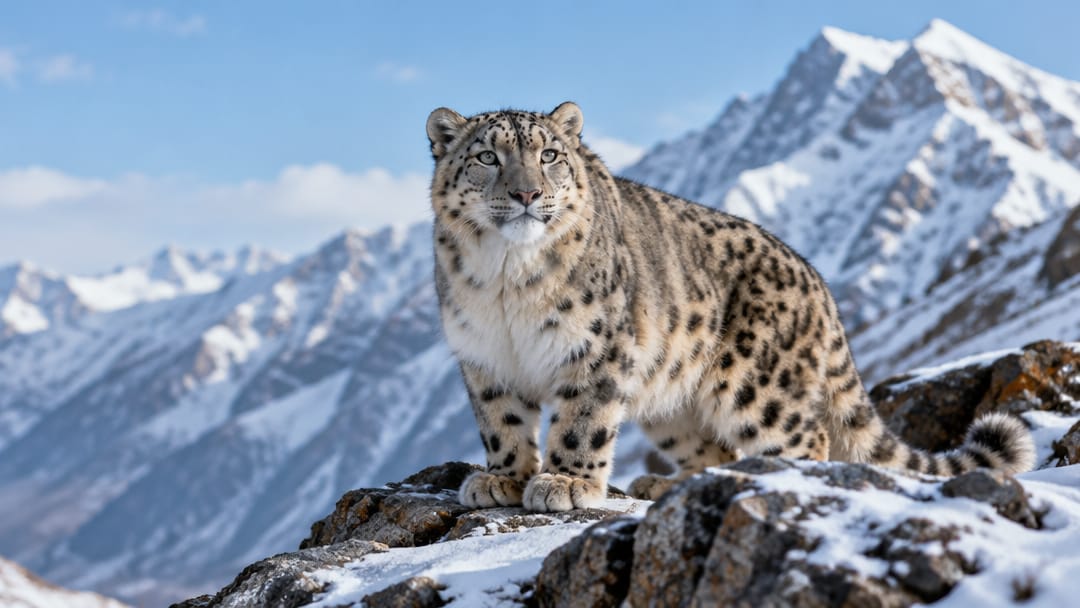
India's first-ever Snow Leopard Population Assessment recorded 718 snow leopards across the Indian Himalayas, with Ladakh alone hosting 477 — roughly two-thirds of the national count. The survey, announced by Minister of State Kirti Vardhan Singh, marks the first scientifically validated baseline for the species in India. Snow leopards are listed as Vulnerable on the IUCN Red List and receive the highest protection under Schedule I of the Wildlife (Protection) Act, 1972.
Why it matters
The Snow Leopard Population Assessment in India (SPAI) is significant because it provides the first statistically robust national estimate for a flagship high-altitude species that serves as an indicator of Himalayan ecosystem health. Snow leopards inhabit the alpine and sub-alpine zones above 3,000 metres across five Himalayan states — Ladakh, Himachal Pradesh, Uttarakhand, Sikkim, and Arunachal Pradesh — plus the trans-Himalayan regions.
Conservation context: India is a signatory to the Global Snow Leopard and Ecosystem Protection (GSLEP) Programme launched in 2013 in Bishkek, which unites the 12 snow leopard range countries. The IUCN downlisted the snow leopard from Endangered to Vulnerable in 2017, reflecting cautious population recovery but ongoing threats from poaching, habitat loss, and climate-driven prey base shrinkage.
Under the Wildlife (Protection) Act, 1972, the snow leopard is listed in Schedule I, Part I — the highest protection category — making hunting or trade punishable with the most severe penalties. Project Snow Leopard, launched in 2009 by the Ministry of Environment, Forest and Climate Change (MoEFCC), is India's dedicated conservation programme for the species, analogous to Project Tiger and Project Elephant.
The survey methodology used camera traps and DNA analysis from scat samples — a non-invasive technique now standard for elusive large carnivores. Ladakh's dominance (477 of 718) reflects its vast, relatively undisturbed high-altitude terrain and lower human pressure compared to other Himalayan states. This baseline number is what examiners will test.
Maldhari pastoralists sustain Gujarat's shrinking gauchars through traditional knowledge
What happened
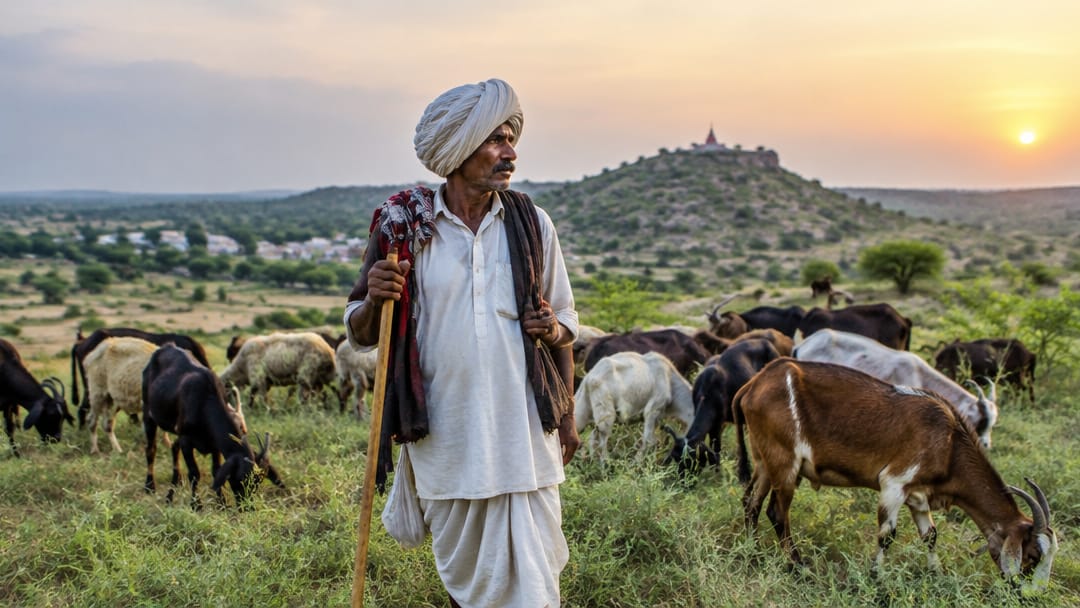
In Chotila, Gujarat, Maldhari pastoralists manage a patchwork of gauchars (village grazing commons), vidis (private pastures), and forest lands using generations of ecological knowledge. As these commons shrink under encroachment and land-use changes, Maldhari communities deploy seasonal migration patterns and species-specific grazing rotations to maintain grassland biodiversity. Their traditional knowledge system supports dryland ecosystem health while sustaining pastoral livelihoods — an intersection of indigenous knowledge, common property resources, and biodiversity conservation.
Why it matters
Gauchars are legally designated village grazing commons recorded under revenue land categories in Gujarat. Vidis are privately held pasture parcels. Together with forest patches, they form a mosaic that sustains both livestock and native grassland biodiversity. The Maldhari are a pastoral community whose livelihood depends entirely on this mosaic.
The exam-relevant architecture here spans several static concepts:
**Common Property Resources (CPRs):** Grazing commons are classic CPRs — rivalrous but non-excludable. Their degradation follows the 'Tragedy of the Commons' logic, but Maldhari knowledge systems represent the counter-argument: community-managed CPRs can be sustainable when governed by traditional institutions.
**Indigenous and Traditional Knowledge (ITK):** Under the Convention on Biological Diversity (CBD) and its Nagoya Protocol, traditional knowledge held by local communities has formal legal status. India's Biological Diversity Act, 2002, and the National Biodiversity Authority (NBA) govern access to such knowledge. The nodal ministry is the Ministry of Environment, Forest and Climate Change (MoEFCC).
**Grassland Ecosystems:** Indian grasslands are among the most threatened ecosystems, often misclassified as 'wastelands' in revenue records, making them vulnerable to diversion. The Wildlife Institute of India has flagged their underprotection relative to forests.
**Dryland Biodiversity:** Arid and semi-arid grasslands of Gujarat fall outside the 18 recognised biodiversity hotspots in India (which include the Western Ghats and Eastern Himalayas), yet they support critical fauna including the Great Indian Bustard — a Critically Endangered species under IUCN.
For NABARD, the livelihood dimension is central: pastoral communities' dependence on CPRs links directly to rural credit need, climate vulnerability, and natural resource governance in semi-arid regions.
India counts 718 snow leopards, yet the species remains Vulnerable on IUCN's Red List
What happened
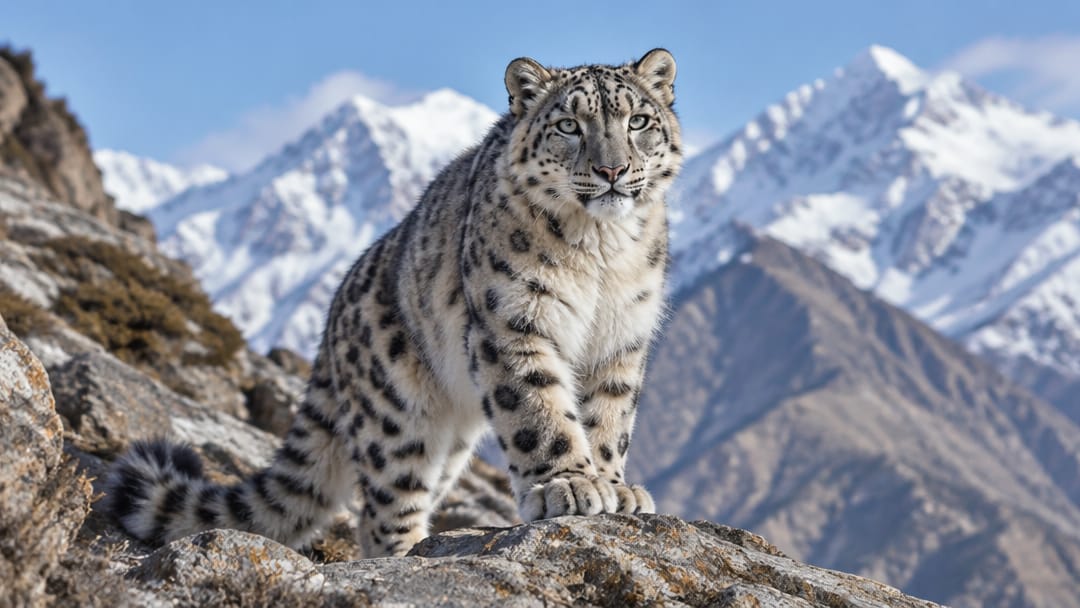
On International Snow Leopard Day, Minister of State for Environment Kirti Vardhan Singh reaffirmed India's commitment to snow leopard conservation. India is home to an estimated 718 snow leopards, the second-largest population globally after China. The species is protected under Schedule I of the Wildlife Protection Act, 1972. India participates in the Global Snow Leopard and Ecosystem Protection Programme and runs Project Snow Leopard since 2009 for high-altitude Himalayan habitat conservation.
Why it matters
The snow leopard (Panthera uncia) occupies a unique ecological niche as an apex predator of high-altitude Central and South Asian mountain ecosystems, found above 3,000 metres. Its conservation carries layered exam relevance across multiple frameworks.
IUCN STATUS: The snow leopard was downlisted from Endangered to Vulnerable on the IUCN Red List in 2017 — a distinction examiners use to test whether aspirants conflate 'rare' with 'threatened.' Vulnerable is still a threatened category under IUCN (the threatened categories are Vulnerable, Endangered, and Critically Endangered).
INDIA'S RANGE STATES: Snow leopards are found across 12 Indian states and Union Territories — primarily Jammu & Kashmir, Ladakh, Himachal Pradesh, Uttarakhand, Sikkim, and Arunachal Pradesh. India has the second-largest population after China.
PROJECT SNOW LEOPARD: Launched in 2009 by the Ministry of Environment, Forest and Climate Change (MoEFCC), it mirrors the administrative model of Project Tiger and Project Elephant, focusing on landscape-level conservation and community participation in Himalayan and Trans-Himalayan regions.
GLOBAL FRAMEWORK: The Global Snow Leopard and Ecosystem Protection Programme (GSLEP) was launched in 2013 in Bishkek, Kyrgyzstan, with 12 range countries including India. Its target: secure 20 viable snow leopard landscapes (Landscapes of Hope) by 2020.
WILDLIFE PROTECTION ACT: Listed in Schedule I, giving it the highest legal protection — hunting is a cognizable offence.
INTERNATIONAL SNOW LEOPARD DAY: October 23, established by GSLEP at its 2013 Bishkek Declaration.
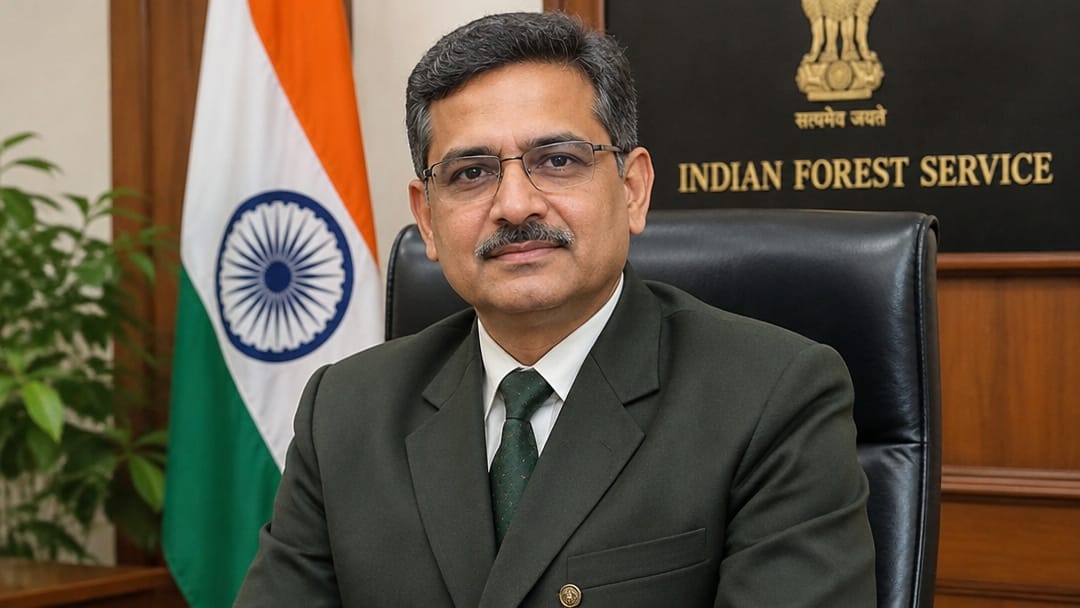
Santosh Tewari, 1993-batch Bihar-cadre IFS officer, appointed Director General of Forests
What happened
Santosh Tewari, a 1993-batch Indian Forest Service officer from the Bihar cadre, has been appointed as India's new Director General of Forests. The Director General of Forests is the senior-most position in the Indian Forest Service and heads the Forest Advisory Committee under the Ministry of Environment, Forest and Climate Change. This appointment places Tewari at the apex of India's forest administration, responsible for policy advice on forest conservation, wildlife, and environmental clearances.
Why it matters
The Director General of Forests (DGF) is the head of the Indian Forest Service and the principal technical adviser to the Ministry of Environment, Forest and Climate Change (MoEFCC) on all forestry matters. The position sits at the apex of the IFS hierarchy and carries significant institutional weight in India's environmental governance architecture.
The DGF chairs the Forest Advisory Committee (FAC), which evaluates proposals for diversion of forest land under the Forest Conservation Act, 1980. This makes the role central to decisions on infrastructure projects, mining, and industrial development that require felling or diversion of forest land — a recurring area of UPSC scrutiny.
The Indian Forest Service (IFS) is one of the three All India Services alongside the IAS and IPS, established under Article 312 of the Constitution. Officers are recruited through the UPSC Civil Services Examination and allocated state cadres; Bihar cadre in Tewari's case.
For exam purposes, the key testable architecture is: MoEFCC at the top, DGF as principal adviser, FAC as the statutory committee under Forest Conservation Act 1980, and the IFS as the All India Service that staffs these roles. Appointment-tracking questions typically ask batch year, cadre, and the institutional role — all three of which are confirmed here.
National Urban Conclave 2026 reviews AMRUT 2.0 and Smart Cities Mission progress
What happened
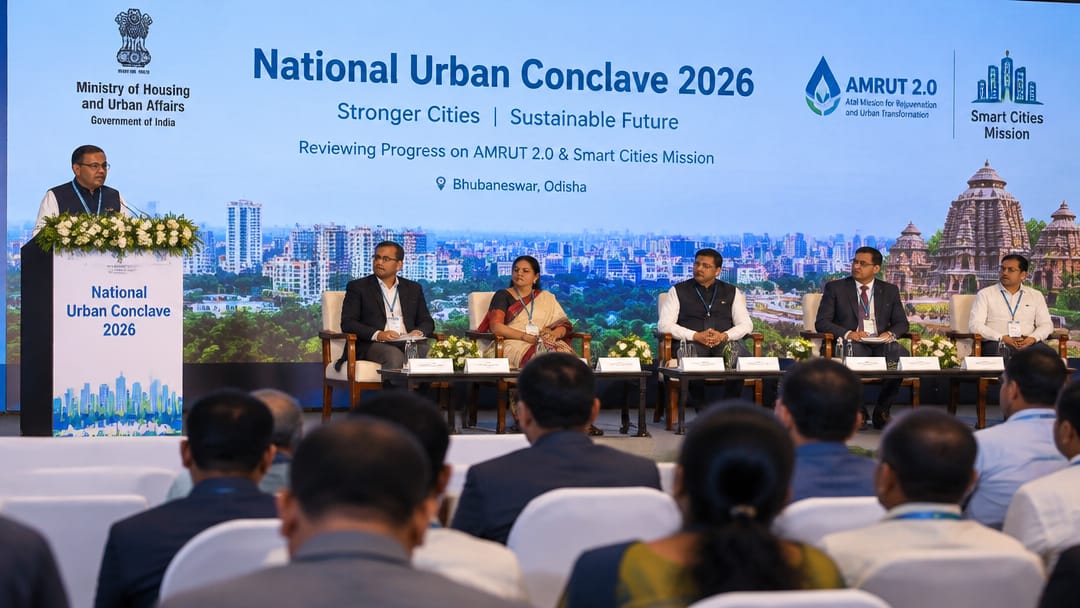
The National Urban Conclave 2026 was inaugurated in Bhubaneswar, Odisha, bringing together urban local bodies, state governments, and the Ministry of Housing and Urban Affairs to review progress under flagship urban schemes including AMRUT 2.0 and the Smart Cities Mission. The conclave focused on sustainable urban infrastructure, water and sanitation targets, and reforms in urban governance. It serves as a convergence platform for aligning state-level urban development plans with central scheme frameworks and expenditure timelines.
Why it matters
The National Urban Conclave is an annual convergence event organised by the Ministry of Housing and Urban Affairs (MoHUA) to assess implementation of centrally sponsored urban schemes. The 2026 edition held in Bhubaneswar is particularly significant because several flagship urban missions are at critical review junctures.
AMRUT 2.0 (Atal Mission for Rejuvenation and Urban Transformation), launched in October 2021 with an outlay of ₹2.77 lakh crore, aims to make all 4,715 statutory towns self-sufficient in water supply and provide functional sewerage and septage management. Unlike AMRUT 1.0 (which covered 500 cities), AMRUT 2.0 covers all urban local bodies (ULBs), introducing a competitive 'Cities Challenge' for funding allocation — a shift from formula-based grants.
The Smart Cities Mission (2015), covering 100 cities with a central allocation of ₹48,000 crore, has moved into a completion phase, with the government monitoring asset utilisation and project completion rates.
The conclave mechanism is important because it activates the Centre-State financial conduit — states must submit State Annual Action Plans (SAAPs) that are reviewed at such platforms before fund releases. For NABARD aspirants, the urban-rural finance linkage matters: NABARD's infrastructure financing arm NABFID and HUDCO both operate in urban infrastructure space. For UPSC aspirants, the governance angle — fiscal federalism, conditionalities on ULBs, and urban local finance reforms — is central to GS Paper 2 and GS Paper 3.