01 Read
What happened
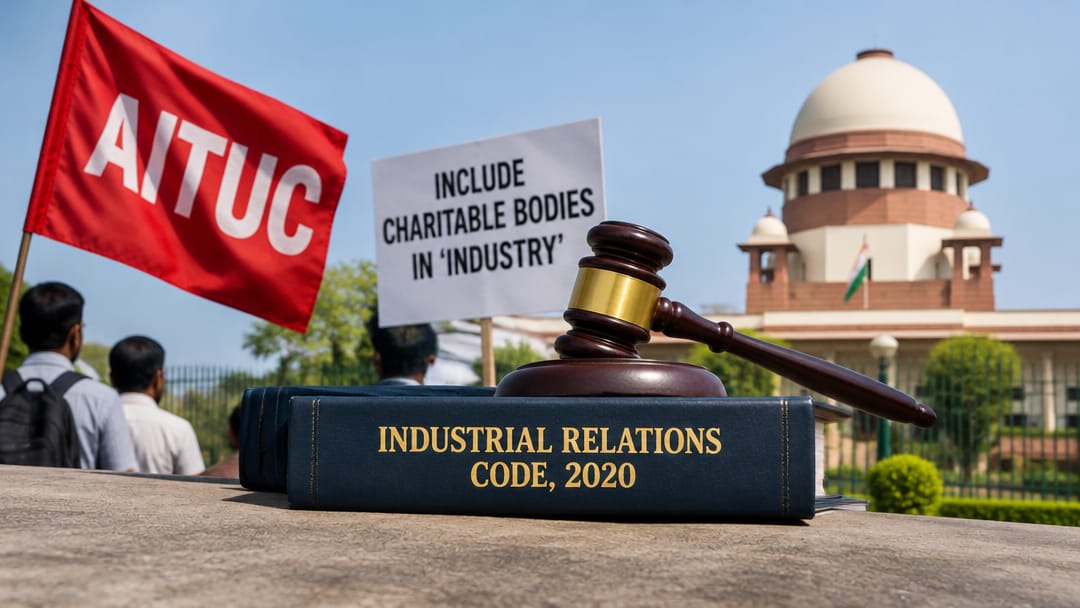
The All India Trade Union Congress, Tamil Nadu has filed a petition in the Supreme Court challenging Section 2(p) of the Industrial Relations Code, 2020, which defines 'industry.' The petition targets specific exclusions from that definition — notably charitable and philanthropic establishments — arguing these exclusions unconstitutionally deny workers in those sectors labour protections. The Supreme Court is set to examine whether Parliament's narrowing of the 'industry' definition violates constitutional rights of workers employed in excluded establishments.
02 Understand
Why it matters
The definition of 'industry' is foundational to labour law because it determines which workers and employers fall within the protective framework of industrial legislation — including rights to unionise, strike, and claim reinstatement. The Industrial Relations Code, 2020 consolidates three earlier statutes: the Industrial Disputes Act 1947, the Trade Unions Act 1926, and the Industrial Employment (Standing Orders) Act 1946. Section 2(p) of the Code defines 'industry' and, crucially, excludes certain establishments such as charitable institutions, hospitals run by trusts, and philanthropic organisations.
The constitutional challenge rests on Articles 14 (equality), 19(1)(c) (right to form associations/unions), and 21 (right to livelihood). Workers in excluded sectors argue that their exclusion from the definition creates an arbitrary classification — they perform the same economic activity as workers in 'industry' but lose all statutory protection.
The landmark precedent in this space is Bangalore Water Supply & Sewerage Board v. A. Rajappa (1978), where a seven-judge Constitution Bench gave the widest possible interpretation to 'industry' under the Industrial Disputes Act, holding that even a municipality, a hospital, or a charitable institution engaged in systematic activity using capital and labour with economic output qualifies as 'industry.' Parliament's exclusions in the 2020 Code are effectively a legislative reversal of Rajappa. The Supreme Court must now decide whether that legislative reversal passes constitutional scrutiny — particularly whether the exclusions violate equality or impair the right to form trade unions under Art. 19(1)(c), which can only be restricted on grounds listed in Art. 19(4), none of which straightforwardly justify removing entire sectors from labour law coverage.
Remember + Why it matters
The key recall facts and exact examiner angle for CLAT PG are in the Crux app.
01
Key figure and date from this topic
02
Specific number or threshold to remember
03
Policy or regulatory implication
Read + Understand free forever · 30-day free trial