01 Read
What happened
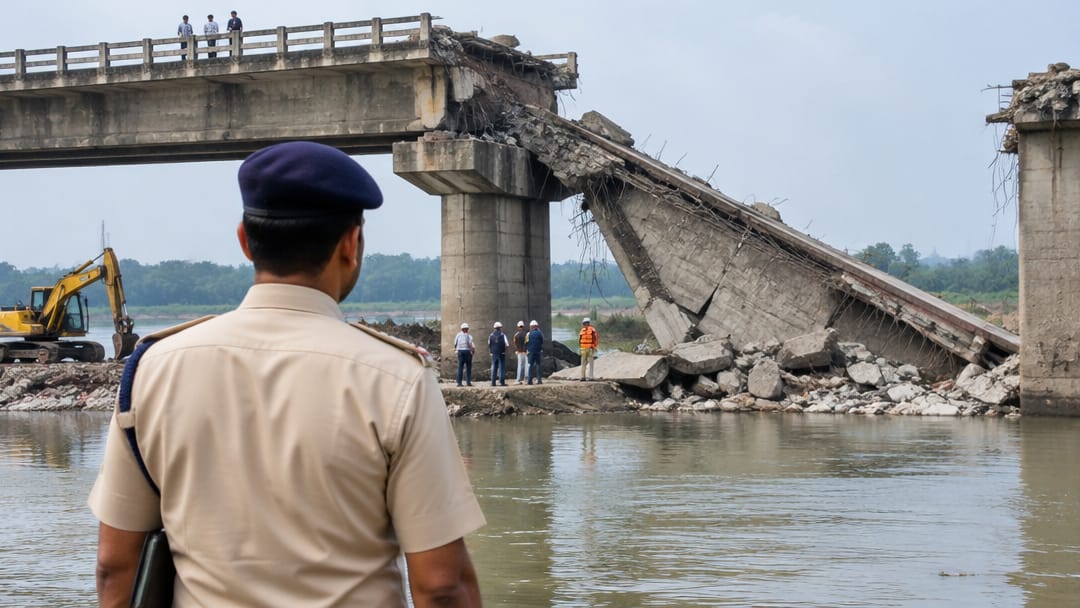
The Jharkhand High Court has directed police to complete long-pending investigations into bridge collapse cases in Dhanbad, Palamau, and Gumla within three months. The court intervened after probes remained inconclusive for an extended period, signalling judicial impatience with investigative inaction. The order reflects the High Court's supervisory jurisdiction over criminal investigations under Article 227 and its power to monitor police compliance with statutory duties under the CrPC.
02 Understand
Why it matters
This order illustrates a core principle repeatedly tested in CLAT PG: the High Court's supervisory and monitoring jurisdiction over criminal investigations. Under the CrPC (and now BNSS 2023), investigation is primarily a police function, but courts are not powerless spectators. The Supreme Court in Vineet Narain v. Union of India (1998) firmly established that the judiciary can monitor investigations without taking over the investigative function — a distinction the examiner loves to test.
When a High Court sets a time-bound deadline for police to complete an investigation, it exercises its power under Article 226 (writ jurisdiction) or Article 227 (superintendence over subordinate courts and tribunals), or both. The court does not direct the outcome of the investigation — it cannot tell police whom to charge — but it can ensure the investigation does not die from deliberate delay or administrative neglect.
The statutory backdrop matters. Section 173 CrPC (Section 193 BNSS) governs the submission of a police report (charge sheet) upon completion of investigation. If police fail to file a charge sheet within the statutory period for cognisable offences, the accused becomes entitled to default bail under Section 167(2) CrPC (Section 187 BNSS). Courts monitor this timeline to protect both victims' rights to justice and accused persons' liberty rights.
For CLAT PG, the examiner typically places a passage describing such a High Court order and then asks: what power is the court exercising, what section governs completion of investigation, or when does default bail arise — testing whether the aspirant can distinguish supervision from interference in investigation.
Remember + Why it matters
The key recall facts and exact examiner angle for CLAT PG are in the Crux app.
01
Key figure and date from this topic
02
Specific number or threshold to remember
03
Policy or regulatory implication
Read + Understand free forever · 30-day free trial