01 Read
What happened
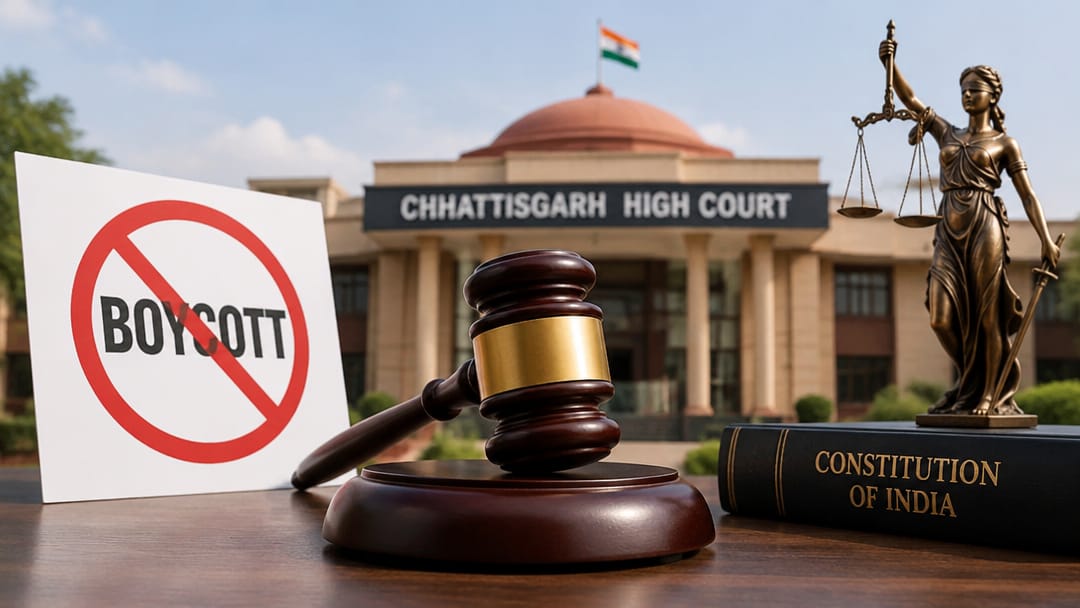
The Chhattisgarh High Court ruled that a fatwa has no legal sanctity to impose social boycott on individuals, reaffirming that religious edicts cannot override constitutional rights. The court dismissed a petition filed by a brother-sister duo who were ostracised after a relative married a Shia Muslim man. While affirming the legal principle against faith-based boycotts, the court found the petitioners lacked sufficient standing on the specific facts presented to grant relief.
02 Understand
Why it matters
This ruling engages three intersecting constitutional guarantees. First, Article 17 abolishes untouchability and forbids its practice in any form — courts have extended its spirit to cover caste or community-based social exclusion even when not rooted in caste hierarchy. Second, Article 19(1)(a) and 19(1)(c) protect freedom of expression and association; a fatwa that socially coerces individuals into silence or conformity infringes these freedoms. Third, Article 21 protects the right to live with dignity — the Supreme Court in Vishakha and later in Shakti Vahini v. Union of India (2018) held that honour-based community sanctions violate the right to life and liberty.
The critical legal principle here is that personal law or religious opinion — however sincerely held — does not acquire the force of state law. The Supreme Court settled this in Vishwaloknath Shastri (1954) and more directly in Mohd. Qasim (Allahabad HC) and the landmark All India Muslim Personal Law Board cases: a fatwa is merely a religious opinion and cannot be enforced by courts, nor can it be used to punish individuals for choices that are otherwise lawful under civil law.
The court's dismissal of the petition on facts — not on principle — is equally important. It demonstrates how courts distinguish between affirming a right in the abstract and granting relief on a specific set of facts. This distinction is a classic CLAT PG trap: the principle was upheld, but the petitioners lost. Aspirants must track both the ratio decidendi (legal rule) and the disposition (outcome) separately.
Remember + Why it matters
The key recall facts and exact examiner angle for CLAT PG are in the Crux app.
01
Key figure and date from this topic
02
Specific number or threshold to remember
03
Policy or regulatory implication
Read + Understand free forever · 30-day free trial