01 Read
What happened
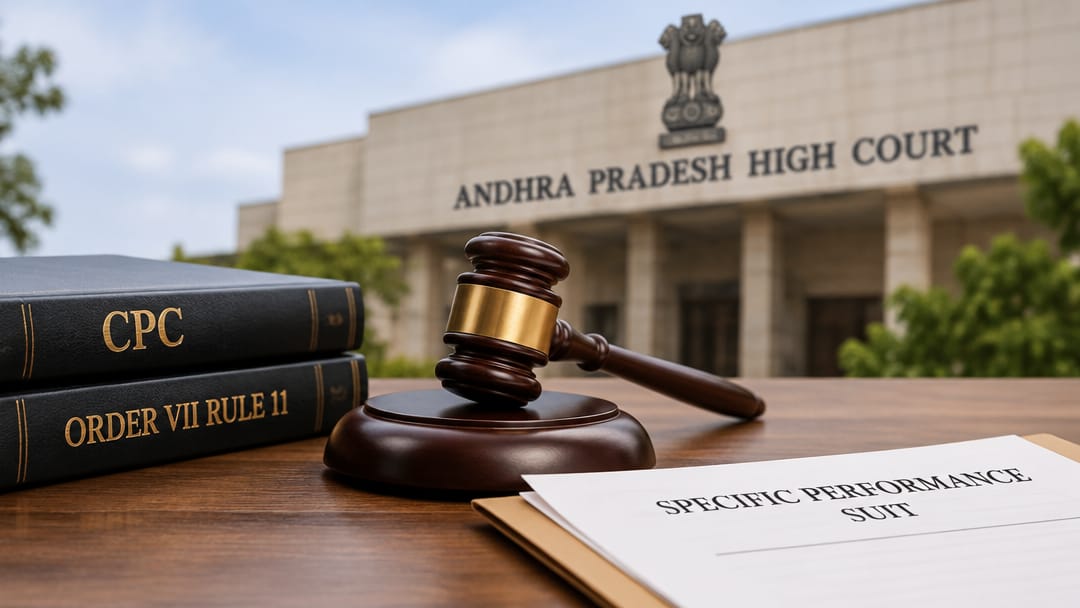
The Andhra Pradesh High Court restored a 16-year-old specific performance suit after setting aside a trial court order that had rejected the plaint under Order VII Rule 11 of the CPC. The trial court had dismissed the suit at the threshold stage, deciding disputed factual questions without a full trial. The High Court held that such contested questions of fact cannot be resolved at the rejection stage and must proceed to trial.
02 Understand
Why it matters
This case sits at the intersection of civil procedure and contract law — specifically the remedy of specific performance under the Specific Relief Act, 1963, and the threshold bar of Order VII Rule 11 CPC.
Order VII Rule 11 CPC allows a court to reject a plaint at the admission stage itself, without a full trial, on narrow grounds: the plaint does not disclose a cause of action, the relief claimed is undervalued, the suit is barred by law, etc. The critical rule here is that at this stage, the court must read the plaint as a whole and take the averments therein as correct. It cannot look beyond the plaint to disputed facts, oral evidence, or the defendant's version.
The AP High Court's ruling reaffirms a settled principle: if the question of whether the suit should proceed requires the court to decide disputed facts, rejection under Order VII Rule 11 is impermissible. The matter must go to trial.
For specific performance suits specifically, this matters because defendants routinely argue at the threshold that the agreement was forged, time-barred, or not specifically enforceable — all disputed questions. Under the 2018 amendment to the Specific Relief Act, specific performance is now a rule rather than a discretionary remedy, making the enforceability of sale agreements even more significant.
The intersection being tested: can a court reject a specific performance suit under Order VII Rule 11 when the enforceability of the underlying agreement itself is disputed? The answer, as this case reinforces, is no.
Remember + Why it matters
The key recall facts and exact examiner angle for CLAT PG are in the Crux app.
01
Key figure and date from this topic
02
Specific number or threshold to remember
03
Policy or regulatory implication
Read + Understand free forever · 30-day free trial