01 Read
What happened
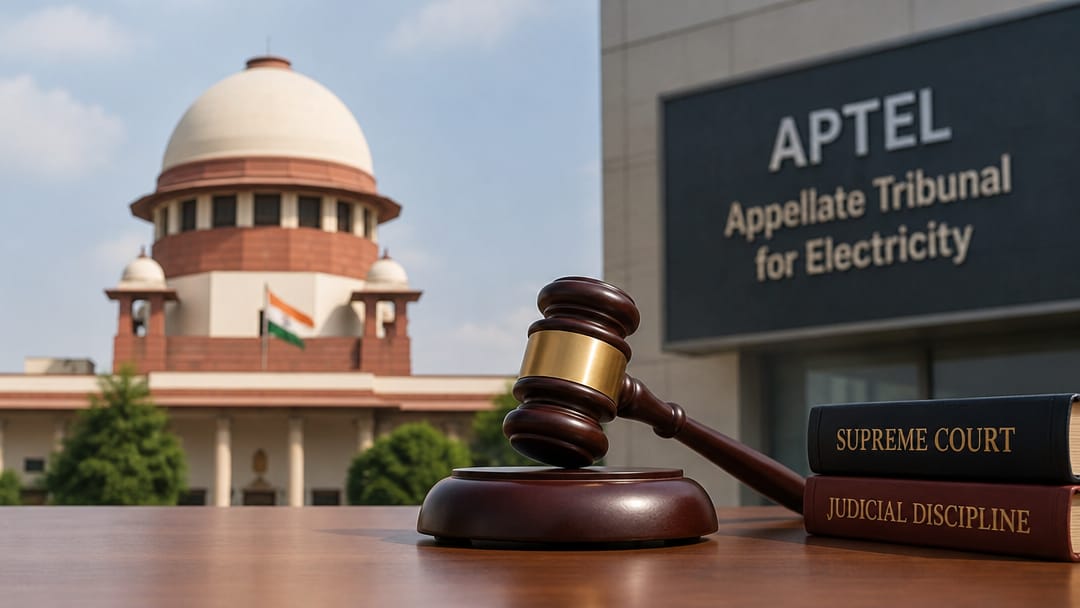
The Supreme Court sharply criticised the Appellate Tribunal for Electricity (APTEL) for conducting a review of an order that the Supreme Court had itself previously upheld. The Court held that this conduct amounted to a breach of judicial discipline, as a lower tribunal cannot revisit or effectively overrule a matter already settled by a higher court. The observation signals a significant reminder about the hierarchy of courts and the binding nature of Supreme Court precedent on all subordinate tribunals.
02 Understand
Why it matters
This episode turns on a foundational constitutional principle: judicial hierarchy and the binding effect of Supreme Court decisions under Article 141 of the Constitution, which declares that the law declared by the Supreme Court shall be binding on all courts within the territory of India. The word 'courts' in Article 141 has been interpreted to include tribunals exercising judicial or quasi-judicial functions — APTEL being one such statutory tribunal established under the Electricity Act, 2003.
When APTEL reviewed an order that the Supreme Court had already upheld, it effectively attempted to reopen a settled legal position. This violates two interlocking principles: first, the doctrine of judicial discipline, which requires lower forums to follow and not circumvent Supreme Court rulings; second, the doctrine of merger, under which once a superior court rules on a matter, the original order merges with the superior court's decision and a lower forum has no residual jurisdiction to revisit it.
The review power of tribunals is a limited, exceptional power. It cannot be invoked to override what a superior court has already decided — that would invert the appellate hierarchy. The Supreme Court's rebuke signals that tribunals exercising review jurisdiction must first check whether the subject matter has already been conclusively determined by a higher court. For CLAT PG aspirants, this event tests understanding of Article 141, the doctrine of merger, judicial discipline, and the constitutional position of tribunals vis-à-vis the Supreme Court.
Remember + Why it matters
The key recall facts and exact examiner angle for CLAT PG are in the Crux app.
01
Key figure and date from this topic
02
Specific number or threshold to remember
03
Policy or regulatory implication
Read + Understand free forever · 30-day free trial