01 Read
What happened
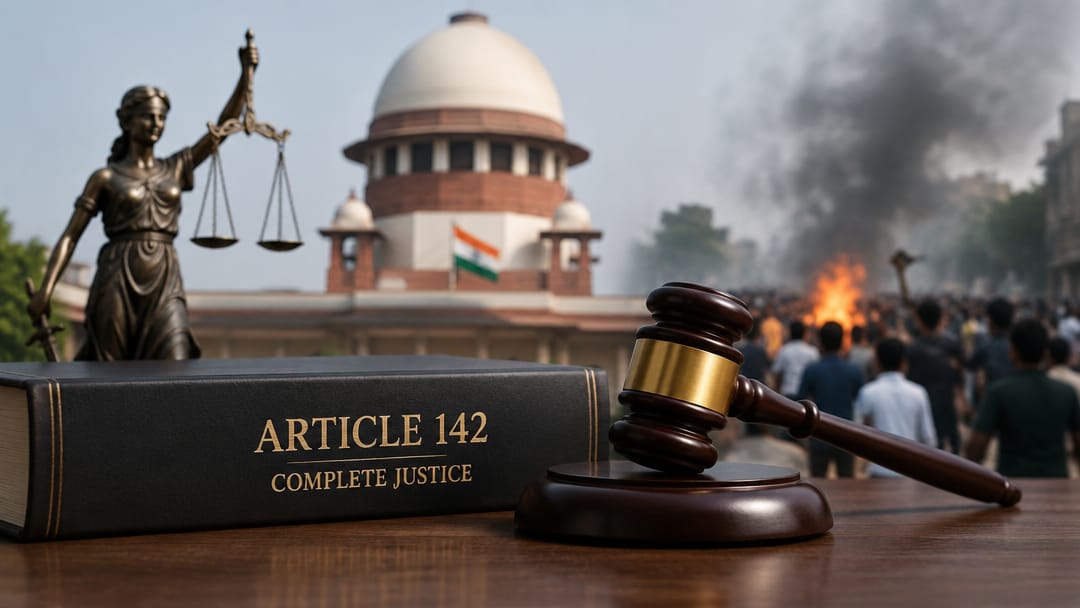
A constitutional law critique argues that the Supreme Court's use of Article 142 — its plenary power to do 'complete justice' — to grant blanket quashing of criminal proceedings, particularly in riot and communal violence cases, substitutes individual adjudication with informal collective settlements. The piece contends this conflates substantive rights protection with procedural convenience, effectively decriminalising serious offences through judicial amnesty rather than legislative pardon, undermining the distinction between civil compounding and public-law prosecution.
02 Understand
Why it matters
Article 142 of the Constitution grants the Supreme Court power to pass any order necessary to do 'complete justice' in pending matters. Originally conceived as a curative, gap-filling tool — used in landmark cases like Union Carbide (Bhopal gas tragedy settlement) and in contempt enforcement — it has no textual limit except that it cannot override substantive law. The Supreme Court in Supreme Court Bar Association v. Union of India (1998) clarified that Article 142 cannot be used to supplant or ignore substantive legal provisions, only to supplement procedural gaps.
The current constitutional debate focuses on a pattern where the Court invokes Article 142 to quash First Information Reports (FIRs) or criminal trials in bulk — especially post-communal riot cases — when the parties (usually the accused and the local community or victim's family) reach a 'compromise.' Critics argue this converts the criminal justice system, which protects public interest, into a panchayat-style private settlement mechanism.
The core doctrinal distinction being violated, critics argue, is between: (1) compoundable offences under Section 320 CrPC (now BNSS), where private settlement is legislatively permitted; and (2) non-compoundable offences like murder, rape, and riot, where the State is the prosecutor and individual compromise cannot extinguish public liability. Using Article 142 to quash non-compoundable offences sidesteps this statutory architecture.
This also intersects with Article 21 (victim's right to fair investigation and justice), Article 14 (equal treatment of similarly situated accused), and the separation of powers — since the power to grant amnesty in criminal law traditionally belongs to the executive under Articles 72 and 161, not the judiciary.
Remember + Why it matters
The key recall facts and exact examiner angle for UPSC CSE are in the Crux app.
01
Key figure and date from this topic
02
Specific number or threshold to remember
03
Policy or regulatory implication
Read + Understand free forever · 30-day free trial