01 Read
What happened
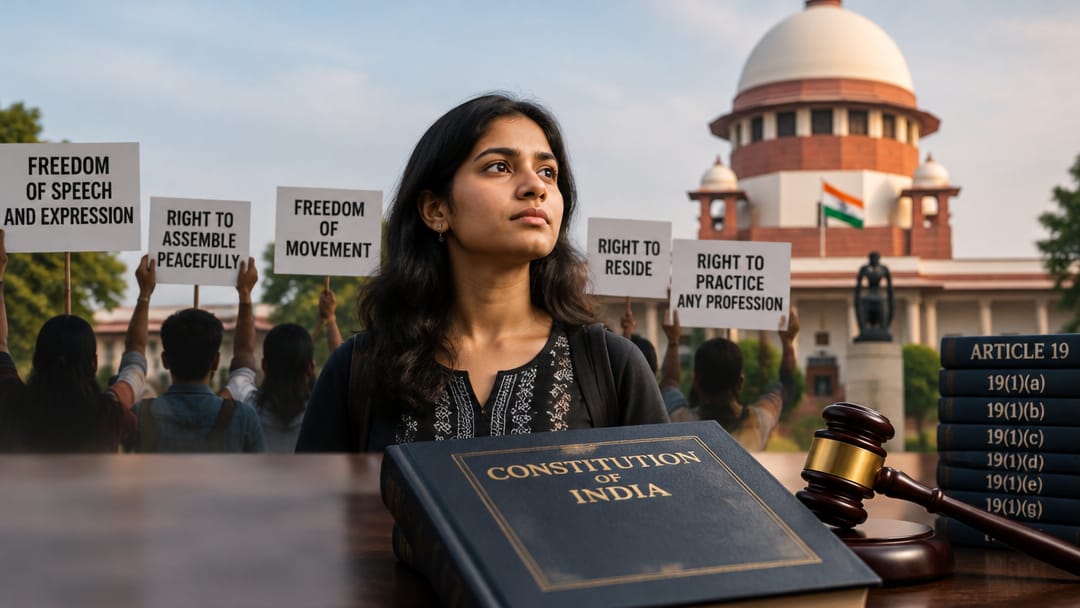
Article 19 of the Indian Constitution guarantees six fundamental freedoms to citizens — speech and expression, peaceful assembly, association, movement, residence, and profession. Each freedom is paired with specific grounds on which the state may impose reasonable restrictions. Courts have repeatedly tested these restrictions against constitutional standards. Landmark rulings from Romesh Thappar to Shreya Singhal have shaped exactly where citizen liberty ends and permissible state regulation begins under Articles 19(1)(a) through 19(1)(g).
02 Understand
Why it matters
Article 19 is the operational core of Part III's freedom guarantees. Originally, it protected seven freedoms — the right to acquire, hold, and dispose of property under 19(1)(f) was deleted by the 44th Constitutional Amendment in 1978, leaving six.
The structure of Article 19 is deliberate: every clause in 19(1) has a corresponding restriction clause (19(2) to 19(6)) that allows the state to impose 'reasonable restrictions' on specified grounds. The word 'reasonable' is the constitutional battleground — it requires courts to apply a proportionality test: is the restriction proportionate to the legitimate aim pursued?
For free speech under 19(1)(a), restrictions under 19(2) can only be imposed on grounds listed in the clause — sovereignty, integrity, security of the state, friendly relations with foreign states, public order, decency, morality, contempt of court, defamation, and incitement to offence. Courts have held this list is exhaustive, not illustrative.
The doctrinal evolution is critical. In Romesh Thappar v State of Madras (1950), the Supreme Court struck down press restrictions not traceable to 19(2) grounds. In Bennett Coleman v Union of India (1972), newsprint restrictions were tested against 19(1)(a). In Shreya Singhal v Union of India (2015), Section 66A of the IT Act was struck down because it penalised speech far beyond 19(2)'s permissible grounds. The court in Shreya Singhal also distinguished 'discussion,' 'advocacy,' and 'incitement' — only incitement to a cognisable offence can be restricted.
For CLAT PG, the examiner consistently uses passage-based questions to test whether candidates can identify: (1) which freedom is engaged, (2) which restriction clause applies, and (3) whether the restriction satisfies the reasonableness standard from the passage's ruling.
Remember + Why it matters
The key recall facts and exact examiner angle for CLAT PG are in the Crux app.
01
Key figure and date from this topic
02
Specific number or threshold to remember
03
Policy or regulatory implication
Read + Understand free forever · 30-day free trial