01 Read
What happened
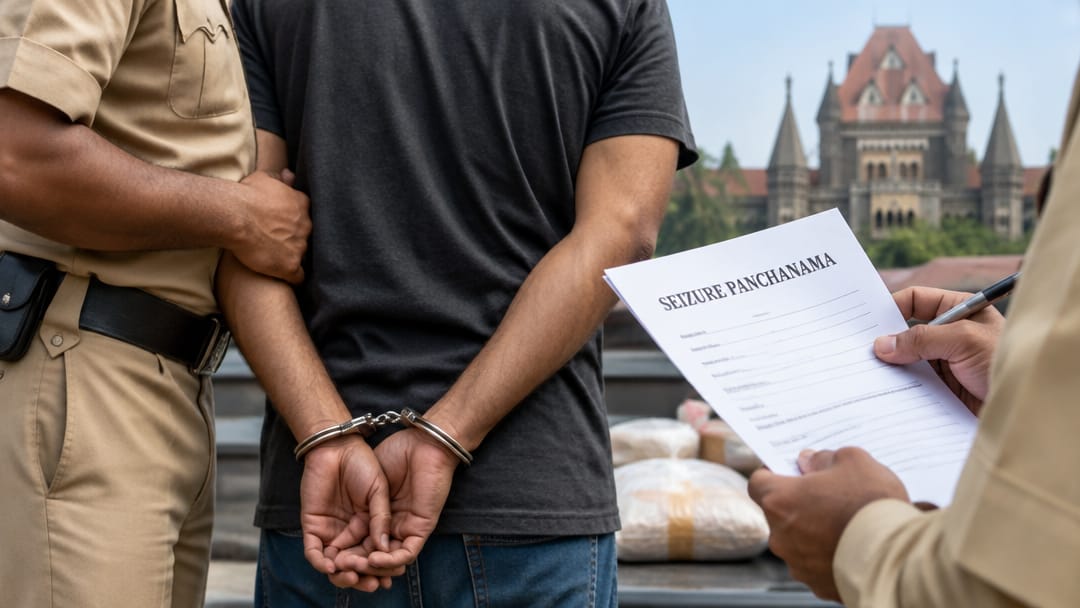
The Bombay High Court has held that serving a seizure panchanama on an accused at the time of arrest does not satisfy the mandatory requirement under the Narcotic Drugs and Psychotropic Substances Act to inform the accused of the grounds of arrest. The court ruled the arrest invalid because the panchanama documents the seizure of contraband, not the reasons for detention, and cannot substitute the distinct statutory obligation to communicate grounds of arrest personally to the accused.
02 Understand
Why it matters
This ruling turns on Section 52A and the broader arrest framework under the NDPS Act, read alongside Article 22(1) of the Constitution, which guarantees every arrested person the right to be informed of the grounds of arrest 'as soon as may be.' The Bombay High Court drew a critical distinction between two documents that officers often treat as interchangeable in narcotics cases: the seizure panchanama and the grounds of arrest memo.
A seizure panchanama is a contemporaneous record of what was found, where, and in whose possession — it establishes the evidentiary chain of custody for the contraband. It is not addressed to the accused as an explanation of why they are being taken into custody. Grounds of arrest, by contrast, must tell the accused the specific reasons the law authorises their detention — which offence, which section, what conduct is alleged.
The Supreme Court in Pankaj Bansal v. Union of India (2023) had already raised the bar nationally by requiring written grounds of arrest to be furnished to the accused, a standard reinforced under Section 47 BNSS 2023. The Bombay HC's ruling extends that logic specifically to NDPS cases: handing over a panchanama is a seizure formality, not an arrest communication. An arrest made without communicating proper grounds is constitutionally void under Article 22(1) and renders subsequent custody illegal.
For CLAT PG, the core principle is: each step in the arrest-custody chain has its own mandatory requirement, and satisfying one does not excuse non-compliance with another.
Remember + Why it matters
The key recall facts and exact examiner angle for CLAT PG are in the Crux app.
01
Key figure and date from this topic
02
Specific number or threshold to remember
03
Policy or regulatory implication
Read + Understand free forever · 30-day free trial