01 Read
What happened
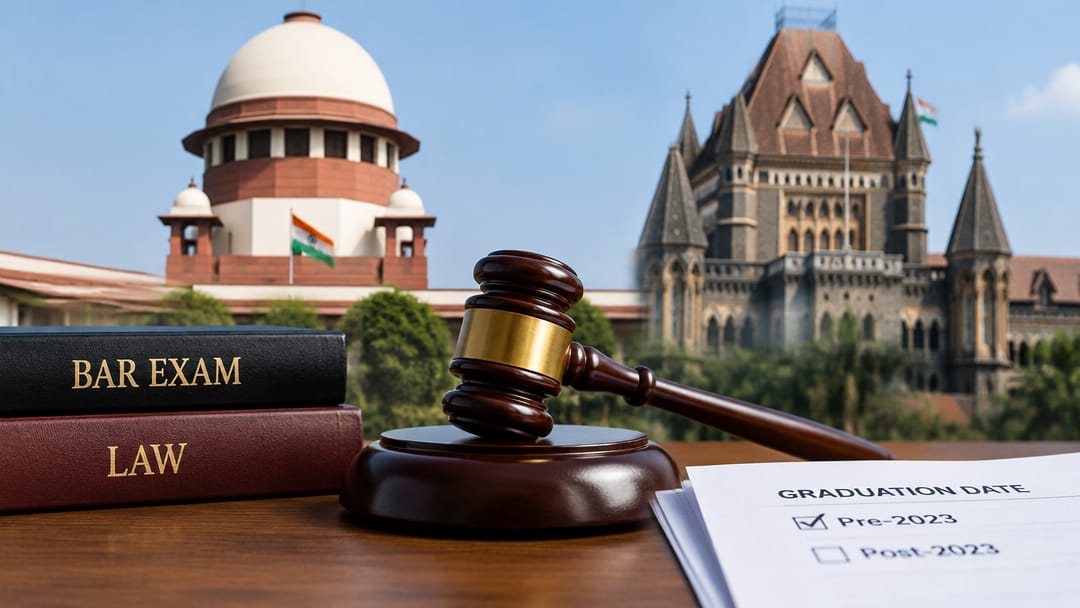
The Bombay High Court restricted the Supreme Court's deemed one-year practice exemption for bar exam eligibility to law graduates who had completed their degree before the transitional period began. The Supreme Court's earlier ruling had extended the benefit to all law graduates during the transitional period without any graduation-date restriction. The Bombay HC's narrower reading effectively excludes recent graduates from claiming the exemption, creating a direct conflict with the broader SC interpretation.
02 Understand
Why it matters
At the heart of this dispute is eligibility for the All India Bar Examination (AIBE), administered by the Bar Council of India (BCI). Under the Advocates Act, 1961, an enrolled advocate must complete one year of practice before appearing for AIBE. The Supreme Court, during a transitional phase, ruled that this one-year practice requirement would be 'deemed' to be satisfied — meaning graduates could appear without actually completing the year — and crucially, it did not restrict this benefit to any particular batch of graduates.
The Bombay High Court's reading departs from this. It interpreted the SC ruling narrowly, confining the deemed-exemption only to those who graduated before a specific cut-off, effectively re-introducing a temporal restriction the Supreme Court had not imposed.
The legal tension here is classic statutory interpretation: when a superior court lays down a rule during a transitional period, does that rule apply universally (as the SC intended) or only to those who were within the system at the time the rule was framed (as the Bombay HC held)? This implicates the principle of beneficial construction — that provisions enabling access to a profession should be read broadly — and also the doctrine of prospective versus retrospective application of judicial pronouncements. CLAT PG examiners test whether aspirants can identify the precise ratio of a ruling versus its obiter, and whether a High Court can legitimately narrow a Supreme Court ruling's scope without expressly overruling it.
Remember + Why it matters
The key recall facts and exact examiner angle for CLAT PG are in the Crux app.
01
Key figure and date from this topic
02
Specific number or threshold to remember
03
Policy or regulatory implication
Read + Understand free forever · 30-day free trial