01 Read
What happened
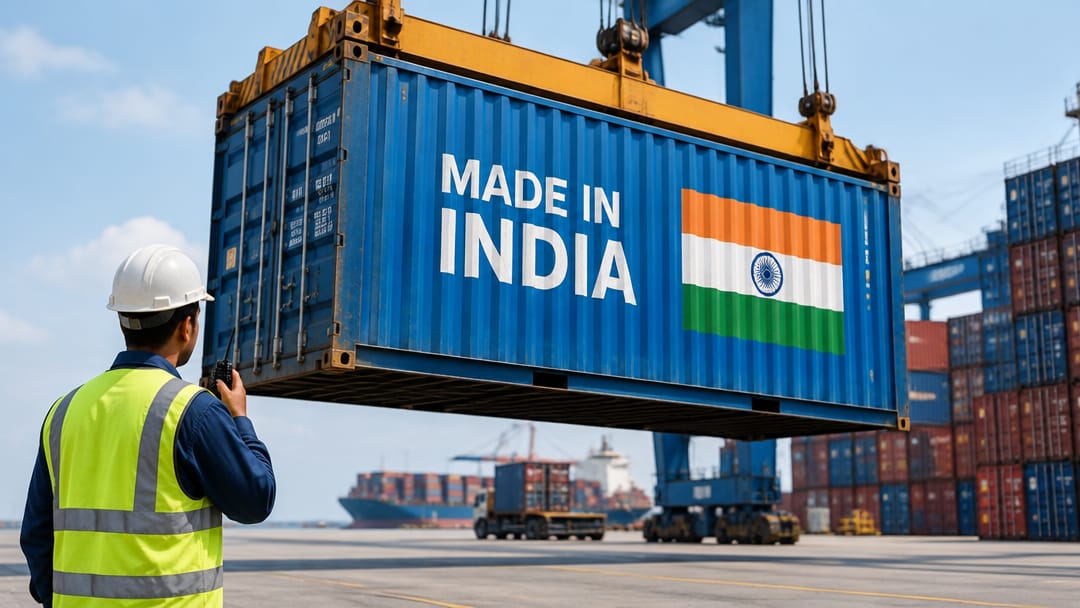
The Union Cabinet approved the Scheme for Container Manufacturing, announced in Union Budget 2026–27, to develop domestic production capacity for shipping containers. India currently imports most of its containers, creating supply chain vulnerabilities and trade logistics costs. The scheme offers interest subvention as its primary financial instrument to incentivise manufacturers. The move aims to reduce dependence on Chinese-manufactured containers and strengthen India's export logistics infrastructure by building an indigenous container industry.
02 Understand
Why it matters
India faces a structural problem in global trade logistics: it imports the vast majority of its shipping containers, with China dominating global container manufacturing at roughly 90% of world output. The COVID-19 pandemic exposed this vulnerability acutely, when container shortages drove freight rates to record highs and disrupted Indian exports.
The Scheme for Container Manufacturing addresses this through interest subvention — a mechanism where the government subsidises the interest component of loans taken by manufacturers, reducing their borrowing cost and making capital-intensive container production financially viable. This is a demand-side push on the supply side: by lowering the cost of setting up manufacturing units, the government nudges private investment into a sector that would otherwise remain uncompetitive against cheap Chinese imports.
For exam purposes, understand the policy logic: interest subvention schemes sit at the intersection of industrial policy, trade logistics, and financial inclusion of MSMEs into manufacturing value chains. The scheme connects to the broader 'Atmanirbhar Bharat' and 'Make in India' frameworks.
For RBI aspirants, the interest subvention mechanism is directly relevant — RBI administers similar subvention schemes in agriculture (Kisan Credit Card) and housing. The delivery mechanism — channelled through banks, with the government reimbursing the interest differential — is a core concept in priority sector and directed lending.
For UPSC aspirants, the scheme sits within India's trade competitiveness, port-led development, and Sagarmala Programme context. Containers are the unit of modern global trade; domestic manufacturing capacity is a strategic infrastructure question, not merely an industrial one.
Remember + Why it matters
The key recall facts and exact examiner angle for UPSC CSE are in the Crux app.
01
Key figure and date from this topic
02
Specific number or threshold to remember
03
Policy or regulatory implication
Read + Understand free forever · 30-day free trial