01 Read
What happened
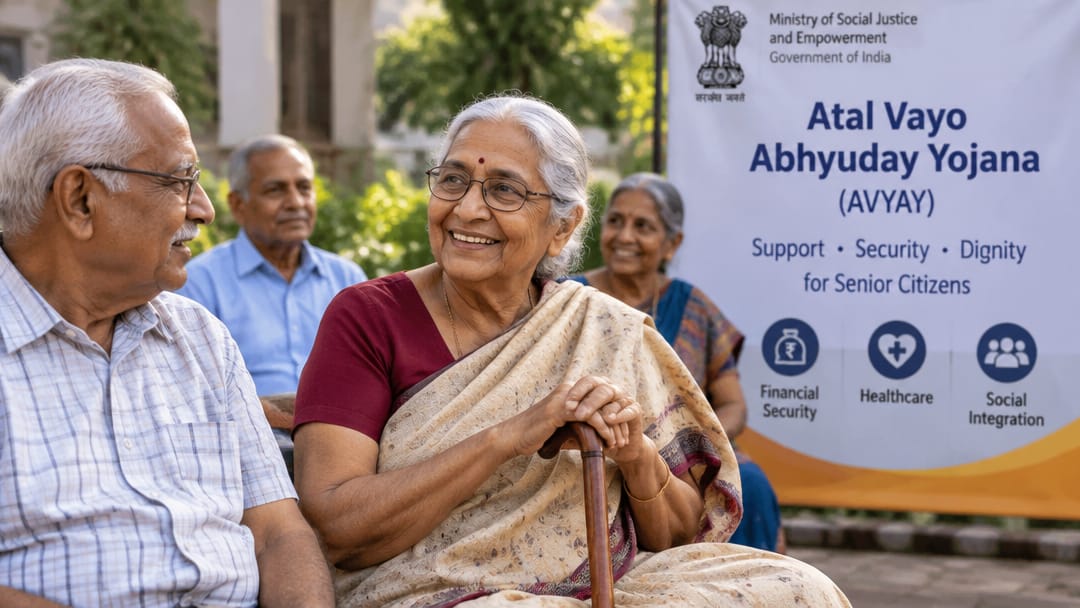
The Central Government has released ₹77.98 crore as grant-in-aid to 755 projects under the Atal Vayo Abhyuday Yojana (AVYAY), its flagship scheme for elderly welfare. AVYAY, implemented by the Ministry of Social Justice and Empowerment, consolidates multiple sub-schemes targeting senior citizens' financial security, healthcare, and social integration. The release signals active fiscal commitment to India's rapidly ageing population, which is projected to exceed 300 million by 2050.
02 Understand
Why it matters
Atal Vayo Abhyuday Yojana (AVYAY) is an umbrella scheme under the Ministry of Social Justice and Empowerment that replaced the earlier National Action Plan for Senior Citizens. It consolidates several sub-schemes into one administrative framework:
1. Integrated Programme for Senior Citizens (IPSrC): Funds NGOs and organisations to run old-age homes, day care centres, and mobile Medicare units for destitute elderly.
2. Rashtriya Vayoshri Yojana (RVY): Provides assisted-living devices (hearing aids, wheelchairs, spectacles, etc.) free of cost to BPL senior citizens suffering from age-related disabilities. Implemented through ALIMCO (Artificial Limbs Manufacturing Corporation of India).
3. Senior Able Citizens for Re-Employment in Dignity (SACRED): An online platform connecting retired/senior citizens with employment opportunities.
4. Elder Line (14567): India's first pan-India helpline for senior citizens covering legal aid, financial fraud, emotional support, and healthcare guidance.
The grant-in-aid mechanism here is key for NABARD and RBI aspirants: funds flow from the Centre to NGOs and State-registered entities through a project-based competitive grant model, not through direct benefit transfer. This distinguishes AVYAY's delivery architecture from schemes like PM-KISAN or PMJDY.
For UPSC aspirants, AVYAY sits at the intersection of demographic dividend reversal (ageing population), SDG Goal 3 (Good Health and Well-Being), and Article 41 of the Constitution (right to public assistance in old age). India's elderly population (60+) currently stands at approximately 149 million (2024), making elder-care policy a governance priority.
Remember + Why it matters
The key recall facts and exact examiner angle for UPSC CSE are in the Crux app.
01
Key figure and date from this topic
02
Specific number or threshold to remember
03
Policy or regulatory implication
Read + Understand free forever · 30-day free trial