01 Read
What happened
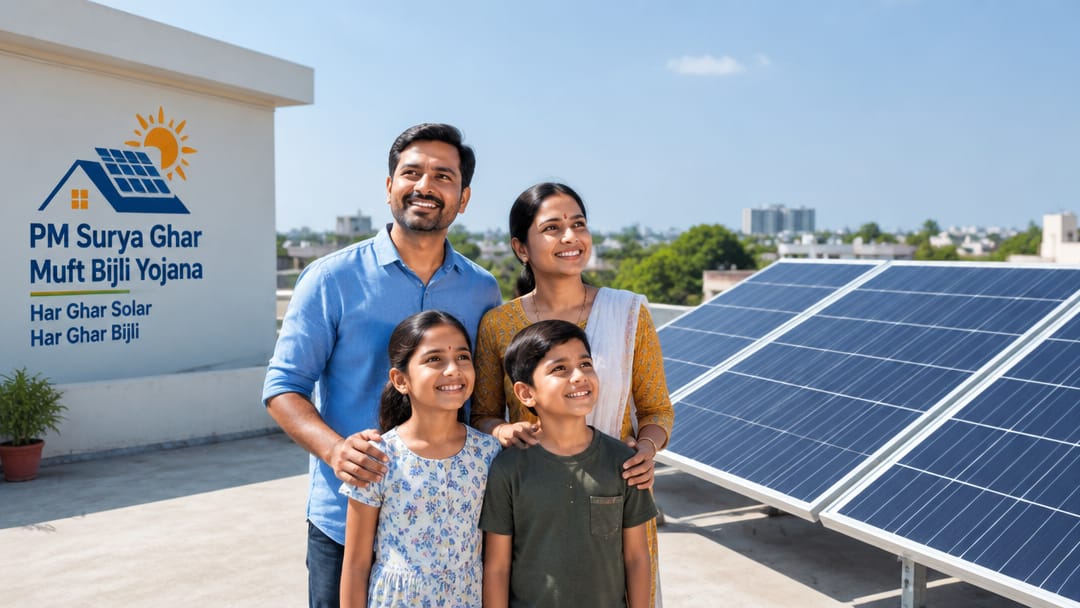
PM Surya Ghar: Muft Bijli Yojana, launched in February 2024, has achieved mass-movement scale with over one crore registrations and lakhs of rooftop solar installations sanctioned across India. The scheme provides up to 300 units of free electricity monthly to households installing rooftop solar panels, with central subsidies channelled directly to beneficiaries. It targets one crore households and aims to deliver savings for families, reduce state electricity subsidies, and advance India's renewable energy capacity goals.
02 Understand
Why it matters
PM Surya Ghar: Muft Bijli Yojana sits at the intersection of three major policy priorities: household welfare (free electricity), energy transition (rooftop solar), and fiscal management (reducing state discoms' subsidy burden). Launched on 13 February 2024 with a budgetary outlay of ₹75,021 crore, it is implemented by the Ministry of New and Renewable Energy (MNRE) through the National Programme on Advanced Chemistry Cell Battery Storage and distributed via DISCOMs.
The scheme's delivery mechanism is distinctive: central financial assistance (CFA) is paid directly to beneficiaries' bank accounts after installation and net-metering connection — making it a Direct Benefit Transfer model for a physical infrastructure scheme. For RBI aspirants, this DBT channel and the involvement of scheduled commercial banks in loan facilitation (with REC Limited and PFC as nodal financing agencies) is the critical angle. For NABARD aspirants, the rural and semi-urban household dimension — energy self-sufficiency reducing household expenditure — connects to rural livelihoods. For UPSC aspirants, the governance architecture (MNRE → DISCOMs → beneficiary), the scheme's role in India's 500 GW renewable target by 2030, and the welfare-fiscal federalism balance are all testable. The scheme offers 1–2 kW installations (subsidised at ₹30,000/kW) and 2–3 kW systems (₹18,000/kW for the incremental unit), with an upper cap. Net metering allows surplus power to be fed back, further reducing effective electricity costs.
The scheme's delivery mechanism is distinctive: central financial assistance (CFA) is paid directly to beneficiaries' bank accounts after installation and net-metering connection — making it a Direct Benefit Transfer model for a physical infrastructure scheme. For RBI aspirants, this DBT channel and the involvement of scheduled commercial banks in loan facilitation (with REC Limited and PFC as nodal financing agencies) is the critical angle. For NABARD aspirants, the rural and semi-urban household dimension — energy self-sufficiency reducing household expenditure — connects to rural livelihoods. For UPSC aspirants, the governance architecture (MNRE → DISCOMs → beneficiary), the scheme's role in India's 500 GW renewable target by 2030, and the welfare-fiscal federalism balance are all testable. The scheme offers 1–2 kW installations (subsidised at ₹30,000/kW) and 2–3 kW systems (₹18,000/kW for the incremental unit), with an upper cap. Net metering allows surplus power to be fed back, further reducing effective electricity costs.
Remember + Why it matters
The key recall facts and exact examiner angle for UPSC CSE are in the Crux app.
01
Key figure and date from this topic
02
Specific number or threshold to remember
03
Policy or regulatory implication
Read + Understand free forever · 30-day free trial