01 Read
What happened
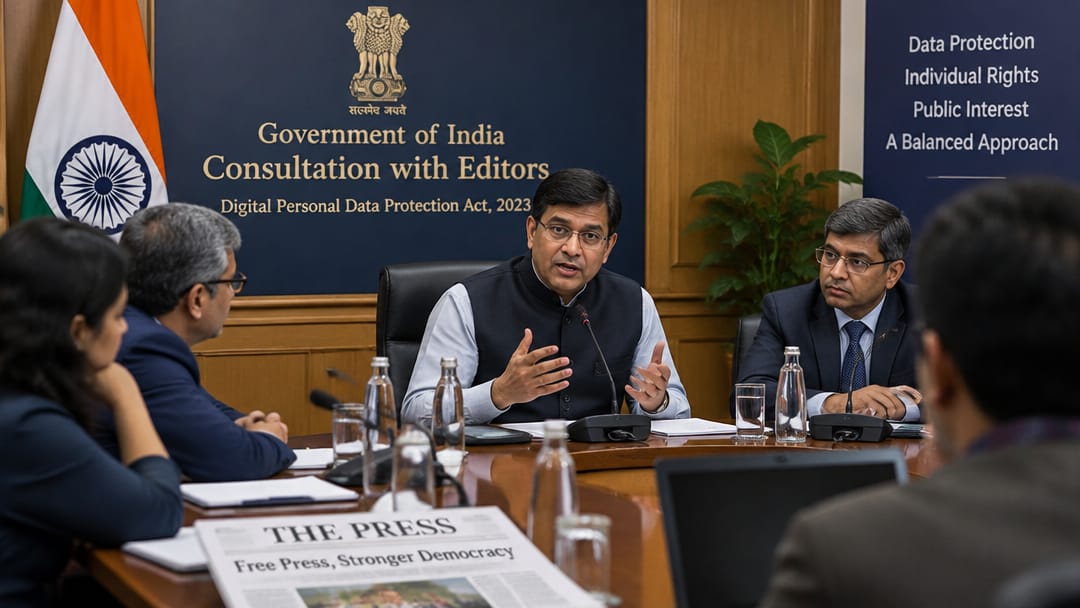
The Central Government invited newspaper editors for consultations on the Digital Personal Data Protection Act, 2023, assuring them it has no intention of restricting journalistic freedom guaranteed under the Constitution. Officials indicated openness to addressing concerns that the law's data-processing obligations and exemptions may conflict with press reporting practices. The move signals that the government is still calibrating how the Act balances individual data rights against the public interest in a free and investigative press.
02 Understand
Why it matters
The Digital Personal Data Protection Act, 2023 (DPDPA) is India's first comprehensive data-privacy statute, replacing the earlier framework under the Information Technology Act, 2000. It operationalises the constitutional right to privacy recognised in Justice K.S. Puttaswamy v. Union of India (2017, nine-judge bench), which held privacy to be a fundamental right under Article 21.
The tension the government is now addressing arises because the DPDPA requires 'Data Fiduciaries' — entities that collect and process personal data — to satisfy strict consent and purpose-limitation rules. News organisations routinely process personal data without explicit consent during investigative reporting. Section 17 of the Act carves out exemptions for certain legitimate state and public-interest activities, but the precise scope of a press exemption has not been finalised in the Rules, which are still being drafted.
Constitutionally, freedom of the press flows from Article 19(1)(a) as part of freedom of speech and expression. It is not absolute; Article 19(2) permits reasonable restrictions in the interests of, among other things, public order and decency. The DPDPA's consent requirements, if applied rigidly to journalism, could function as an indirect restriction on Art 19(1)(a) — a classic 'chilling effect' argument. Courts test such indirect restrictions under the proportionality standard articulated in Modern Dental College v. State of MP (2016) and Anuradha Bhasin v. Union of India (2020): the measure must be (i) backed by law, (ii) pursue a legitimate aim, (iii) be necessary, and (iv) be proportionate.
For CLAT PG aspirants, this event is the live legislative application of Puttaswamy and the Art 19(1)(a) press-freedom doctrine simultaneously.
Remember + Why it matters
The key recall facts and exact examiner angle for UPSC CSE are in the Crux app.
01
Key figure and date from this topic
02
Specific number or threshold to remember
03
Policy or regulatory implication
Read + Understand free forever · 30-day free trial