01 Read
What happened
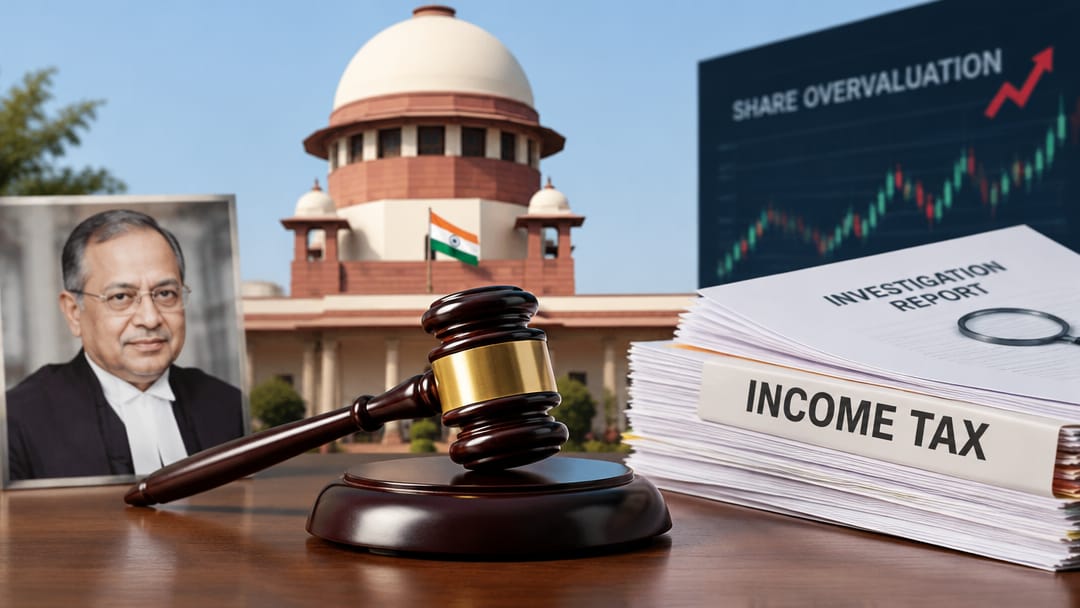
The Supreme Court upheld the reopening of income-tax assessments against the sons of former Chief Justice of India Y.K. Sabharwal, ruling that an investigation report alleging overvaluation of shares constituted sufficient fresh material to justify reassessment. The Court held that the investigation report qualified as tangible new information giving the tax authority valid reason to believe income had escaped assessment, satisfying the threshold required under the Income Tax Act to reopen concluded proceedings.
02 Understand
Why it matters
This ruling turns on the reassessment jurisdiction under Section 147 read with Section 148 of the Income Tax Act, 1961. For years, courts debated the threshold an assessing officer must meet before reopening a completed assessment. The Supreme Court's jurisprudence — crystallised in cases like GKN Driveshafts (India) Ltd. v. ITO (2003) and later ACIT v. Rajesh Jhaveri Stock Brokers (2007) — established that the officer needs only a 'reason to believe' that income has escaped assessment, not conclusive proof. The 2021 Finance Act amendments (introducing Sections 148A and the new reassessment regime) raised the bar by requiring the officer to issue a show-cause notice and consider objections before reopening, but the core principle — that credible fresh material such as an investigation report qualifies as tangible new information — remains intact.
In this case, the investigation report flagging alleged share overvaluation provided exactly that tangible new material. The Court distinguished between mere change of opinion (which cannot ground reassessment) and genuine fresh material (which can). This distinction is the examiner's favourite testing point: if an officer reopens based on information already on record and already considered, that is a change of opinion and is bad in law; if genuinely new material surfaces, reopening is valid.
For CLAT PG, the significance is doctrinal: the ruling reaffirms the 'reason to believe' versus 'reason to suspect' distinction, the bar against reassessment as mere review, and the evidential sufficiency of an investigation report. These are principles routinely tested through passage-based hypotheticals.
In this case, the investigation report flagging alleged share overvaluation provided exactly that tangible new material. The Court distinguished between mere change of opinion (which cannot ground reassessment) and genuine fresh material (which can). This distinction is the examiner's favourite testing point: if an officer reopens based on information already on record and already considered, that is a change of opinion and is bad in law; if genuinely new material surfaces, reopening is valid.
For CLAT PG, the significance is doctrinal: the ruling reaffirms the 'reason to believe' versus 'reason to suspect' distinction, the bar against reassessment as mere review, and the evidential sufficiency of an investigation report. These are principles routinely tested through passage-based hypotheticals.
Remember + Why it matters
The key recall facts and exact examiner angle for CLAT PG are in the Crux app.
01
Key figure and date from this topic
02
Specific number or threshold to remember
03
Policy or regulatory implication
Read + Understand free forever · 30-day free trial