01 Read
What happened
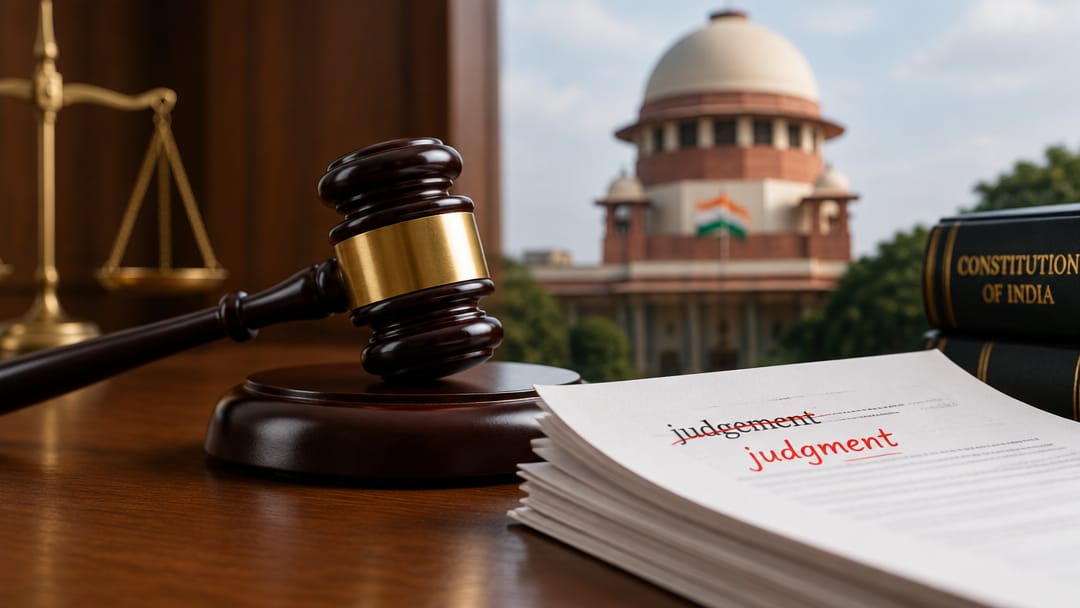
The Supreme Court expunged adverse remarks and strictures recorded by the Rajasthan High Court against a Special Judge, holding that inadvertent typographical errors in a judgment do not warrant castigation of a judicial officer. The Court emphasised that higher courts must exercise restraint before recording adverse remarks that can damage a judge's career and reputation, and that such remarks should be confined to cases of deliberate misconduct, not clerical or inadvertent mistakes.
02 Understand
Why it matters
This ruling clarifies an important principle governing the supervisory jurisdiction of High Courts over subordinate judiciary. While High Courts possess the power to record adverse remarks against judicial officers under their administrative and appellate jurisdiction, the Supreme Court has consistently held that this power must be exercised with care and proportionality.
The legal principle established here has two dimensions. First, the standard for adverse remarks: observations that stigmatise a judicial officer must be anchored in deliberate or gross dereliction, not in typographical or clerical errors that are inadvertent in nature. Second, the proportionality test: even where errors exist, the court must weigh the severity of the remark against its career consequences for the officer.
This connects to the broader constitutional framework protecting the independence of the subordinate judiciary. Articles 233–237 of the Constitution govern the appointment and conditions of service of district judges. The Supreme Court, exercising its jurisdiction under Article 136 (special leave) and its inherent power to do complete justice under Article 142, routinely reviews adverse remarks to ensure they meet the threshold of fairness.
For CLAT PG, the examiner will likely test whether a candidate understands the distinction between supervisory correction (permissible) and punitive castigation based on inadvertent error (impermissible), and can apply it to a variation involving a different category of judicial error.
Remember + Why it matters
The key recall facts and exact examiner angle for CLAT PG are in the Crux app.
01
Key figure and date from this topic
02
Specific number or threshold to remember
03
Policy or regulatory implication
Read + Understand free forever · 30-day free trial