01 Read
What happened
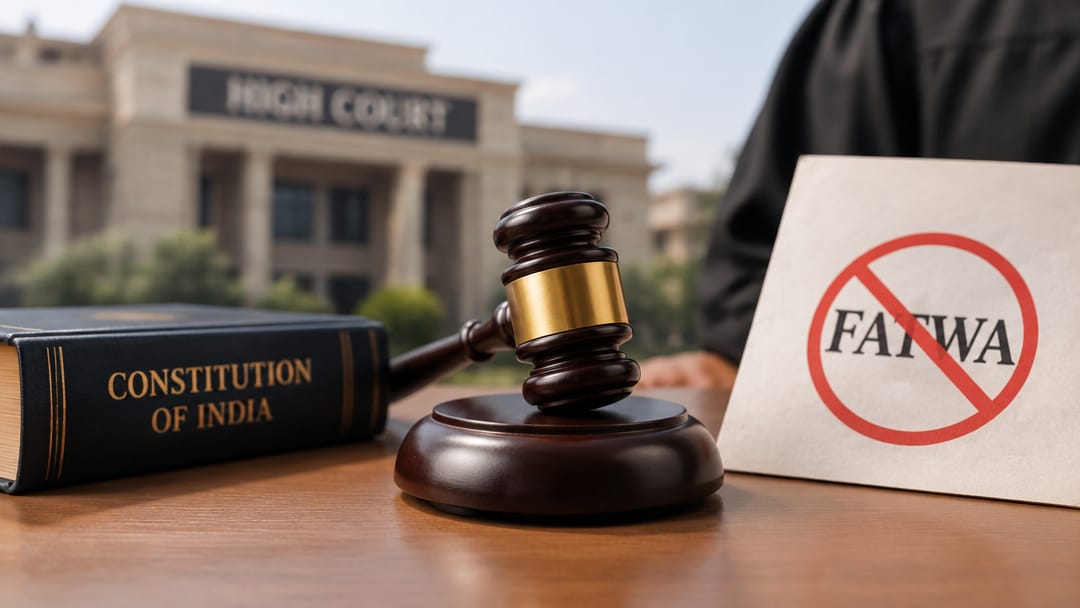
The Chhattisgarh High Court has ruled that a fatwa — a religious opinion issued by an Islamic authority — carries no binding legal force and cannot be enforced in a manner that prejudices an individual's legal rights. The court's ruling reaffirms that religious edicts issued by unofficial bodies have no standing in Indian civil or criminal law, and that constitutional rights of individuals cannot be overridden by such pronouncements under any circumstances.
02 Understand
Why it matters
A fatwa is a non-binding religious opinion issued by a qualified Islamic scholar (mufti) on a question of Islamic law. In India, fatwas are frequently issued by bodies such as Darul Uloom Deoband or local Sharia courts (Dar-ul-Qazas), but they have no statutory backing and cannot be enforced by state machinery.
The Chhattisgarh HC's ruling is consistent with the Supreme Court's landmark position in Vishwa Lochan Madan v. Union of India (2014), where the Supreme Court unanimously held that fatwas have no legal sanction, cannot be enforced by any authority, and any attempt to do so would be unconstitutional. The Court held that Dar-ul-Qazas and Sharia courts are neither courts nor tribunals under Indian law — they derive no authority from any statute.
Constitutionally, this ruling engages several fundamental rights: Article 14 (equality before law), Article 19(1)(a) (freedom of speech and expression), Article 21 (right to life and personal liberty), and Article 25 (freedom of conscience and religion). The key principle is that while Article 25 protects the right to practise religion, it does not permit religious directives to override statutory rights or constitutional guarantees of other individuals.
The distinction the courts consistently draw is between a fatwa as personal religious guidance — which is protected speech — and a fatwa as an enforceable directive that curtails another person's freedom, which is constitutionally impermissible. This is the classic rights-versus-rights balancing the examiner tests under constitutional law passages.
Remember + Why it matters
The key recall facts and exact examiner angle for UPSC CSE are in the Crux app.
01
Key figure and date from this topic
02
Specific number or threshold to remember
03
Policy or regulatory implication
Read + Understand free forever · 30-day free trial