01 Read
What happened
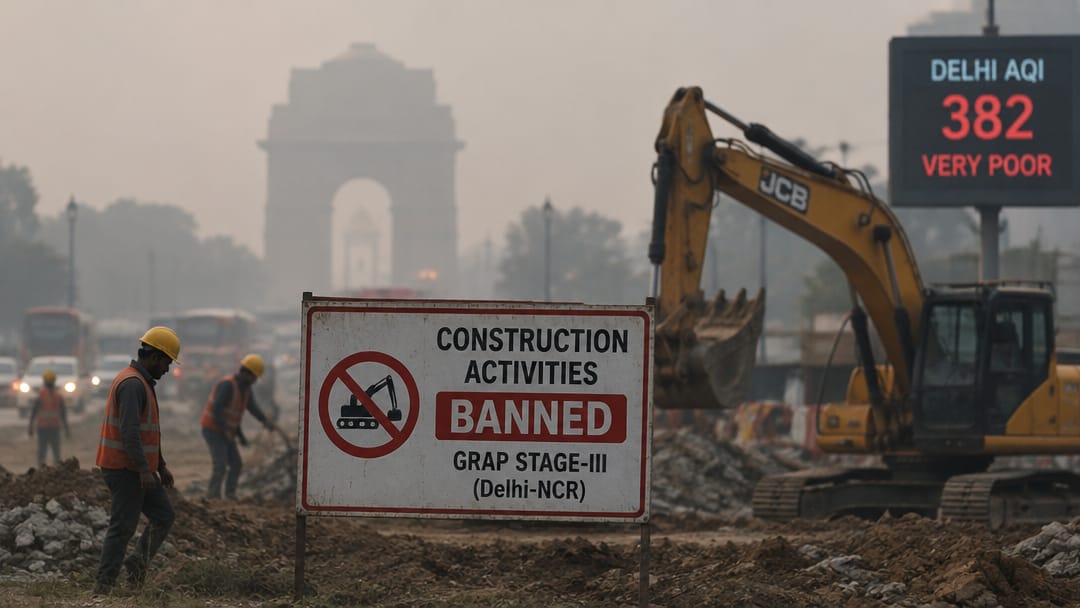
The Commission for Air Quality Management (CAQM) activated GRAP Stage-III across Delhi-NCR on November 6 after Delhi's Air Quality Index reached 382, placing it in the 'Very Poor' category. Stage-III restrictions ban most construction and demolition activities, limit entry of polluting vehicles, and intensify traffic management. The CAQM, a statutory body under a 2021 Act, holds authority to issue binding directions on air quality across Delhi and adjoining states.
02 Understand
Why it matters
GRAP — the Graded Response Action Plan — is a tiered emergency framework for managing air pollution in Delhi-NCR. It was notified by the Ministry of Environment, Forest and Climate Change (MoEFCC) and is now operationalised by CAQM. The four stages are triggered by AQI thresholds: Stage-I (Poor: 201–300), Stage-II (Very Poor: 301–400), Stage-III (Severe: 401–450), and Stage-IV (Severe+: above 450). Note: AQI 382 falls in the 'Very Poor' band, but CAQM can invoke higher stages pre-emptively based on forecast trajectory.
CACM was established under the Commission for Air Quality Management in National Capital Region and Adjoining Areas Act, 2021, replacing the earlier Environment Pollution (Prevention and Control) Authority (EPCA). It has statutory powers to direct state governments, local bodies, and industries — making its orders legally binding, unlike advisory committees.
Stage-III restrictions typically include: banning construction and demolition work (except essential services), stopping entry of BS-III petrol and BS-IV diesel vehicles, closing brick kilns and hot-mix plants, and deploying additional public transport. Stage-IV adds school closures and potential odd-even vehicle schemes.
For exam purposes, the key concept is the institutional shift from EPCA to CAQM, the legal basis of GRAP, the AQI classification scale (set by CPCB), and the specific triggers for each stage.
Remember + Why it matters
The key recall facts and exact examiner angle for UPSC CSE are in the Crux app.
01
Key figure and date from this topic
02
Specific number or threshold to remember
03
Policy or regulatory implication
Read + Understand free forever · 30-day free trial