01 Read
What happened
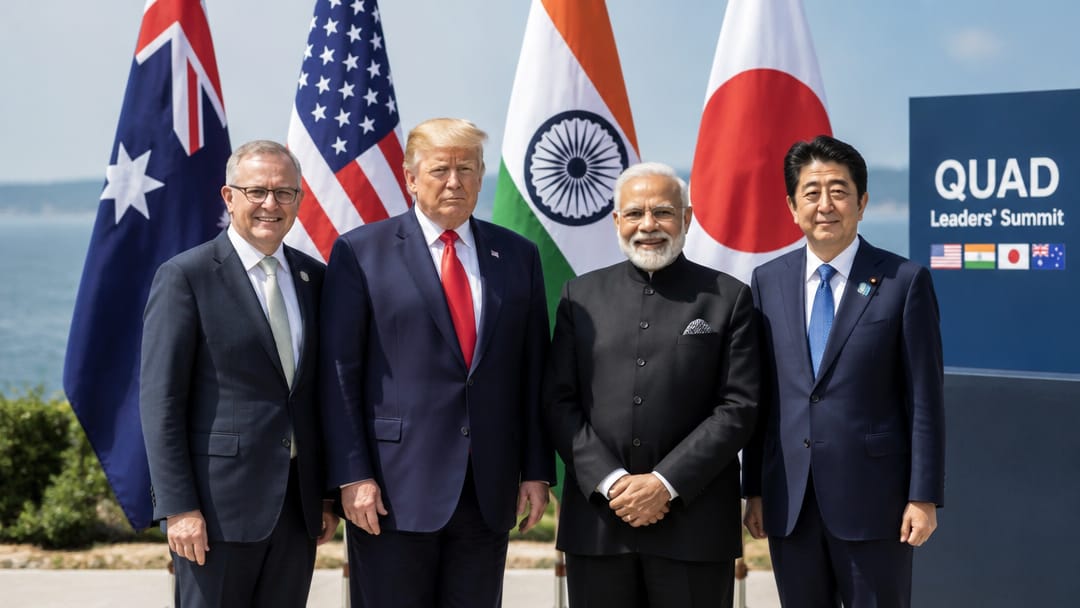
President Trump's upcoming Asia trip is expected to include a Quad leaders' meeting — bringing together the US, India, Japan, and Australia — before his anticipated talks with China. Experts suggest this sequencing could reinforce US-India strategic ties and signal to Beijing that Washington maintains its Indo-Pacific partnerships. The Quad, revived as a leaders-level forum in 2021, has become a central mechanism for coordinating security, technology, and infrastructure cooperation across the Indo-Pacific.
02 Understand
Why it matters
The Quad — formally the Quadrilateral Security Dialogue — groups the United States, India, Japan, and Australia. Originally launched in 2007 by Japanese PM Shinzo Abe, it was revived after the 2017 Doklam standoff and elevated to a leaders' summit format in March 2021 under President Biden. Its stated agenda spans maritime security, vaccine distribution, clean energy, critical technologies, infrastructure, and cybersecurity — deliberately avoiding a formal military alliance structure to allow India's strategic autonomy.
The timing of a Quad meeting before US-China talks carries strategic weight. It signals that Washington treats the Indo-Pacific grouping as a standing diplomatic platform, not merely a reactive China-containment tool — a distinction India consistently emphasises. India's position in the Quad is particularly sensitive: New Delhi participates in the grouping while maintaining independent ties with Russia and avoiding explicit anti-China rhetoric.
For UPSC aspirants, the Quad sits at the intersection of India's foreign policy doctrine (strategic autonomy), multilateral frameworks (non-alliance security cooperation), and the Indo-Pacific construct. Examiners frequently test its founding year, member composition, working groups, and India's stated rationale for participation. The evolution from a naval exercise format (Malabar exercises) to a heads-of-government summit is itself an important progression worth noting.
Remember + Why it matters
The key recall facts and exact examiner angle for UPSC CSE are in the Crux app.
01
Key figure and date from this topic
02
Specific number or threshold to remember
03
Policy or regulatory implication
Read + Understand free forever · 30-day free trial