01 Read
What happened
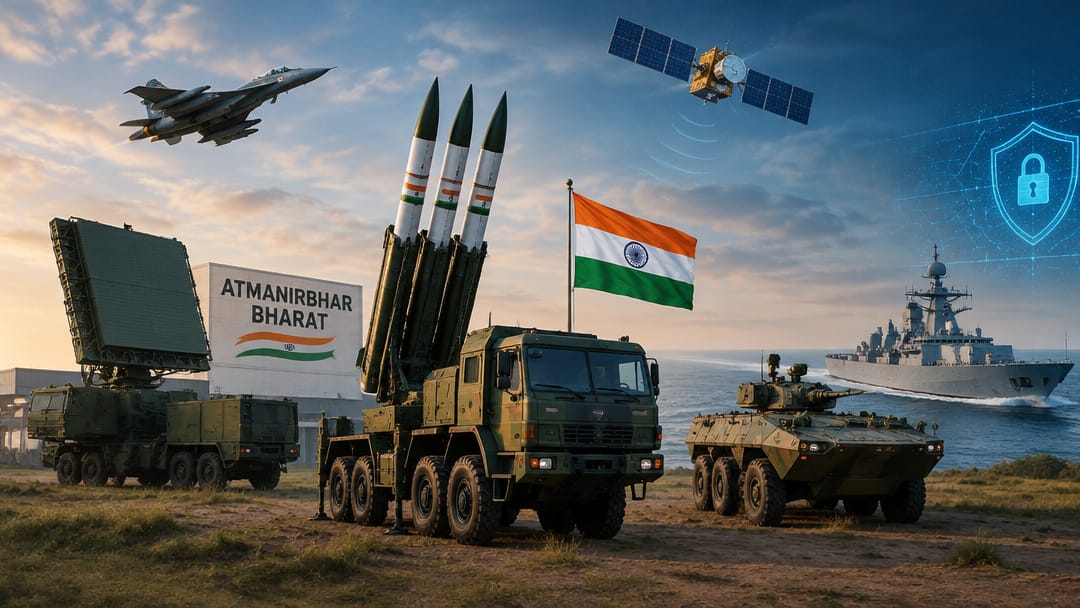
India has developed significant indigenous capabilities across missiles, artillery, ammunition, radars, electronic warfare systems, naval platforms, and armoured vehicles, marking a shift from import dependence to self-reliance in multi-domain warfare. DRDO, ISRO, and Defence PSUs drive this effort under the Atmanirbhar Bharat framework. The push covers land, sea, air, space, and cyber domains simultaneously, reflecting a doctrine that modern conflicts are won by integrating capabilities across all these domains rather than through single-domain superiority.
02 Understand
Why it matters
Multi-domain warfare (MDW) is a military doctrine holding that victory requires the simultaneous, coordinated use of capabilities across land, sea, air, space, cyber, and electromagnetic spectrum domains. Unlike older joint-operations thinking — which coordinated distinct service arms — MDW seeks true integration so that action in one domain creates exploitable advantages in others.
India's drive toward MDW capability is institutionally anchored in several reforms: the creation of the Chief of Defence Staff (CDS) post in January 2020 and the Department of Military Affairs (DMA); the ongoing theatre-command restructuring; and the iDEX (Innovations for Defence Excellence) scheme that funds startups developing dual-use technologies.
On the hardware side, key programmes include the BrahMos supersonic cruise missile (India-Russia JV), the Akash surface-to-air missile system, the LCA Tejas fighter, the INS Vikrant aircraft carrier (India's first indigenously built carrier, commissioned August 2022), the Arjun MBT, and the DRDO-developed ASAT capability demonstrated in Mission Shakti (March 2019).
Electronic warfare and cyber are the newer frontiers. India's Defence Cyber Agency and Defence Space Agency, both established in 2019, formalize non-kinetic domains. The examiner often tests the institutional architecture — which agency controls which domain — and landmark dates like Mission Shakti or INS Vikrant's commissioning.
Remember + Why it matters
The key recall facts and exact examiner angle for UPSC CSE are in the Crux app.
01
Key figure and date from this topic
02
Specific number or threshold to remember
03
Policy or regulatory implication
Read + Understand free forever · 30-day free trial