01 Read
What happened
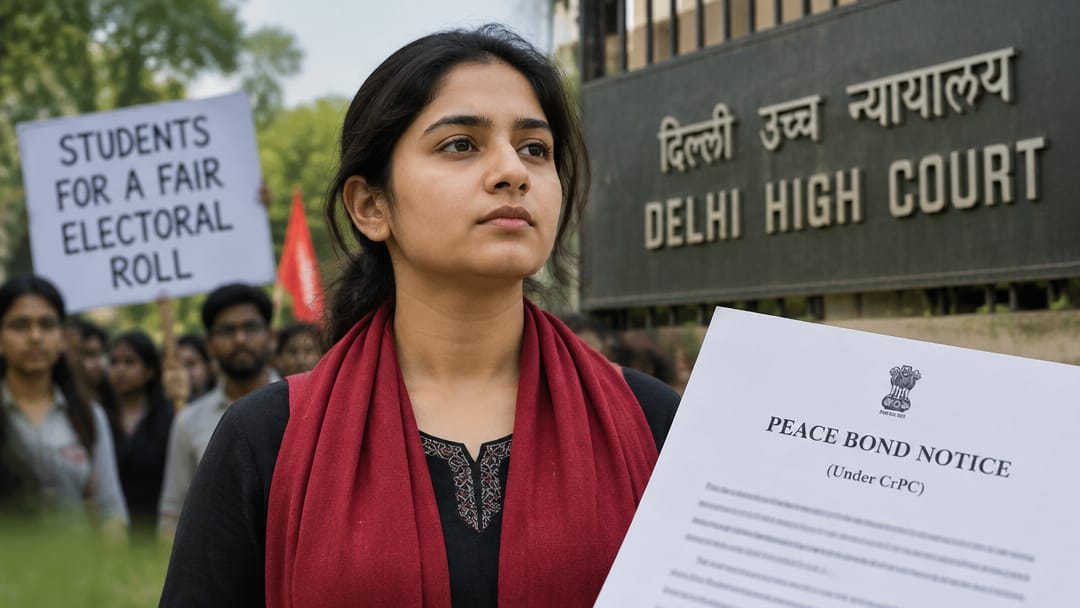
The Delhi High Court dismissed a petition challenging a peace bond notice issued to Neha Bora, a student leader associated with the All India Students Association. The notice arose amid protests over electoral roll revisions. The court found the notice legally valid, rejecting arguments that it violated free speech or assembly rights. The ruling is significant because it tests the boundary between preventive state action under CrPC peace bond provisions and constitutionally protected protest activity by civil society actors.
02 Understand
Why it matters
A peace bond notice — issued under Sections 107–110 of the Code of Criminal Procedure (now mirrored in the Bharatiya Nagarik Suraksha Sanhita, 2023) — is a preventive, not punitive, mechanism. A magistrate can direct a person to execute a bond with sureties if there is reasonable apprehension that their conduct may disturb public peace. The person need not have committed any offence; the standard is anticipatory.
The constitutional tension here is acute. Article 19(1)(a) guarantees free speech and Article 19(1)(b) guarantees peaceful assembly, but Article 19(2) and 19(3) permit reasonable restrictions in the interest of public order. The state often uses peace bond powers against political protesters, student leaders, and activists — which courts have sometimes found to be a chilling effect on legitimate dissent.
The Delhi HC's ruling upholding the notice signals that the court found the magistrate's apprehension of breach of peace to be legally sufficient — even where the petitioner argued the notice was retaliatory and politically motivated.
For CLAT PG, the key doctrinal question is: what distinguishes a valid preventive notice from an abuse of preventive power? Courts have held that the apprehension must be real, not imaginary, and the restriction must be proportionate. The PIL maintainability angle is also relevant — whether a third party could challenge such a notice on public interest grounds.
Remember + Why it matters
The key recall facts and exact examiner angle for CLAT PG are in the Crux app.
01
Key figure and date from this topic
02
Specific number or threshold to remember
03
Policy or regulatory implication
Read + Understand free forever · 30-day free trial